





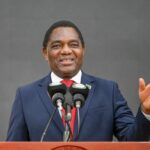


President Hakainde Hichilema has urged Zambians, particularly farmers, to take advantage of the current planting season despite unpredictable weather conditions associated with the El Niño phenomenon. The President has encouraged farmers not to leave their fields idle but to continue planting while following guidance from agricultural and meteorological experts. His message highlights the importance of maintaining agricultural production to protect Zambia’s food security and strengthen the national economy. The call comes at a time when changing rainfall patterns have created uncertainty for farmers who depend on seasonal rains to grow crops. President Hichilema has stressed that careful planning, timely decisions and expert advice will be essential to ensuring that the country maintains sufficient food production despite the challenging weather conditions.
The President made the remarks after arriving in Choma, Southern Province, at the start of a working visit. During his engagement, he reiterated the government’s commitment to growing the Zambian economy through initiatives aimed at increasing national revenue and expanding opportunities for businesses and workers. He explained that the government remains focused on implementing the Grow Zambia Agenda, which seeks to unlock the country’s economic potential and create sustainable opportunities across different sectors. According to the President, economic growth should translate into increased income for the national treasury, stronger businesses and more employment opportunities for ordinary citizens. He emphasised that every province has resources and economic strengths that can contribute to Zambia’s overall development.
President Hichilema identified agriculture as one of the major economic opportunities in Southern Province, noting that the region has significant potential to support national production and economic growth. Agriculture remains an important part of Zambia’s economy because it provides livelihoods for millions of people, supports rural communities and contributes to the country’s food supply. Southern Province has a strong agricultural foundation, with farming activities playing a major role in household incomes and local economic activity. The President’s remarks reflect the government’s intention to encourage provinces to make better use of their natural resources and productive capacity. By strengthening agriculture and supporting farmers, the region can contribute more effectively to national development while creating opportunities for businesses involved in agricultural production, processing, transportation and trade.
The President’s warning against leaving fields idle is particularly important given the uncertainty surrounding rainfall patterns during El Niño-affected seasons. El Niño is a climate phenomenon associated with changes in ocean temperatures in the Pacific Ocean that can influence weather conditions in different parts of the world. In Southern Africa, El Niño has often been associated with below-average rainfall, drought conditions and increased pressure on agricultural production. However, weather conditions can vary between locations and throughout the farming season, making it difficult for farmers to rely on traditional planting schedules alone. This is why President Hichilema has encouraged farmers to seek professional guidance rather than abandon their fields because of concerns about unpredictable weather.
Farmers have been advised to rely on information provided by agricultural specialists and meteorological experts when deciding what crops to plant and when to begin planting. Such guidance can help farmers select suitable crop varieties, identify appropriate planting windows and make informed decisions based on expected rainfall conditions. Agricultural extension officers can also assist farmers with practical advice on soil preparation, seed selection, moisture conservation and other farming methods that can improve productivity. Choosing crops that are better suited to local weather conditions can help reduce the risks associated with irregular rainfall. Access to reliable weather information is equally important because farmers need to understand changing conditions before making decisions that affect their harvests and household incomes.
The importance of planting during uncertain weather conditions extends beyond individual farming households. Zambia depends on agricultural production to maintain food availability, support rural employment and supply raw materials to various industries. When farmers experience poor harvests, the effects can spread across the wider economy through higher food prices, reduced household incomes and increased pressure on food supply systems. Small-scale farmers are particularly vulnerable because many depend on rainfall and have limited financial resources to recover from poor agricultural seasons. Encouraging farmers to continue planting while using expert advice is therefore an important part of protecting national food security. It also reinforces the need for agricultural policies that help farmers adapt to changing climate conditions.
The Grow Zambia Agenda places emphasis on using the economic strengths of individual provinces to promote development across the country. This approach recognises that Zambia’s provinces have different natural resources, agricultural opportunities and economic activities that can support national growth. In Southern Province, agriculture offers opportunities to increase crop production, improve livestock farming and expand agricultural value chains. Better agricultural productivity can also stimulate demand for transport services, storage facilities, processing industries and other businesses that support farmers. These activities can create jobs and generate income for communities while contributing to government revenue through increased economic activity. By investing in productive sectors and encouraging local participation, the government aims to strengthen the connection between regional development and national economic growth.
For farmers, the President’s message is a reminder that unpredictable weather should encourage careful preparation rather than complete inaction. Planting decisions must take local conditions into account because rainfall patterns, soil types and crop suitability differ from one farming area to another. Farmers who receive timely information can adjust their planting strategies to reduce exposure to drought and other weather-related risks. They can also consider practices such as conserving soil moisture, diversifying crops and using drought-tolerant seed varieties where appropriate and available. These measures cannot eliminate the risks associated with climate variability, but they can help improve resilience and protect agricultural investments. Cooperation between farmers, agricultural experts and government institutions will therefore remain essential throughout the farming season.
President Hichilema’s call also highlights the importance of strengthening Zambia’s agricultural sector as part of the country’s broader economic transformation. Food production is closely connected to economic stability because reliable agricultural output helps meet domestic demand and supports trade opportunities. A productive farming sector can reduce dependence on imported food while providing raw materials for local industries. It can also improve rural livelihoods by giving farming households more opportunities to earn income and invest in their communities. However, achieving these benefits requires more than encouraging farmers to plant. Farmers also need access to suitable seeds, fertilisers, agricultural information, markets and other essential services that support successful production.
As President Hakainde Hichilema continues his working visit to Southern Province, his message places agriculture and food security firmly at the centre of Zambia’s development priorities. His appeal to farmers is clear: unpredictable El Niño-related weather conditions should not automatically bring farming activities to a standstill. Instead, farmers should make informed planting decisions based on advice from agricultural and meteorological experts while taking local conditions into account. The government’s Grow Zambia Agenda also highlights the need to use the economic potential of every province to generate national revenue, support businesses and create employment. Ultimately, protecting Zambia’s food supply and building a stronger agricultural economy will require cooperation, preparation and continued investment in the farming sector. By encouraging farmers to remain active and adapt to changing weather conditions, the President has reinforced the importance of agriculture in securing the country’s economic future.