





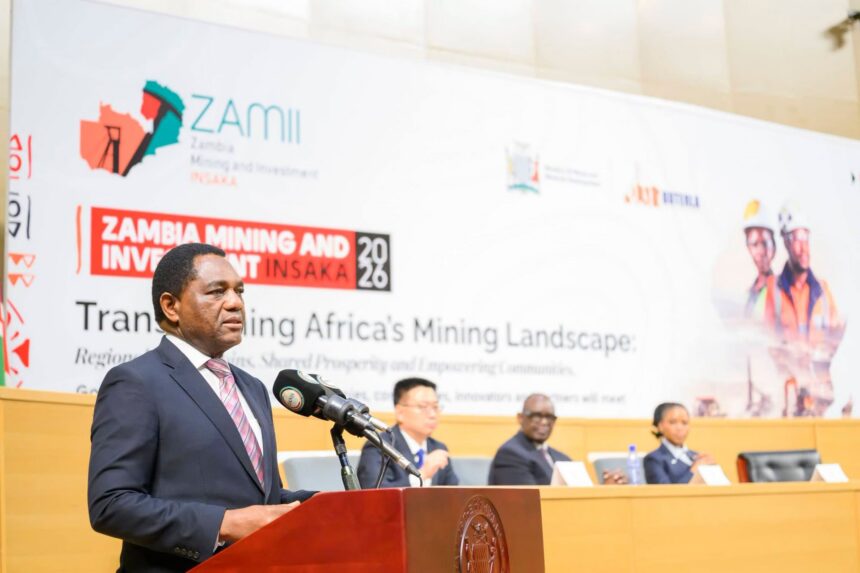
Zambia is calling on mining investors to turn the country’s mineral wealth into jobs, economic growth and better living conditions for its people. At the Zambia Mining and Investment Insaka, President Hakainde Hichilema urged mining licence holders to develop their mining tenements instead of holding licences for speculative purposes. His message highlighted the importance of responsible investment, efficient government processes, modern mining technology and stronger cooperation between the public and private sectors. He stressed that Zambia’s mineral resources must contribute directly to national development and create meaningful opportunities for local communities. The President’s remarks reflect a broader commitment to building a mining industry that attracts investment, increases production and supports the country’s long-term economic ambitions under the Grow Zambia Agenda.
Mining remains an important part of Zambia’s economy, with the sector playing a significant role in exports, investment and employment. The country has substantial copper resources and other minerals that offer opportunities to expand industrial activity and strengthen its position in regional and international markets. However, possessing mineral resources does not automatically translate into economic prosperity. The benefits depend on whether mining projects move from exploration and licensing into productive operations that generate revenue, create jobs and support local businesses. President Hichilema’s call for licence holders to develop their mining tenements addresses this challenge by emphasising the need to convert mineral rights into tangible economic activity. The central message is that Zambia’s mineral wealth must serve the interests of the country and its citizens through productive investment and responsible resource development.
The President’s warning against speculative licence holding highlights a concern about the effective use of mineral resources. Mining licences provide holders with rights to undertake activities under the applicable legal and regulatory framework, but licences alone do not produce minerals, create employment or generate economic benefits. When investors hold mining tenements without making meaningful progress towards development, potentially valuable resources may remain undeveloped for extended periods. This can delay investment, restrict opportunities for other qualified investors and prevent communities from benefiting from mining-related economic activity. Encouraging licence holders to develop viable projects can help improve the use of available mineral resources and strengthen confidence in the mining sector. A productive mining industry requires investors who are prepared to commit capital, conduct appropriate technical assessments and advance projects responsibly within the requirements of the law.
Job creation is another important part of Zambia’s mining and investment strategy. New mining projects can create employment during exploration, construction, production and supporting operations. They can also generate demand for transport services, engineering firms, equipment suppliers, catering businesses and other local enterprises. These opportunities can contribute to household incomes and stimulate economic activity in mining communities. However, the scale of these benefits depends on the design of individual projects, their commercial performance and the extent to which local workers and businesses can participate. President Hichilema’s emphasis on turning mineral wealth into jobs and better lives reinforces the need to measure mining success not only by production volumes and investment figures but also by its contribution to wider economic development.
The President also called on investors to inform the government when bureaucracy obstructs progress. This message recognises that an attractive investment environment depends on more than the availability of natural resources. Investors need clear regulations, timely administrative decisions and predictable procedures when applying for permits, developing projects and managing ongoing operations. Unnecessary delays can increase costs, disrupt project schedules and weaken investor confidence. At the same time, effective regulation remains essential for protecting workers, communities and the environment while ensuring that mining activities comply with national laws. The challenge is to make government processes efficient without weakening the standards that responsible mining requires. Open communication between investors and government institutions can help identify administrative bottlenecks, clarify regulatory expectations and develop practical solutions that support legitimate investment.
Cooperation between the government and the private sector is particularly important when mining projects encounter obstacles that cannot be resolved by individual companies alone. Investors may face challenges involving licensing procedures, overlapping administrative responsibilities, infrastructure constraints or uncertainty about regulatory requirements. Identifying the specific causes of these problems can help the relevant authorities determine whether existing procedures need clarification, improved coordination or reform. President Hichilema’s invitation for investors to raise concerns directly with the government signals an approach based on engagement and joint problem-solving. For this approach to produce results, concerns must receive appropriate attention and lead to practical action where changes are justified. Clear communication, accountable institutions and consistent implementation of decisions can help build the trust needed for long-term mining investment.
The President’s call to resolve disputes through dialogue also carries an important message for Zambia’s mining industry. His statement, “Let us mine in the ground, not in court,” expresses the need to prioritise productive mining activities over prolonged legal battles wherever disputes can be resolved fairly through discussion. Disagreements over licences, contractual obligations, project development and regulatory decisions can create uncertainty for investors and delay economic activity. Litigation remains an important legal avenue when parties cannot reach a fair resolution or when their rights require judicial protection. However, negotiation and structured dialogue may offer a faster and less costly way to address some commercial and administrative disagreements. A dispute resolution approach that respects the law while encouraging constructive engagement can help protect legitimate interests and allow viable projects to move forward.
Technology and innovation are equally important to the future of Zambia’s mining sector. President Hichilema urged investors to bring the best available technology to maximise production, transfer skills and expand local processing. Modern mining technology can improve operational efficiency, support more accurate geological assessments and help companies manage resources more effectively. Depending on the project, suitable technologies may also improve worker safety, reduce waste and strengthen environmental monitoring. Selecting the right technology requires careful consideration of geological conditions, operating costs, workforce capabilities and environmental responsibilities. Investors must also ensure that technological improvements translate into sustainable productivity gains rather than simply increasing extraction rates without adequate attention to long-term impacts. By encouraging modern technology, Zambia can pursue a more competitive mining industry that uses its mineral resources efficiently while maintaining responsible operating standards.
Skills transfer is another essential element of sustainable mining investment. Although foreign investment can provide access to capital, specialised equipment and technical expertise, its long-term value increases when local workers gain the knowledge needed to manage and operate increasingly sophisticated mining activities. Training programmes, apprenticeships and partnerships with technical institutions can help prepare Zambians for careers in engineering, geology, mineral processing, equipment maintenance and mine management. Companies can also strengthen local capabilities by developing career pathways that allow employees to progress into specialised and leadership positions. Effective skills transfer requires more than occasional training because workers need practical experience, professional development and opportunities to apply what they learn. By investing in local talent, mining companies can improve their operations while contributing to a skilled workforce that supports Zambia’s wider industrial development.
Expanding local mineral processing could also help Zambia capture greater economic value from its natural resources. Mining and exporting raw or minimally processed minerals can generate substantial economic activity, but additional processing may create opportunities in manufacturing, engineering, logistics and other industrial services. The feasibility of these activities depends on factors such as energy supply, transport infrastructure, access to finance, market demand and the availability of suitable technology. Copper processing and related industrial activities are particularly relevant to Zambia’s ambition to strengthen its position in regional mineral value chains. Developing these capabilities requires careful planning, commercially viable projects and consistent policies that encourage investment across the production chain. Greater local processing can support industrial diversification and create additional employment opportunities when projects remain competitive and meet appropriate environmental and operational standards.
A predictable regional operating environment is another priority identified by President Hichilema. Mining investors often make decisions based on long-term expectations about regulation, infrastructure, market access and the movement of goods across borders. Differences in administrative procedures and inconsistent implementation of rules can complicate regional investment and increase operating costs. Greater coordination among neighbouring countries could make it easier for mining companies and supporting industries to plan projects, transport equipment and access markets. Regional cooperation may also create opportunities for shared infrastructure, technical expertise and investment in mineral processing. However, a common operating environment requires practical agreements, effective institutions and policies that remain consistent enough for businesses to plan with confidence. If countries work together to address unnecessary barriers while maintaining their respective legal responsibilities, the region can become more attractive to responsible mining investment.
The Grow Zambia Agenda provides the broader context for these priorities by emphasising economic development, investment and improved living standards. Within this framework, mining has the potential to support national growth by attracting capital, creating productive employment and strengthening industries connected to mineral extraction. Achieving these outcomes requires cooperation between government agencies, investors, local businesses, workers and communities. Government must provide clear rules and efficient public services, while investors must develop their projects responsibly, comply with applicable laws and contribute to the economy. Mining companies also need to recognise that long-term success depends on sound relationships with the communities where they operate. Transparent engagement, responsible environmental management and credible commitments to local development can help build the trust required for mining projects to deliver lasting benefits.
The success of Zambia’s mining investment ambitions will ultimately depend on how effectively these priorities translate into action. Licence holders must demonstrate meaningful progress in developing viable mineral assets, while government institutions must address unnecessary bureaucratic obstacles and provide predictable regulatory processes. Investors should adopt appropriate technologies, develop local skills and assess opportunities to expand processing within Zambia. Disputes should be addressed through fair and lawful mechanisms, with dialogue encouraged where it can resolve disagreements effectively. Regional cooperation can further strengthen investment conditions and create opportunities for shared economic growth. These efforts require clear responsibilities, consistent implementation and a commitment to measuring results through actual production, employment, skills development and broader economic benefits.
President Hakainde Hichilema’s message at the Zambia Mining and Investment Insaka sets out a clear expectation for the country’s mining industry. Mineral resources should not remain undeveloped assets held for speculation when they have the potential to support productive investment and national prosperity. Investors and government must work together to remove avoidable barriers, resolve disputes constructively and create conditions that support long-term business confidence. Modern technology, skills transfer and local processing can help Zambia capture more value from its mineral wealth while expanding opportunities for its people. Through responsible investment and practical cooperation under the Grow Zambia Agenda, the country can strengthen its mining industry and improve its contribution to jobs, livelihoods and economic development. The ultimate measure of success will be whether Zambia’s mineral resources deliver lasting benefits to its citizens and support a stronger, more productive economy.