







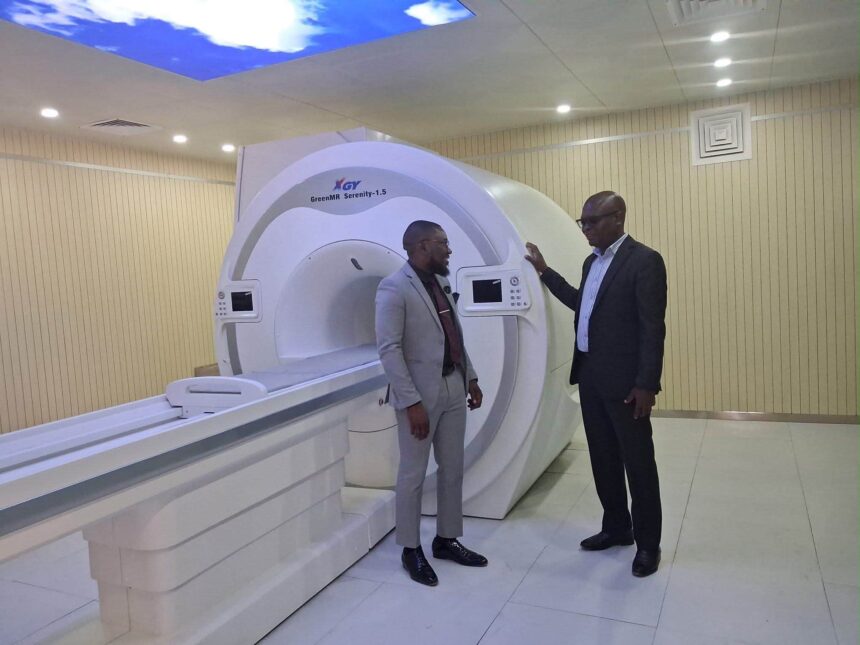
The Government has installed a Magnetic Resonance Imaging (MRI) scanner at Choma General Hospital, marking a major milestone in improving healthcare services in Southern Province. This development introduces advanced diagnostic capacity to the region for the first time, reducing the need for patients to travel long distances for specialised imaging. The MRI scanner is expected to significantly improve early detection and treatment of complex medical conditions. It also forms part of a broader effort to modernise public health infrastructure across the country. Health officials view this as a practical step toward strengthening diagnostic services at district and provincial levels.
An MRI scan is a non-invasive medical imaging method that uses strong magnetic fields, radio waves and computer technology to produce detailed images of internal body structures. It provides high-resolution three-dimensional and cross-sectional images that help medical professionals examine organs, tissues and bones with precision. The technology is especially important for diagnosing conditions affecting the brain, spinal cord, joints, ligaments and soft tissues. It is also widely used in detecting tumours and monitoring disease progression. With this installation, patients in Southern Province will gain access to advanced imaging that was previously only available in larger referral hospitals.
Southern Province Health Director Callistus Kaayunga confirmed that the MRI machine at Choma General Hospital has already been fully installed. He stated that the equipment is currently awaiting official commissioning before it becomes fully operational for public use. According to Dr Kaayunga, the commissioning process depends on the completion of related installations within the same facility. He explained that the Government is taking a coordinated approach to ensure that all diagnostic systems function efficiently together. His remarks highlighted the importance of proper planning before activating advanced medical equipment. He also expressed confidence that the facility will soon begin serving patients once all requirements are met.
Dr Kaayunga further explained that the commissioning of the MRI scanner will take place after the installation of a Computed Tomography (CT) scanner is completed at the same hospital. The CT scanner is expected to complement the MRI machine by providing additional imaging capabilities for faster diagnosis. Both machines are part of an integrated diagnostic unit designed to improve patient care at Choma General Hospital. Once operational, the combination of MRI and CT scanning will reduce pressure on referral hospitals in other provinces. It will also shorten waiting times for patients who previously had to travel long distances for imaging services. Health officials believe this development will improve efficiency in medical diagnosis and treatment planning.
A similar MRI machine is also expected to be installed soon at Livingstone Teaching Hospital, further expanding access to advanced diagnostic services in Southern Province. This planned installation reflects the Government’s broader strategy to decentralise specialised healthcare services across the country. By placing high-end medical equipment in regional hospitals, more patients can receive timely and accurate diagnosis closer to where they live. This reduces both financial and logistical burdens on families seeking medical care. It also strengthens the capacity of provincial hospitals to handle complex medical cases without immediate referral to tertiary facilities. The expansion is seen as a step toward more equitable healthcare delivery.
The introduction of MRI technology at Choma General Hospital represents a significant improvement in the region’s healthcare system. Patients will now benefit from faster diagnosis of serious conditions such as neurological disorders, spinal injuries and internal organ abnormalities. Medical practitioners will also have access to clearer imaging that supports better treatment decisions. The development is expected to improve overall health outcomes by enabling early detection of diseases. As the facility moves toward full operation, Southern Province is set to experience a major upgrade in diagnostic healthcare services. This investment signals continued progress in strengthening Zambia’s public health infrastructure and improving access to specialised medical care.