







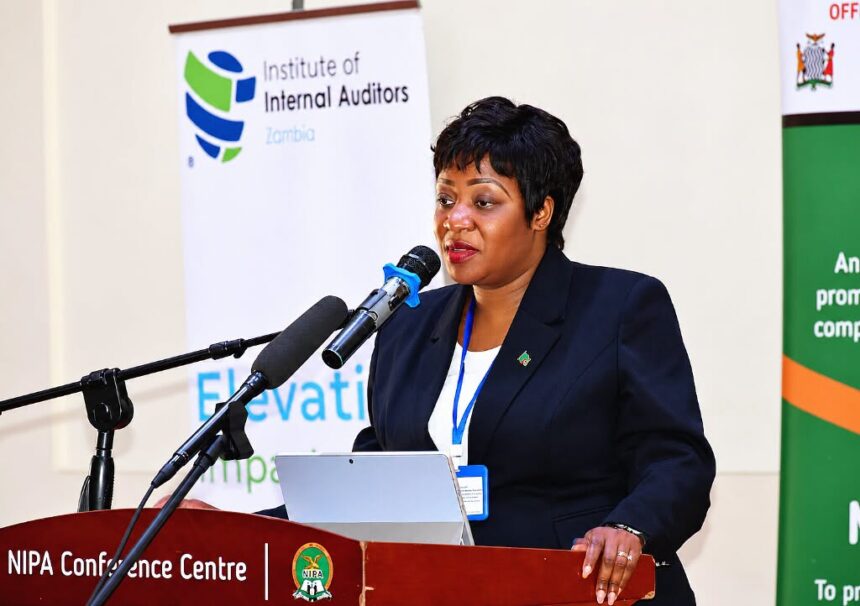
The Zambian Government is strengthening internal audit across the Public Service as part of a broader effort to improve accountability, protect public resources and ensure that government institutions deliver better services to citizens. Controller of Internal Audit Jamie Mukuwa has called for a more rigorous, independent and results-focused internal audit profession that does more than identify weaknesses after problems occur. She said internal auditors must help institutions identify risks early, strengthen controls and ensure that public resources achieve their intended purposes. The initiative comes at a time when effective financial management and institutional performance are central to the country’s development ambitions. Strong internal audit systems can help bridge the gap between government policy, public spending and measurable results for citizens.
Ms. Mukuwa made the call while officially opening a five-day Internal Audit Training Programme at the National Institute of Public Administration, NIPA, Main Campus in Lusaka. The programme is being held under the theme “Driving Value, Managing Risk, and Strengthening Accountability in the Public Service.” The training forms part of Government’s wider effort to professionalize the Public Service and improve financial management, oversight and institutional performance. It also reflects the growing importance of internal audit in helping public institutions manage risks and use resources responsibly. The programme is intended to equip internal auditors with practical skills that can strengthen the quality of assurance and advisory services across Government.
The need for stronger internal audit is closely connected to the quality of public services experienced by ordinary citizens. Ms. Mukuwa explained that weaknesses in internal controls can eventually result in undelivered services, wasted resources and projects that fail to achieve their intended objectives. This means internal audit is not simply an administrative or accounting function within Government institutions. Its effectiveness can influence whether public programmes deliver the outcomes they were designed to achieve. When auditors identify weaknesses early and management acts on their recommendations, institutions have a better opportunity to prevent losses and improve performance.
Internal audit also plays an important role in protecting public resources from poor management and ineffective processes. Government institutions manage funds allocated for programmes, infrastructure, public services and other national priorities. Every amount spent should contribute to the purpose for which it was approved and should be managed with appropriate controls. Internal auditors help assess whether systems are working properly, whether risks are being managed and whether management has adequate information to make sound decisions. A stronger internal audit profession can therefore contribute to greater accountability and better value for money across the Public Service.
The Government’s focus on internal audit is particularly relevant to the Grow Zambia Agenda. Higher production, increased investment, job creation and improved public services require public institutions to implement policies effectively and manage resources with discipline. Weak controls can create risks that delay or undermine these objectives. Strong internal audit systems can help identify such risks before they become larger problems. By linking audit work to national development priorities, Government aims to ensure that internal auditors focus on the issues that can have the greatest impact on implementation and service delivery.
Ms. Mukuwa has urged internal auditors to move beyond producing technically correct reports and become trusted advisers within their institutions. This approach requires auditors to understand the risks facing an institution and communicate their findings in a clear and useful manner. It also requires them to follow up on agreed corrective measures instead of treating the submission of an audit report as the end of the process. Effective follow-up can help determine whether identified weaknesses have actually been addressed. This results-focused approach can make internal audit more relevant to management decisions and institutional performance.
Independence remains another important element of effective internal audit. Auditors must be able to examine systems and processes objectively and communicate weaknesses without inappropriate interference. Their findings need to provide management and oversight structures with an honest assessment of risks and controls. At the same time, internal auditors must maintain professional standards and base their conclusions on reliable evidence. Protecting the independence and credibility of the internal audit function can strengthen confidence in the information it provides to public institutions.
The Government has also announced a standardized training and certification programme for public service internal auditors through NIPA, in line with Public Service Management Division Circular No. B4 of 2026. Controlling Officers and Heads of Internal Audit Units are expected to make provision for the training in their institutional plans and budgets. About 350 internal auditors are expected to undergo the programme, with approximately 50 officers forming the first cohort. A standardized approach can help ensure that internal auditors working across ministries, provinces and agencies receive consistent professional training. It can also support more comparable standards in audit quality, assurance practices and professional conduct across the Public Service.
The decision to place standardized internal audit training within a structured professional development programme reflects the increasing complexity of public sector responsibilities. Modern internal auditors need knowledge that extends beyond traditional financial checks. They must understand governance, risk management, information technology, cybersecurity and the operational processes that influence service delivery. Continuous training can help auditors keep pace with changes in government systems and emerging risks. It can also strengthen their ability to provide practical advice to management while maintaining the independence expected of the profession.
Public Service Management Division Permanent Secretary Lois Mulube said the training programme puts into practice the Public Service Competence Development and Certification Strategy, which was launched on 30 June 2026. The strategy makes structured training and certification an important part of public service career development. Its scope covers officers entering the Public Service, serving employees, officers preparing for senior management responsibilities and specialized professionals who require continuous development. Ministries, provinces, agencies and local authorities are expected to include training in their annual planning and budgeting processes. This approach recognizes that effective public administration depends not only on policies and financial resources but also on the competence of the people responsible for implementation.
Ms. Mulube emphasized that Zambia’s development plans and growth targets depend heavily on the ability of public officers to implement them effectively. Competence development can therefore serve as a bridge between policy commitments and actual results. For specialized functions such as internal audit, the need for continuous learning is especially important because auditors oversee systems that support public resources, institutional controls and accountability. Their work can affect the quality of management decisions and the ability of institutions to identify problems early. Strengthening professional competence can consequently improve both the quality of audit work and the wider performance of public institutions.
The Institute of Internal Auditors Zambia has also stressed the importance of strong institutions, sound governance, ethical leadership and effective internal controls. President Lubinda Namiluko said every Kwacha appropriated by Parliament carries an expectation that it will be used for its intended purpose with economy, efficiency, effectiveness and integrity. This places internal auditors at an important point within the public financial management system. Their work can help management understand whether resources are being used appropriately and whether institutional processes are achieving their intended objectives. Strong internal audit can therefore contribute to public value by helping institutions make better decisions about the resources entrusted to them.
Mr. Namiluko has called on public institutions to strengthen compliance with the Global Internal Audit Standards. This includes protecting audit independence, providing adequate resources, ensuring unrestricted access to information and strengthening oversight by management and audit committees. These conditions are important because auditors cannot provide effective assurance if they lack access to relevant information or sufficient resources to conduct their work. Strong oversight structures can also help ensure that audit findings receive appropriate attention. Effective internal audit therefore depends not only on the skills of individual auditors but also on the institutional environment in which they operate.
Cybersecurity has emerged as another important area of concern for the internal audit profession. Government services, payments and records are increasingly being managed through digital platforms, creating new opportunities as well as new risks. Cybersecurity weaknesses can affect the confidentiality, integrity and availability of information and can disrupt important public services. Internal auditors need sufficient knowledge of information and communication technology to assess whether digital systems have appropriate controls. Including ICT governance and cybersecurity in the five-day training programme reflects the need to prepare public sector auditors for these changing risks.
The programme’s focus extends across leadership, governance, risk management, internal controls, assurance and advisory services, ICT governance and cybersecurity. This broad curriculum recognizes that internal audit must address the full range of factors that can affect institutional performance. Risk management helps institutions identify threats before they undermine programmes, while internal controls provide mechanisms for managing those risks. Assurance services provide independent assessments of whether systems are operating as intended, while advisory work can help management improve processes without compromising audit independence. Together, these functions can strengthen the ability of public institutions to protect resources and deliver results.
The development of a stronger internal audit profession can also support public confidence in government programmes. Citizens expect public resources to be managed responsibly and development programmes to produce meaningful results. When institutions have effective systems for monitoring risks, controlling resources and addressing weaknesses, they are better positioned to demonstrate accountability. Internal audit cannot solve every problem within the Public Service, but it can provide an important layer of assurance and early warning. Its contribution becomes more valuable when management takes audit findings seriously and implements agreed corrective actions.
The Government’s decision to train approximately 350 internal auditors represents an important investment in public sector capacity. The first cohort of about 50 officers provides the starting point for a broader standardized training programme across the Public Service. If implemented consistently, the programme can help establish common professional expectations among auditors working in different ministries, provinces and agencies. It can also support continuous improvement by giving auditors a stronger foundation in modern audit practices and emerging risks. The long-term impact will depend on the quality of training, the resources available to audit units and the willingness of institutions to act on audit findings.
Strengthening internal audit should ultimately be measured by its contribution to better government performance. The purpose of an audit is not simply to identify weaknesses but to help institutions understand and manage the risks that could prevent them from achieving their objectives. When public institutions respond to audit findings, improve controls and monitor corrective actions, they can reduce waste and improve the use of public resources. This can help government programmes operate more effectively and increase the likelihood that budget allocations translate into tangible services and development outcomes. For the Grow Zambia Agenda, this connection between accountability and delivery is particularly important.
Zambia’s renewed focus on internal audit reflects a broader recognition that strong economic and development ambitions require strong public institutions. The Government’s plans for increased production, investment, job creation and improved public services depend on disciplined implementation and effective management of public resources. Professional internal auditors can help identify risks, strengthen controls, improve governance and provide management with reliable assurance about institutional performance. The standardized training and certification programme through NIPA provides a structured mechanism for developing these capabilities across the Public Service. By strengthening independence, professional competence, accountability and risk management, Zambia can improve its ability to turn public resources and policy commitments into measurable results for citizens.