




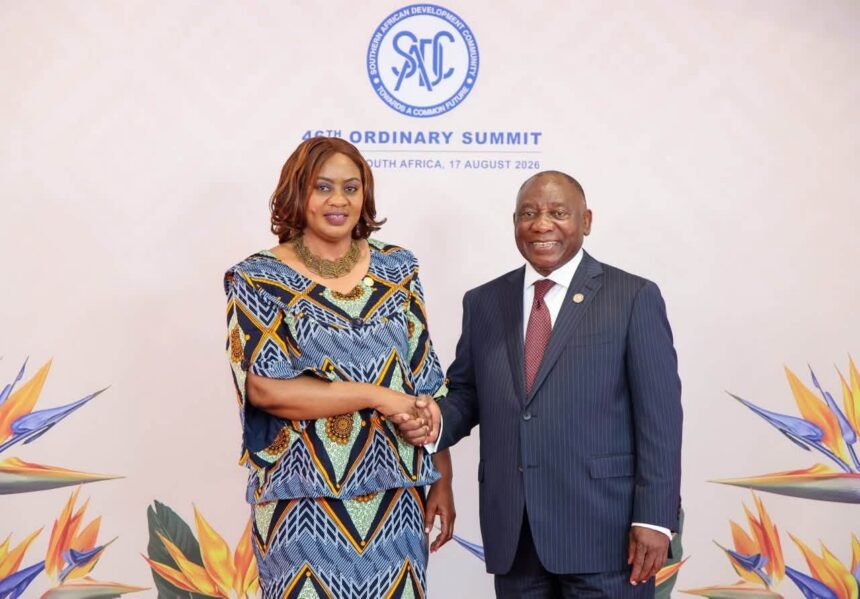
Zambia has taken another important step towards assuming a greater leadership role within the Southern African Development Community (SADC) after High Commissioner H.E. Pamela Chisanga represented the country at the 46th SADC Heads of State Summit in eThekwini, South Africa. The high-level meeting brought together regional leaders and representatives to discuss issues affecting economic development, integration and cooperation across Southern Africa. The summit was held under the theme “Resilient, Sustainable and Inclusive Industrialization through Infrastructure Development, Agricultural and Critical Minerals Transformation in pursuit of a just world.” The theme reflects the region’s focus on building stronger economies through infrastructure, agriculture, critical minerals and increased regional cooperation. Zambia’s participation is particularly significant because the country is next in line to assume the SADC chairpersonship in August 2027.
The summit provided an important platform for member states to assess progress towards the region’s long-term development objectives. Among the key matters reviewed was the implementation of the SADC Regional Indicative Strategic Plan 2020-2030, which provides a framework for advancing regional integration and development. The plan covers strategic areas intended to strengthen cooperation among SADC member states and improve the region’s ability to respond to economic and social challenges. Discussions around implementation are important because regional plans require sustained cooperation, investment and coordination among member states. Zambia’s participation in these discussions comes as the country prepares for an increasingly prominent role in shaping the direction of the regional bloc.
The theme of the 46th SADC Heads of State Summit placed industrialisation at the centre of regional development efforts. SADC member states continue to seek ways to strengthen their economies by increasing production, developing infrastructure and creating opportunities for value addition within the region. The focus on critical minerals is particularly relevant as Southern Africa possesses significant mineral resources that can contribute to economic growth if they are processed and developed within the region. Agriculture also remains an important part of the regional economy, making investment in agricultural transformation essential for food security, employment and trade. The summit therefore brought together several priorities that can support more resilient and inclusive economic growth across Southern Africa.
Infrastructure development and connectivity were also central to the regional agenda discussed at the summit. Strong transport networks, energy systems, digital infrastructure and other forms of connectivity can make it easier for goods, services and people to move between SADC countries. Improved regional infrastructure can also reduce trade barriers and help businesses access larger markets. SADC leaders reaffirmed their commitment to advancing regional integration through infrastructure development and enhanced connectivity. These priorities have particular importance for land-linked countries such as Zambia, where efficient regional transport and trade corridors can support economic activity and strengthen access to international markets.
The summit also reaffirmed the importance of increasing intra-regional trade among SADC member states. Greater trade within Southern Africa can create opportunities for businesses, support local industries and reduce dependence on markets outside the region. However, achieving stronger intra-regional trade requires investment in infrastructure, streamlined border procedures and cooperation on policies and regulations. The commitment expressed at the summit highlights the need for member states to continue working together to address barriers that limit the movement of goods and services. Zambia’s involvement in these discussions is important as the country prepares to take on the responsibility of guiding the regional organisation in the coming years.
South Africa has now substantively assumed the SADC chairpersonship after serving in an interim capacity following the change in leadership in Madagascar, which had held the chairmanship of the regional organisation. The transition gives South Africa a formal role in guiding the organisation’s agenda and coordinating regional priorities during its tenure. The change also demonstrates the importance of continuity within SADC structures as member states respond to political developments that affect the leadership of the bloc. Zambia’s position as the next country scheduled to take over the chairmanship gives it an opportunity to observe and prepare for the responsibilities associated with leading the organisation. The period before August 2027 will therefore be important for Zambia as it prepares its priorities and strengthens engagement with fellow SADC members.
Zambia is next in line to chair SADC starting in August 2027 and has consequently assumed the role of incoming chairperson. This position gives Zambia an opportunity to contribute more directly to the regional agenda and promote priorities that align with its national and regional interests. The incoming chair will be expected to work with member states on matters ranging from economic integration and infrastructure development to trade, agriculture and critical minerals transformation. Zambia’s preparations will therefore involve more than simply taking over a ceremonial position, as the chairpersonship carries responsibilities for facilitating cooperation and advancing agreed regional priorities. The country’s participation at the 46th summit provides an important opportunity to understand the current regional agenda and prepare for the leadership responsibilities ahead.
High Commissioner H.E. Pamela Chisanga’s representation of Zambia at the summit also highlights the role of diplomatic missions in supporting the country’s engagement with regional organisations. Representing Zambia at a major SADC gathering allows the country to remain actively involved in discussions that affect regional economic and political cooperation. Such engagement is especially important as Zambia moves closer to assuming the chairpersonship. The country will need to work closely with other SADC member states to build consensus around shared priorities and ensure continuity in the implementation of regional programmes. Zambia’s diplomatic representation at the summit therefore forms part of a broader process of preparing for its future leadership role.
The 46th SADC Heads of State Summit has reinforced the importance of regional cooperation at a time when Southern African countries are seeking stronger and more sustainable economic growth. The focus on industrialisation, infrastructure, agriculture and critical minerals reflects an effort to create a more integrated regional economy capable of generating opportunities for its citizens. Zambia’s upcoming chairpersonship presents the country with an important opportunity to help advance these objectives when it assumes the role in August 2027. As South Africa takes forward the current SADC agenda, Zambia will have time to prepare its priorities and engage with member states ahead of its tenure. The summit has therefore marked an important point in Zambia’s preparations to take on greater responsibility within SADC and contribute to the region’s pursuit of sustainable development, stronger integration and shared prosperity.