






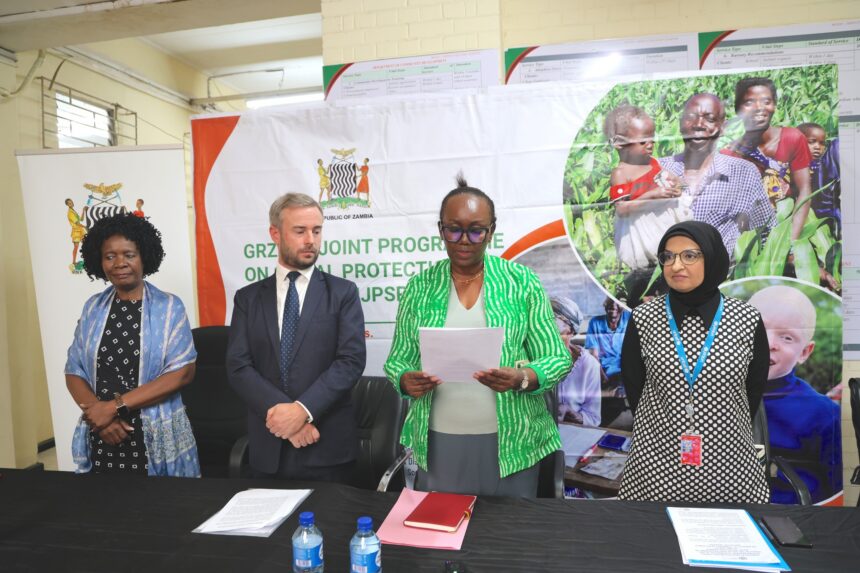
Zambia has officially launched the United Nations Joint Programme on Social Protection Phase III (2025–2028), marking a major step toward strengthening the country’s social welfare systems and improving support for vulnerable households. The programme is implemented in partnership with the United Nations in Zambia and aims to build a more inclusive, coordinated and resilient social protection framework. It comes at a time when many households continue to face pressures linked to poverty, climate shocks and economic vulnerability. Government officials say the initiative will help ensure that social protection systems are not only responsive but also sustainable in the long term. The launch reflects a shared commitment to improving dignity, reducing inequality and expanding access to essential support services.
The programme is structured around three strategic pillars designed to address key gaps in Zambia’s social protection landscape. The first pillar focuses on enabling provision of rights-based social protection, with an emphasis on strengthening systems that ensure coordinated, accountable and sustainable assistance for vulnerable people at every stage of life. The second pillar prioritises leveraging social protection to enhance climate resilience and food security, recognising that climate-related shocks such as droughts and floods continue to affect livelihoods and food systems. The third pillar promotes gender-responsive and disability-inclusive social protection, ensuring that women, girls and persons with disabilities are not left behind in access to support services. These pillars are intended to create a more comprehensive and integrated system that responds to both immediate needs and long-term development challenges.
The programme is being implemented through a broad partnership involving multiple government ministries and United Nations agencies. Key implementing institutions include the Ministry of Community Development and Social Services, the Ministry of Agriculture, and the Disaster Management and Mitigation Unit. On the United Nations side, agencies such as UNICEF Zambia, FAO Zambia and the World Food Programme are playing central roles in delivering technical and operational support. Financial backing is provided by international development partners including the Swedish International Development Cooperation Agency, the Swiss Agency for Development and Cooperation and the United Kingdom Foreign Commonwealth and Development Office. This multi-partner approach reflects a strong global commitment to strengthening Zambia’s social protection systems through coordinated investment and technical collaboration.
The programme places strong emphasis on linking social protection with climate resilience, recognising the growing impact of environmental challenges on vulnerable populations. By integrating early warning systems, emergency response mechanisms and long-term resilience planning, the initiative aims to help households better anticipate and recover from climate shocks. It also seeks to improve food security by ensuring that support systems are responsive during periods of drought, flooding or economic disruption. Officials involved in the programme highlight that social protection is no longer viewed only as a safety net but also as a development tool that supports productivity and stability. This approach is expected to help communities become more self-reliant while still receiving targeted support when needed.
Gender equality and disability inclusion form a central part of the programme’s design, with targeted interventions aimed at ensuring equitable access to services. Women and girls, who often face higher levels of economic vulnerability, are prioritised through programmes that support income security, access to services and participation in decision-making processes. Persons with disabilities are also included through improved accessibility measures and tailored support systems that address specific barriers they face. The programme recognises that inclusive social protection systems are essential for reducing inequality and promoting social cohesion. Stakeholders emphasise that leaving no one behind is not only a policy goal but a practical requirement for sustainable development.
The launch of the United Nations Joint Programme on Social Protection Phase III represents a strengthened commitment by both the government and development partners to build a more resilient and inclusive society. It reflects a shared understanding that effective social protection systems are essential for reducing poverty, responding to shocks and supporting long-term economic development. Through coordinated implementation and sustained investment, the programme is expected to improve the lives of vulnerable households across the country. It also reinforces Zambia’s broader development agenda, which focuses on inclusion, resilience and sustainable growth. As implementation begins, attention will remain on ensuring that the programme delivers tangible benefits for communities and strengthens the country’s capacity to respond to future challenges.