




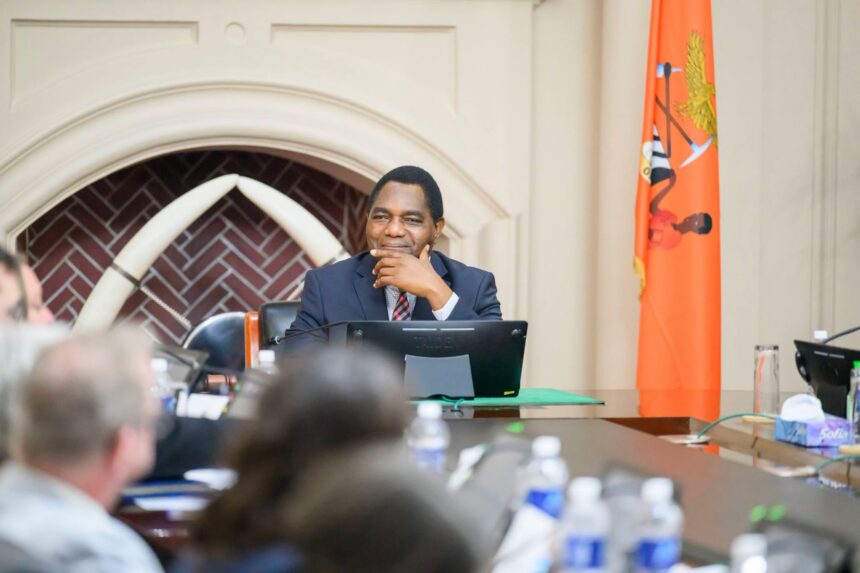
Zambian President Hakainde Hichilema has reaffirmed his government’s commitment to strengthening democracy and implementing electoral reforms following a meeting with a delegation from the European Union Election Observation Mission (EU EOM). The delegation was led by Chief Observer Michael McNamara, who visited the President as part of the Mission’s engagement with Zambia following the 13 August general elections. The European Union was among the regional and international organisations invited by the Zambian Government to observe the electoral process. President Hichilema expressed appreciation for the Mission’s participation and its contribution to promoting transparency, accountability and democratic governance. He also welcomed the delegation’s observations and recommendations, describing election observers as important partners in strengthening Zambia’s democratic institutions.
During the meeting, President Hichilema thanked the EU Election Observation Mission for taking the time to assess the electoral process and provide recommendations. He noted that independent election observers play an important role in building public confidence in democratic institutions. Their work helps assess whether elections meet established democratic standards and identifies areas that may require improvement. Observation missions also provide valuable feedback that can guide electoral reforms and strengthen future elections. President Hichilema said Zambia appreciated the contribution made by the European Union delegation and other international observer missions.
The President also expressed gratitude for the warm wishes and congratulations extended to him and his government by the delegation through Chief Observer Michael McNamara. The recognition followed the outcome of the 13 August general elections, in which Hichilema and his government secured another electoral victory. The President welcomed the delegation’s message and described the engagement as an opportunity to strengthen relations between Zambia and the European Union. Such diplomatic interactions are important because they provide opportunities for governments and international partners to discuss democratic progress and areas of mutual interest. They also help maintain dialogue on governance, institutional development and international cooperation.
A major issue discussed during the meeting was the government’s commitment to continuing democratic and electoral reforms. President Hichilema assured the delegation that his administration would remain committed to changes aimed at strengthening Zambia’s democratic system. Electoral reforms can help improve the credibility, transparency and efficiency of future elections. They can also address weaknesses identified by election observers and other stakeholders during electoral assessments. By engaging with international observation missions, the government has an opportunity to consider recommendations that could improve the country’s electoral processes.
The President further linked democratic development to his administration’s Grow Zambia Agenda. He emphasised that a flourishing democracy is essential to achieving the country’s broader development objectives. Strong democratic institutions provide a foundation for accountability, public participation and responsible leadership. They also create an environment in which citizens can express their views and participate in decisions affecting their communities and the country. According to Hichilema, strengthening democracy is therefore not only a political priority but also an important part of Zambia’s national development ambitions.
Zambia’s relationship with the European Union also featured prominently in the President’s remarks. The EU remains an important international partner in areas such as governance, development cooperation, trade and institutional strengthening. Continued engagement on democratic reforms can help deepen cooperation and build mutual confidence between the two sides. President Hichilema expressed his government’s willingness to maintain this relationship through constructive dialogue and a shared commitment to democratic principles. The meeting with the EU Election Observation Mission provided another opportunity to reinforce those diplomatic ties.
Election observation missions contribute to democratic development by examining different stages of the electoral process. Their assessments can cover the political environment, election administration, voter participation, campaign activities and the conduct of polling and vote counting. After completing their observations, missions generally provide findings and recommendations intended to help countries improve future electoral processes. These recommendations can address issues involving electoral laws, institutional capacity, transparency and the protection of democratic rights. Their value ultimately depends on how relevant stakeholders consider and implement the proposed improvements.
President Hichilema’s engagement with the EU delegation also highlights the importance of maintaining dialogue between national governments and international partners after elections. Democratic development requires continuous attention rather than action limited to election periods. Governments, political parties, electoral institutions, civil society organisations and citizens all have responsibilities in protecting democratic standards. Constructive engagement with observer missions can help identify practical measures for addressing challenges and strengthening public confidence. Zambia’s commitment to reviewing and improving its democratic processes will therefore remain important as the country looks towards future elections.
The meeting with Chief Observer Michael McNamara and the European Union Election Observation Mission represents an important diplomatic engagement following Zambia’s 13 August general elections. President Hakainde Hichilema has welcomed the Mission’s observations and recommendations while reaffirming his government’s commitment to democratic reforms. His remarks also underline the connection between good governance, national development and stronger international partnerships. As Zambia continues pursuing its Grow Zambia Agenda, maintaining credible democratic institutions and encouraging public participation will remain essential. The lasting impact of this commitment will depend on turning reform promises and observer recommendations into practical improvements that strengthen democracy for all Zambians.