






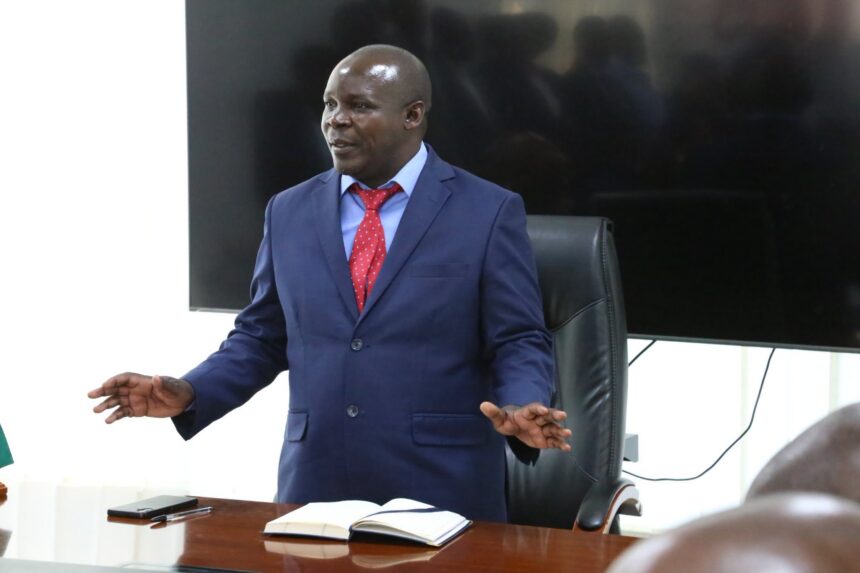
The newly appointed Minister of Green Economy and Environment, Dr Gilbert Siame, has called on members of staff to position the Ministry as a key driver of Zambia’s growth and development agenda. Dr Siame made the call during a familiarisation meeting with management and staff, where he outlined his expectations for the Ministry’s role in supporting national development. He stressed that the Ministry’s responsibilities extend beyond environmental protection and must contribute directly to economic growth. The Minister said Zambia needs development that is climate-smart, sustainable and resilient while creating practical benefits for citizens. His remarks placed strong emphasis on turning government policies and ideas into projects that deliver measurable results.
Dr Siame said the Ministry of Green Economy and Environment is a critical institution in delivering the country’s development aspirations and must play a leading role in domesticating and implementing the Grow Zambia Agenda. He explained that the Ministry needs to understand how its mandate can contribute to the broader economic priorities of the country. This includes identifying opportunities within the green economy and using environmental and natural resources in ways that support sustainable economic activity. The Minister also referred to the need to understand and implement the 10-10-5-3-3-1-1-1 framework from the perspective of the Ministry. He urged staff to ensure that their daily work connects clearly with Zambia’s wider development objectives.
The Minister emphasised that the Ministry’s mandate should not be limited to environmental protection without considering the economic opportunities that can emerge from sustainable development. He called for an approach that combines environmental responsibility with practical economic outcomes for the country. Green economic development can create opportunities across areas such as sustainable resource utilisation, climate action, forestry and environmental management. Zambia has significant natural resources that require careful management while also providing opportunities for investment, employment and economic activity. Dr Siame therefore challenged the Ministry to develop approaches that protect the environment while supporting growth and improving the livelihoods of Zambians.
A major focus of the Minister’s message was the need to move from policy development towards practical implementation. He urged members of staff to focus on developing and actualising projects that can translate the Ministry’s policies and programmes into tangible benefits for the Zambian people. According to Dr Siame, departments must also strengthen their engagement with academic institutions and communities to develop solutions that respond to real needs. Collaboration with academia can support research, innovation and the development of evidence-based approaches to environmental and economic challenges. Engagement with communities can ensure that programmes are informed by local realities and deliver outcomes that people can experience directly.
Dr Siame said the Ministry should become an institution that identifies opportunities, develops innovative solutions and delivers measurable results. He identified green economic development, climate action, environmental management, forestry, sustainable resource utilisation and climate resilience as areas where the Ministry can make a direct contribution to national development. These sectors have links to economic activity, resource management and the long-term sustainability of communities. Effective programmes in these areas can also help Zambia respond to environmental challenges while creating opportunities for development. The Minister’s message was therefore centred on ensuring that the Ministry’s work produces practical outcomes rather than remaining focused solely on policies and plans.
Integrity, professionalism and accountability were also highlighted as important requirements for the Ministry’s work. Dr Siame said he expects to work with people who are committed to developing sound plans, actualising projects and embracing innovation. He stressed the importance of having staff who can move from ideas to implementation and from projects to measurable results. The Minister also linked this approach to the wider call for economic growth made by President Hakainde Hichilema during the swearing-in ceremony. He said the Ministry needs people who can plan effectively, implement programmes and contribute to the growth of the Zambian economy while maintaining high standards of integrity.
The Minister further encouraged management and staff to work collaboratively and break down institutional silos within the Ministry. He said stronger coordination would help departments maximise the impact of their programmes and ensure that different areas of work support one another. A coordinated approach can help reduce duplication and improve the use of available resources while making it easier to track progress across programmes. Dr Siame also called for every department and member of staff to understand their contribution to the Ministry’s overall mandate. This results-oriented approach is intended to connect individual responsibilities with the broader Grow Zambia Agenda.
The familiarisation meeting gave Dr Siame an opportunity to interact directly with management and members of staff following his appointment as Minister of Green Economy and Environment. It also allowed him to gain a better understanding of the Ministry’s operations, programmes and areas of responsibility. At the same time, the meeting provided a platform for the Minister to communicate his expectations and priorities for the institution. His emphasis on implementation, innovation, accountability and collaboration signals a focus on strengthening the Ministry’s contribution to national development. The engagement also underscored the importance of ensuring that the Ministry’s programmes respond to both environmental needs and Zambia’s economic priorities.
Dr Siame’s call comes as Zambia continues to place greater attention on the relationship between economic development, environmental sustainability and climate resilience. The Ministry of Green Economy and Environment has a broad role in shaping how the country manages its natural resources while responding to environmental and climate-related challenges. Its work also has implications for investment, community development, forestry, sustainable resource use and the growth of emerging green economic activities. By focusing on practical projects and measurable outcomes, the Ministry can connect its policies more directly to the needs of citizens and the country’s development objectives. Strong collaboration among departments, communities, academia and other stakeholders will remain important in translating these priorities into effective programmes.
The familiarisation meeting has set out a clear expectation for the Ministry of Green Economy and Environment to play a stronger role in Zambia’s growth and development agenda. Dr Gilbert Siame has called for staff to combine environmental responsibility with economic opportunity while ensuring that development remains climate-smart, sustainable and resilient. His emphasis on practical implementation, innovation, integrity, professionalism and accountability places attention on the delivery of measurable results. The Ministry will also be expected to strengthen collaboration and ensure that its departments understand how their work contributes to the broader Grow Zambia Agenda. With these priorities, the focus now turns to translating plans and policies into projects that can support sustainable economic growth and deliver tangible benefits for the Zambian people.