






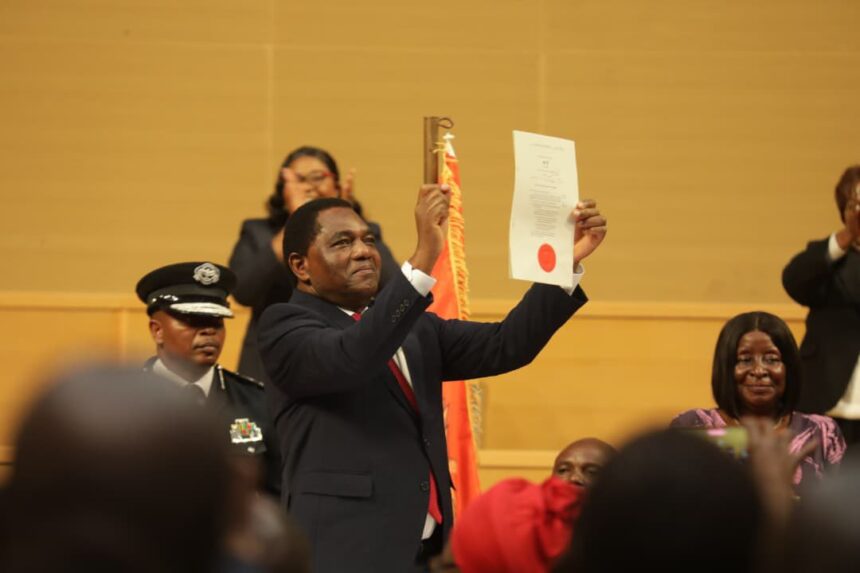
President Hakainde Hichilema has formally assented to the Constitution Amendment Bill No.7 of 2025, urging Zambians to treat debates around the measure as concluded and to shift attention toward electricity supply, decentralised development, and economic production.
“After signing, now that is law, I declare that the debate is now behind us,” the President said during the ceremony. He emphasised that the reform should not be seen as a victory for any party, leader, ethnic group, or church, but rather as a milestone for all Zambians. Highlighting the country’s diversity, he reiterated that the amendment process belongs to the entire citizenry and warned against interpreting it through partisan lenses.
President Hichilema dismissed claims that the bill sought to extend the presidential term to seven years, remove the 50 percent plus one requirement, or eliminate the running mate arrangement, describing these allegations as misinformation used to divide citizens. He framed the amendment as addressing non-contentious issues while expanding representation for underrepresented groups, including women, young people, and persons living with disabilities.
A significant part of the address focused on the tone of national debate. The President noted that discussions had been intense and sometimes divisive, calling for reflection and civility. Drawing on a Biblical teaching, he stressed reconciliation and peace as national values following a polarising discussion.
On procedural matters, President Hichilema explained that assent had been delayed to allow wider consultations. He praised the Mushabati Technical Committee for completing its work in two months, rejecting claims that the committee was unlawful. He also provided examples of compromise, such as retaining by-elections between general elections despite his initial preference to remove them.
The President highlighted cross-party support for the amendment, noting that the bill passed with 135 Members of Parliament voting in favour, exceeding the two-thirds threshold required for constitutional change.
Shifting focus to decentralisation and development, President Hichilema shared a chiefdom example showing that community-level control reduced project costs and allowed more classrooms to be built. He emphasised the importance of delivering resources to communities rather than centralising decisions in Lusaka, linking this approach to constituency delimitation and broader resource distribution.
Electricity provision featured prominently in the address. The President noted citizens’ demands for reliable power to support small businesses and health facilities, including oxygen-dependent patients. He attributed the power crisis to the worst drought in living memory and highlighted efforts to diversify energy sources, including solar and coal projects. He cited Mamba Phase 2 and Chisamba development projects, noting improvements in transmission capacity in collaboration with Zimbabwe.
President Hichilema also outlined broader economic progress, including debt restructuring, recovery in mining, tourism growth from 500 arrivals in 2021 to 2.5 million this year, and record-high foreign reserves. He highlighted initiatives for fertilizer self-sufficiency and domestic medicine production as part of a shift toward production over consumption.
In closing, the President called for unity, hard work, and integrity, pledging that cheating, theft, and deliberate wrongdoing would not be tolerated. He emphasised correction over deception and urged citizens to advance love over hatred.
“With teamwork, unity of purpose, hard work, and respect for each other, we’ll be OK,” President Hichilema said, concluding with a blessing for Zambia and thanks to the audience.