

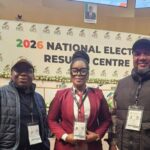






Dolika Banda has raised concerns over what she describes as a dangerous erosion of Zambia’s democratic framework, warning that the separation of powers between the executive, legislature, and judiciary is under threat.
In a podcast interview released over the weekend, Banda said Zambia’s stability depends on the independence of its three arms of government. She cautioned that weakening these institutions risks concentrating power in ways that undermine accountability. “The doctrine of separation of powers is not an abstract idea, it is the foundation of our democracy,” she said.
Her comments come amid debate over the role of institutions ahead of the 2026 elections. Opposition parties have alleged that parliamentary processes are dominated by the executive, while some members of the public have questioned the judiciary’s impartiality in politically sensitive cases. Banda said these developments signal a system under strain.
Zambia has a history of peaceful democratic transitions, including in 1991, 2011, and 2021, when opposition parties replaced incumbents without violence. Banda warned that this record should not be taken for granted. “History shows that democracies do not collapse overnight, they weaken when institutions are allowed to lose their independence,” she said.
Political analysts note that her warning reflects broader public unease. Recent incidents, such as the alleged assault of Mambilima MP Jean Chisenga within Parliament by a ruling party cadre, are cited as evidence of declining respect for national institutions. Banda did not mention the incident directly but emphasized institutional fragility, which resonates with public concerns.
Her remarks come at a time of heightened political polarisation. The ruling United Party for National Development (UPND) highlights achievements in debt management, inflation reduction, and infrastructure development. Opposition parties argue that reforms are overshadowed by partisan control and challenges such as load shedding and rising living costs.
Banda’s message aligns with calls from civil society organisations for institutional strengthening to ensure free and fair elections. “The decisions we take now will shape whether Zambia preserves its reputation for peaceful democratic transitions or slips into instability,” she said.
Although relatively new to frontline politics, Banda’s background in international finance and governance lends weight to her warnings. Analysts suggest her focus on governance integrity could appeal to urban voters concerned about economic and power crises.
The 2026 elections are expected to feature multiple opposition candidates, including the Patriotic Front and the Socialist Party. Banda faces the challenge of building a broad coalition capable of competing against UPND, which retains control of government machinery.
Analysts say her emphasis on institutional independence addresses a critical but often overlooked aspect of Zambian politics. While economic issues dominate headlines, the autonomy of parliament, courts, and the executive determines whether power is exercised fairly and transparently.
Banda’s warning highlights that institutional decay affects citizens’ ability to hold leaders accountable, secure justice, and participate in credible elections. Her remarks may shift campaign discourse, placing governance reforms alongside economic and social concerns, keeping institutional independence at the center of political debate as the 2026 elections approach.