






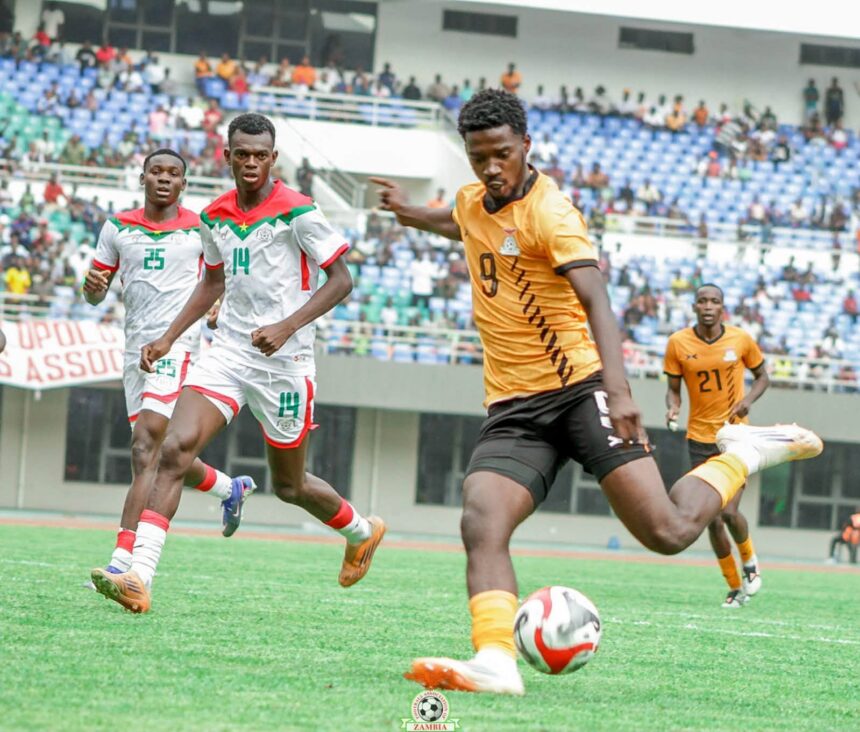
Zambia’s U23 Men’s National Team has taken a major step towards qualifying for the 2027 Africa Cup of Nations (AFCON) after defeating Burkina Faso 3-2 on post-match penalties at Heroes Stadium in Lusaka on Sunday. The victory secured Zambia’s place in the final round of the U23 AFCON 2027 qualifiers following a tense encounter that tested the team’s determination, confidence and fighting spirit. Goalkeeper Christo Chitambala emerged as the hero of the match after making two crucial saves during the penalty shootout. His outstanding performance helped the Young Chipolopolo overcome a stubborn Burkina Faso side and keep their qualification hopes alive. The result was particularly important for Zambia, who had travelled to Ouagadougou for the first leg last Wednesday and needed to overturn an aggregate deficit to progress.
The two teams entered the decisive encounter with everything to play for after Burkina Faso had secured an advantage in the first leg. Zambia responded with determination in front of their home supporters, knowing that anything less than a victory would end their campaign at this stage of the competition. The Chisi Mbewe-coached side approached the match with a clear objective of reaching the final qualifying round. However, Burkina Faso proved difficult opponents and made the contest challenging for the hosts. With the aggregate score level at 1-1 after Zambia’s response in Lusaka, neither team could secure qualification during the available playing time, forcing the match to be decided through penalties.
The first half produced several promising opportunities for Zambia, although the hosts struggled to turn their attacking moves into goals. Striker Eliya Mandanji came close to opening the scoring early in the match, but his effort from close range failed to seriously trouble the Burkina Faso goalkeeper. Emmanuel Mutale also had a good opportunity in the 23rd minute after David Simukonda delivered an accurate cross into a dangerous area. Unfortunately for Zambia, Mutale could not make the necessary connection to direct the ball towards goal. Burkina Faso responded with an attacking threat of their own two minutes later when Jack Diara worked his way through the Zambian defence, but goalkeeper Chitambala produced an important save to keep his team in the contest.
Zambia continued searching for a breakthrough as the match progressed, with the technical bench looking for ways to improve the team’s attacking effectiveness. At the beginning of the second half, coach Mbewe introduced two changes, withdrawing Emmanuel Mutale and Given Kalusa for Tumelo Mununga and Pascal Phiri. The substitutions provided fresh options as Zambia attempted to increase their attacking pressure. The hosts came close to scoring in the 48th minute when Jonathan Kalimina struck a well-taken free-kick that hit the upright. It was another frustrating moment for the Zambian players, who had created opportunities but were still unable to find the back of the net. Burkina Faso remained organised defensively and continued making life difficult for the home side.
As the match approached its closing stages, Mbewe made another double substitution in the 78th minute to give his team additional attacking energy. Caleb Musonda and Gift Siame came on for Anthony Shipanuka and David Simukonda as Zambia intensified their search for a decisive goal. The changes eventually paid off when Musonda broke the deadlock in the 83rd minute. The forward showed excellent individual skill by dribbling past his marker before unleashing a well-directed shot from inside the penalty area. His finish gave Zambia a crucial breakthrough and brought the aggregate score to 1-1. The goal lifted the atmosphere inside Heroes Stadium and gave the hosts renewed belief that they could complete the comeback and secure a place in the next qualifying round.
Despite Musonda’s late goal, neither side managed to find another breakthrough before the contest was decided by penalties. The shootout placed enormous pressure on both teams, with qualification depending on the ability of the players to convert their opportunities from the spot. Chitambala took centre stage for Zambia by producing two outstanding saves. The goalkeeper denied Cherif Barro and Fadil, giving his teammates a significant advantage during the decisive moments. His contribution proved essential in a shootout where small margins determined the outcome. Burkina Faso managed to convert two penalties through Jack Diara and Doque Fofana, but their efforts were not enough to prevent elimination.
Zambia demonstrated composure from the penalty spot, converting three attempts through Eliya Mandanji, Charles Buyoya and Pascal Phiri. Their successful efforts, combined with Chitambala’s two saves, secured a 3-2 shootout victory for the Young Chipolopolo. The celebrations at Heroes Stadium reflected the importance of the result for the players, coaching staff and Zambian football supporters. Chitambala’s performance was particularly significant because goalkeepers often play a decisive role in penalty shootouts, where concentration and anticipation can determine whether a team advances or exits the competition. His ability to handle the pressure and deny two Burkina Faso players gave Zambia the advantage they needed. The victory also highlighted the importance of teamwork and mental strength in high-pressure international football matches.
Speaking during the post-match press conference, Zambia coach Chisi Mbewe praised his players for their character, commitment and fighting spirit. He explained that Burkina Faso had largely played according to the expectations of his technical bench, although their organisation and determination made the encounter difficult. Mbewe said the team’s objective had been to qualify for the next stage and expressed satisfaction that the players had achieved their target. He described the victory as a sweet result for the team and the country, acknowledging that Burkina Faso had presented several challenges throughout the match. The coach also congratulated his players for maintaining their determination despite the difficulties they encountered during the contest.
Mbewe emphasised that confidence had been one of the most important messages delivered to the players before the decisive match. He believed the team needed to trust its abilities and remain mentally strong, particularly after facing an unfavourable situation in the first leg. According to the coach, the players responded positively to that message and demonstrated the belief required to overcome their opponents. He also singled out Chitambala for his outstanding contribution during the penalty shootout. Mbewe acknowledged that the goalkeeper had stood up for the team when his services were needed most. His comments reflected the importance of preparation, confidence and individual responsibility in achieving success at international level.
Burkina Faso coach Moussa Sanogo expressed disappointment following his team’s elimination from the competition. He explained that his players had entered the encounter with the ambition of securing qualification but ultimately failed to achieve their objective. Sanogo also acknowledged the unpredictable nature of penalty shootouts, describing them as a lottery in which the outcome can depend on very small margins. His comments reflected the frustration of a team that had remained competitive throughout the tie but could not produce the decisive results required to progress. Although Burkina Faso converted two penalties, Zambia’s greater success from the spot proved decisive.
Zambia’s qualification represents an important achievement in the country’s efforts to secure a place at the 2027 U23 Africa Cup of Nations. The tournament provides an opportunity for young footballers to demonstrate their abilities on the continental stage while gaining valuable experience against some of Africa’s strongest emerging talents. Progressing through the qualifying rounds also gives the coaching staff an opportunity to assess the squad’s strengths, address weaknesses and build a more competitive team. The victory over Burkina Faso showed that Zambia can respond positively to difficult situations, particularly when facing opponents who are disciplined and difficult to break down. However, the team will need to maintain its progress and improve its overall performance as the competition becomes more demanding.
The Young Chipolopolo will now turn their attention to the final qualifying round, where they are scheduled to face either Nigeria or the Democratic Republic of Congo in March. Both potential opponents present a significant challenge, making the next stage an important test of Zambia’s ambitions. Nigeria has a strong history in African youth football, while DR Congo also possesses the potential to produce a difficult contest. Zambia will therefore need to prepare carefully, maintain its confidence and approach the next fixtures with the same determination displayed against Burkina Faso. The technical bench will also have to assess the team’s attacking efficiency and defensive organisation to ensure that the players are ready for the challenge ahead.
Zambia’s dramatic victory over Burkina Faso has demonstrated the value of persistence, tactical adjustments and mental strength in international football. Caleb Musonda’s late goal brought the aggregate score level, while Christo Chitambala’s two penalty saves ultimately secured the team’s progression. The contributions of Eliya Mandanji, Charles Buyoya and Pascal Phiri from the penalty spot further underlined the importance of collective responsibility during decisive moments. Coach Chisi Mbewe will now have the opportunity to prepare his players for one final qualifying hurdle in their pursuit of a place at the 2027 U23 AFCON. Although the challenge ahead will be demanding, the victory in Lusaka provides Zambia with renewed confidence and momentum. The Young Chipolopolo have kept their continental ambitions alive, and their next assignment will determine whether they can turn this important qualification achievement into a place at the tournament itself.