






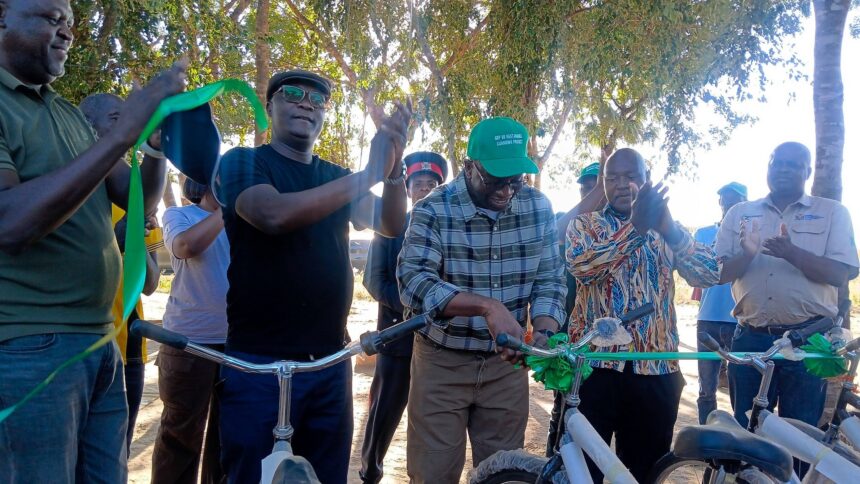
Permanent Secretary in the Ministry of Green Economy and Environment, Dr. Douty Chibamba, has strengthened community-based climate action after handing over eight bicycles valued at approximately K40,000 to mentors under the Kaswa Beekeeping Producer Group in Mafinga District. The support forms part of a wider government push to promote sustainable livelihoods while protecting natural ecosystems in vulnerable rural areas. The initiative focuses on equipping local communities with practical tools that improve mobility and increase the reach of environmental education. It also reflects growing efforts by the government to link economic empowerment with climate resilience. The handover marks a key step in expanding grassroots participation in sustainable natural resource management.
The initiative is being implemented under the Sustainable Luangwa Project, which operates under the Ministry of Green Economy and Environment and is funded through GEF-7 support. The programme is delivered in partnership with international and local cooperating institutions, including the World Wide Fund for Nature (WWF) and the Wildlife Environmental and Conservation Society of Zambia (WECSZ). These partners provide technical training, capacity building, and material support such as beehives to selected community members. The project is designed to reduce pressure on natural forests by encouraging alternative income sources through beekeeping. It also strengthens conservation efforts by linking household income generation to environmental protection.
So far, 26 beneficiaries have been trained under the beekeeping initiative, gaining practical skills in hive management, honey production, and sustainable harvesting techniques. The programme aims to expand local knowledge while creating long term economic opportunities that reduce dependence on unsustainable land use practices. Eight mentors within the Kaswa Beekeeping Producer Group are expected to receive five bicycles each to support their field operations and improve their ability to reach remote beneficiaries. These bicycles are intended to ease transportation challenges that often limit rural extension work. Improved mobility is expected to strengthen mentoring systems and increase productivity within the beekeeping value chain.
The programme will also see the distribution of 1,800 beehives to beneficiaries as part of its broader strategy to scale up sustainable livelihood activities in Mafinga District. This large scale distribution is expected to significantly boost honey production capacity while encouraging more households to participate in environmentally friendly income generation. The beehives are designed to promote conservation agriculture practices that protect forests and biodiversity. By supporting structured beekeeping, the initiative reduces reliance on activities such as charcoal production and unsustainable logging. It also contributes to climate change mitigation through better land use practices.
Speaking during the handover ceremony, Dr. Chibamba urged beneficiaries to maintain focus on long term sustainability and continue applying the skills acquired beyond the lifespan of the project. He emphasized the importance of self reliance and encouraged communities to view beekeeping as a lasting economic activity rather than a short term intervention. His message highlighted the need for continued knowledge transfer within communities to ensure project benefits extend beyond direct participants. He also stressed the importance of protecting natural ecosystems as a foundation for sustainable economic growth. The engagement reinforced government efforts to promote environmentally responsible development models.
The event was attended by senior officials, including Muchinga Province Deputy Permanent Secretary Brian Sichande, Mafinga District Commissioner, Director of Forestry in the Ministry of Green Economy and Environment Dr. Freddie Siangulube, Director of Environmental Management Richard Lungu, and officials from the Water Resources Management Authority. Their presence underscored the multi sectoral nature of climate resilience initiatives being implemented in the region. It also demonstrated coordinated government support for environmental and livelihood programmes at district level. Stakeholders highlighted the importance of collaboration in achieving sustainable development goals. The visit reflected continued engagement between central government and local authorities.
The Permanent Secretary has since concluded his working visit in Muchinga Province, leaving behind a strengthened framework for community based environmental action. The initiatives under the Sustainable Luangwa Project are expected to continue supporting livelihoods while promoting conservation outcomes across participating communities. The integration of training, equipment provision, and institutional partnerships positions the programme as a long term investment in sustainable development. It also reinforces Zambia’s broader commitment to balancing economic growth with environmental protection. The Mafinga beekeeping initiative stands as a practical example of how climate resilience can be built through targeted community empowerment.