


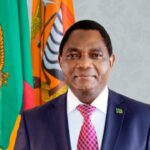




Zambia’s 2026 presidential election count has entered a significant stage after the Electoral Commission of Zambia announced results from 135 of the country’s 226 constituencies. Incumbent President Hakainde Hichilema has established a substantial lead over his closest challenger, Brian Mundubile, as counting continues across the country. Hichilema has accumulated 1,544,140 votes from the constituencies declared so far, while Mundubile has received 1,030,662 votes. The figures give the incumbent a lead of 513,478 votes at this stage of the count. The latest results were announced during an overnight session on August 17, with the commission confirming that 91 constituencies remain outstanding.
The latest announcement marked the third results session held on August 17 and added 30 constituencies to the previous total of 105. The Electoral Commission of Zambia has continued to release results in batches as verification and tabulation progress at the national results centre. With 135 constituencies now accounted for, 59.7 percent of the country’s constituencies have reported their presidential results. This figure should not be confused with voter turnout, which measures the proportion of registered voters who participated in the election. The commission’s latest figures show that Hichilema has maintained a commanding position as more constituencies have been added to the national tally.
Hichilema, who is seeking a second term under the United Party for National Development, has received 1,544,140 votes across the 135 declared constituencies. Mundubile, representing the NRPUP, has recorded 1,030,662 votes over the same number of constituencies. When the two leading candidates are compared directly, Hichilema holds approximately 60 percent of their combined votes while Mundubile has about 40 percent. The broader percentage reported against all valid votes places Hichilema at 58.87 percent at this stage, because other candidates also remain in the race. The size of the current margin has increased considerably compared with earlier batches of results.
The other presidential candidates remain considerably behind the two leading contenders. Citizens First candidate Hari Kalaba has recorded 11,711 votes, while Kelvin Walia of the Zambia Must Prosper party has 11,062 votes. Socialist Party candidate Fred M’membe has accumulated 6,905 votes and independent candidate Given Katuta has received 4,382 votes. Given Chansa of MEE, Brian Mushimba of OPP, Richard Silumbe of LM, Akim Njovu of DU, Howard Kunda of Zawapa and Richwell Siamunene of NFP have each recorded fewer than 3,300 votes across the declared constituencies. Their figures demonstrate the substantial gap that has emerged between the two frontrunners and the rest of the presidential field.
The 135 declared constituencies account for 4,793,053 registered voters. The commission recorded 2,623,640 valid votes and 77,647 rejected votes, bringing the total number of votes cast to 2,701,287. Based on those figures, voter turnout across the constituencies announced so far stands at 56.36 percent. The turnout figure is separate from the 59.7 percent of constituencies that have reported results, as the two percentages measure different aspects of the election. Turnout measures participation among registered voters, while the constituency figure measures how much of the geographical counting process has been completed.
The Electoral Commission also used the latest session to address an earlier discrepancy involving Kembe East. The Chief Electoral Officer explained that a results spreadsheet had printed the Kembe East schedule twice instead of displaying separate entries for Kembe East and Kembe West. According to the explanation, the underlying vote totals had not changed and the correction was intended to provide greater clarity to political stakeholders, observers and members of the media. Such clarifications are particularly important during a closely watched national count because errors in presentation can create confusion even when the underlying figures remain unchanged. The commission’s decision to explain the discrepancy formed part of its effort to clarify the results being released during the ongoing process.
Commissioners continued reading the results constituency by constituency across several provinces during the session. The announced constituencies included areas in Northwestern, Northern, Southern, Copperbelt, Central, Western, Luapula and Eastern provinces. Among the constituencies reported were Fumbo, Mpulungu South, Choma South, Itezhi-Tezhi East, Nshanga, Mwengwa, Sesheke West, Kapiri Mposhi East, Kazungula South, Mazabuka Central and Mazabuka Central, among many others. The breadth of the latest results provided a wider picture of how support for the leading candidates is distributed across different parts of Zambia. Hichilema continued to lead in a large number of the declared constituencies, although Mundubile also recorded notable victories in several areas.
Some constituency results illustrated the scale of Hichilema’s support in parts of the country. In Mazabuka Central, the incumbent recorded 38,895 votes against 3,410 for Mundubile, producing a substantial advantage in that constituency. Hichilema also performed strongly in a number of urban and Southern Province constituencies included in the latest batch. However, the results were not uniformly dominated by the incumbent, with Mundubile recording significant leads in several constituencies. In Nshanga on the Copperbelt, Mundubile received 22,090 votes compared with Hichilema’s 10,207, while he also led in Lima with 22,486 votes against 8,578 and in Chifubu with 20,789 votes against 10,295.
Voter participation has also varied significantly across the constituencies announced so far. Some constituencies recorded turnout levels in the lower 40 percent range, including Kapiri Mposhi East and Vubwi. Others reported considerably higher participation, with Kabompo West recording turnout above 85 percent and Fumbo exceeding 91 percent. These differences show that voter engagement has not been uniform across the country. Factors affecting turnout can vary between constituencies and may include local political dynamics, accessibility, population patterns and voter mobilisation. The final national turnout will only become clear after all constituencies have been processed and the full set of figures has been consolidated.
The commission’s running results infographic also shows how Hichilema’s lead has expanded throughout the counting process. After the first five constituencies, the difference between Hichilema and Mundubile stood at 21,312 votes. The margin increased to 81,626 votes after 27 constituencies, 120,639 after 70 constituencies and 225,971 after 105 constituencies. At the 135-constituency mark, the difference had reached 513,478 votes. The steady expansion of the margin has strengthened Hichilema’s position, although the remaining 91 constituencies still have to be counted before the final result can be determined.
Despite Hichilema’s current advantage, no winner has been declared at this stage. Zambia’s presidential electoral system requires a candidate to obtain more than 50 percent of the valid vote to secure victory in the first round. If no candidate crosses that threshold once all valid votes have been counted, the electoral process provides for a second-round contest between the leading candidates. Hichilema’s current percentage gives him a strong position, but the outstanding constituencies mean that the final outcome remains subject to the remaining count. The distinction between leading the partial results and being formally declared the winner remains important as the Electoral Commission continues its work.
The next results session is scheduled to continue at 09:00, with the commission expected to process more of the 91 constituencies that have not yet reported. The ongoing count follows a temporary suspension earlier in the election process after incidents involving election officials and ballot materials, before counting resumed under strengthened security arrangements. The commission has continued urging stakeholders to rely on official announcements as the process moves forward. The latest session proceeded with the reading of results while separate legal and political concerns surrounding the election process remained part of the wider national discussion.
The 2026 presidential election is being closely watched because the outcome will determine whether Hichilema secures a second term or whether Zambia moves toward a change in leadership. Hichilema entered the election seeking another mandate after taking office in 2021, while Mundubile emerged as his main challenger in a contest involving multiple presidential candidates. The election has also taken place against a backdrop of economic debate, with issues including the cost of living, economic recovery, employment and the country’s debt situation featuring prominently in public discussion. The final result will therefore have significance beyond the immediate contest between the leading candidates. It will shape Zambia’s political direction and influence the country’s economic and social priorities for the next term.
For now, Hakainde Hichilema remains firmly ahead in Zambia’s presidential vote count after results from 135 of 226 constituencies were declared. His 513,478-vote advantage over Brian Mundubile represents a significant lead, but 91 constituencies remain and the Electoral Commission has yet to announce a final winner. The commission’s continued release of verified results will provide the clearest indication of how the race develops as counting moves toward completion. With the next results session expected to add more constituencies to the national tally, attention will remain focused on whether Hichilema can maintain his current advantage and cross the required threshold. Until all results are counted and officially declared, Zambia’s presidential election remains an ongoing process, with the final outcome still to be confirmed by the Electoral Commission of Zambia.