







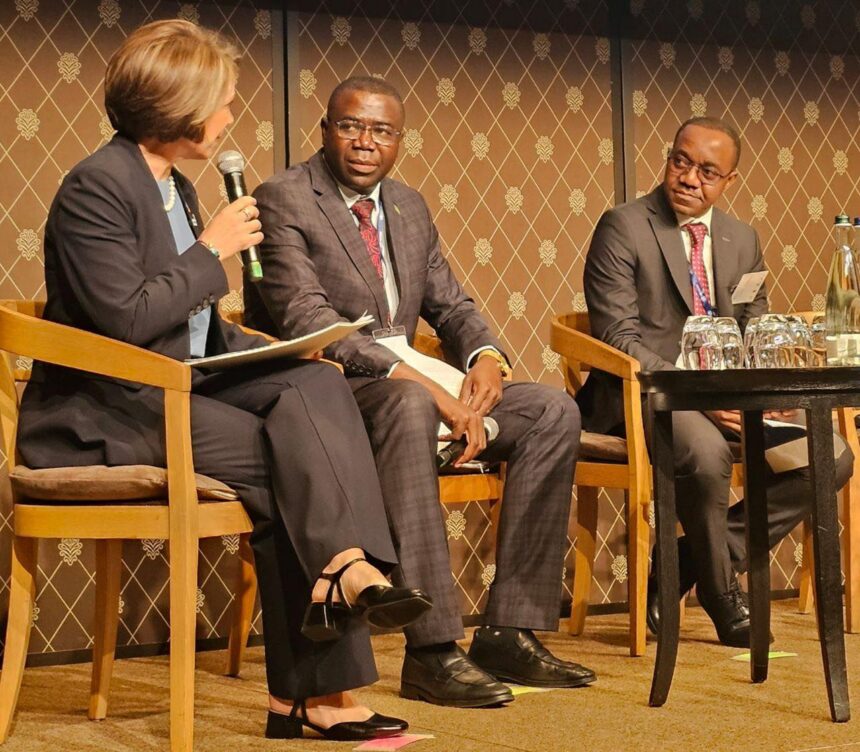
Zambia has taken a leading role in global health innovation discussions by co-hosting a high-level side event on Artificial Intelligence during the 79th World Health Assembly (#WHA79) in Geneva, Switzerland. The event focused on how AI can strengthen healthcare systems and improve service delivery, especially at the frontline of care where health workers interact directly with patients. The session, titled “Frontline First: Investing in and Designing AI for Real-World Care,” was co-hosted by the Republic of Mozambique, Jhpiego and Viamo alongside Zambia. Zambia was represented by Prof Roma Chilengi, Director General of the Zambia National Public Health Institute, who contributed to discussions on digital health transformation and innovation. The engagement reflected Zambia’s growing commitment to integrating technology into public health systems. It also highlighted the increasing global attention on artificial intelligence as a tool for improving healthcare delivery.
The side event brought together a wide range of participants, including policymakers, senior government officials, representatives from the World Health Organization, AI developers, and international development partners. The discussions focused on how emerging technologies can be used to build stronger, more responsive, and more equitable health systems. Participants shared experiences from different regions, with a particular emphasis on low and middle income countries where access to healthcare remains uneven. The dialogue emphasized that digital innovation is no longer optional but necessary for closing gaps in service delivery. Many speakers highlighted the urgency of adapting health systems to keep pace with rapid technological change. The event created a platform for collaboration between governments and technology stakeholders.
A central theme of the discussions was the role of artificial intelligence as a potential equalizer in global healthcare systems. Delegates noted that AI tools can help extend quality healthcare services to rural and underserved communities that often face shortages of medical professionals and infrastructure. In many cases, AI powered systems can assist in diagnostics, patient monitoring and health data analysis. This allows health systems to operate more efficiently while reaching more people with limited resources. Participants stressed that countries must actively prepare to integrate these tools into their national health strategies. The focus remained on ensuring that innovation translates into real improvements in patient care.
The discussions also placed strong emphasis on governance, ethics and regulation in the use of AI in healthcare. Speakers warned that without clear legal and regulatory frameworks, digital health solutions could create risks related to data privacy, equity and accountability. They stressed that governments must ensure that AI systems are transparent, safe and designed to serve public interest. Ethical considerations were seen as essential for building trust in digital health systems. Participants agreed that strong governance structures are necessary to guide the responsible use of emerging technologies. This approach ensures that innovation does not outpace the systems meant to manage it.
Another key outcome of the meeting was the call for sustained investment in AI driven health innovations. Participants emphasized that investment should not only focus on technology but also on supporting infrastructure, workforce training and system readiness. Health workers must be equipped with the skills needed to use digital tools effectively in real world settings. Without adequate capacity building, even the most advanced technologies may fail to deliver meaningful impact. The discussions encouraged partnerships between governments, development agencies and private sector actors to support long term digital transformation. The goal is to ensure that innovation is both practical and scalable.
Delegates also agreed that artificial intelligence should be used to support, not replace, healthcare workers. AI systems can assist with tasks such as disease surveillance, administrative work and clinical decision support. This can reduce pressure on frontline health workers and allow them to focus more on direct patient care. Participants emphasized that human judgement remains essential in all aspects of healthcare delivery. Technology should therefore be designed to enhance human capability rather than eliminate it. This balanced approach was seen as critical for maintaining quality and trust in healthcare systems.
Zambia used the platform to reaffirm its commitment to advancing digital transformation within the health sector. The country highlighted ongoing efforts to strengthen public health systems through innovation and improved data use. These initiatives are aimed at expanding access to quality healthcare services and improving health outcomes for citizens. Zambia’s participation at #WHA79 demonstrated its intention to be part of global conversations shaping the future of healthcare delivery. The engagement also reflects national priorities focused on building resilient and technology enabled health systems. The country continues to explore ways to integrate digital tools into routine health service delivery.
The discussions at the World Health Assembly side event reflected a growing global agreement that technology, when properly designed and governed, can transform healthcare systems. Participants recognized that artificial intelligence offers practical solutions to long standing challenges in access, efficiency and quality of care. However, success depends on strong leadership, clear policies and inclusive implementation strategies. The event reinforced the idea that digital transformation must be people centered and focused on real world outcomes. For Zambia and other participating countries, the dialogue provided valuable insights into building future ready health systems. The outcomes of the meeting point toward a future where innovation plays a central role in strengthening global healthcare delivery.