



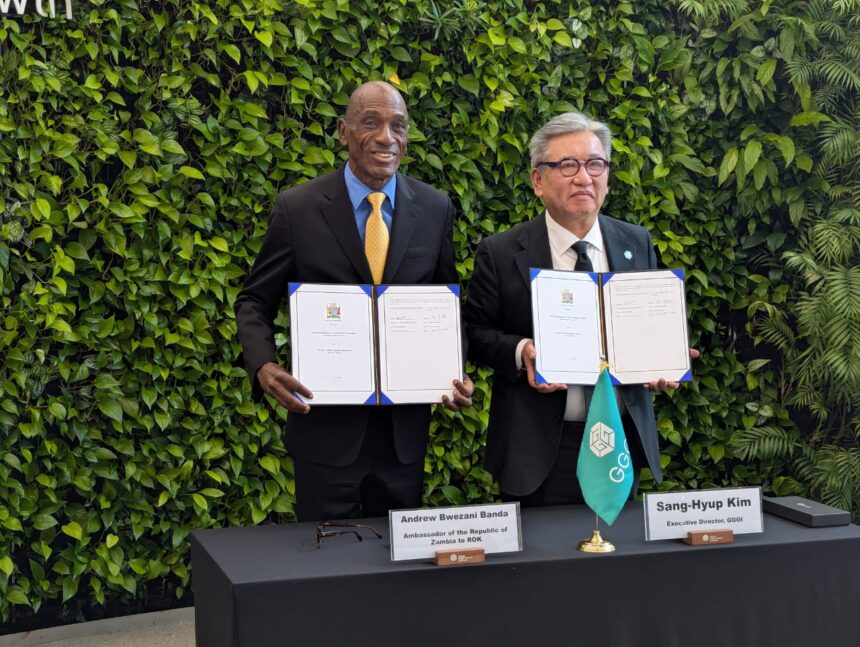
Zambia has taken a significant step in advancing its climate and development agenda by signing a Host Country Agreement with the Global Green Growth Institute. This agreement formalizes the institute’s legal status in the country and reinforces a shared commitment to climate action and inclusive green growth. The signing marks a strategic move aimed at strengthening Zambia’s institutional capacity to respond to environmental challenges while promoting sustainable economic development. The ceremony brought together key representatives from both Zambia and the institute, reflecting the importance of the partnership. This development positions Zambia to benefit from global expertise and structured collaboration in addressing climate-related priorities.
The agreement was signed by Andrew Banda, Ambassador of the Republic of Zambia to the Republic of Korea, and Sanghyup Kim, Executive Director of the institute. Their participation highlights the high-level commitment from both sides to ensure the success of the partnership. The formalization of the agreement provides a clear legal and operational framework for the institute’s activities in Zambia. It also strengthens cooperation between Zambia and international partners working in climate and environmental development. This level of engagement reflects growing recognition of the need for coordinated global action on climate issues.
Speaking during the signing ceremony, Ambassador Banda emphasized that the partnership would play a key role in supporting Zambia’s pursuit of sustainable economic growth. He pointed out that environmental protection and economic development must go hand in hand to ensure long-term national progress. The agreement was described as both a commitment and a call to action, requiring effective implementation and collaboration among stakeholders. He stressed that Zambia is ready to work closely with the institute to deliver practical solutions that improve livelihoods. His remarks highlighted the importance of turning policy into measurable outcomes that directly benefit citizens.
The Host Country Agreement also strengthens Zambia’s institutional framework for implementing climate and development priorities. It supports the country’s efforts to meet its Nationally Determined Contributions, which outline targets for reducing emissions and adapting to climate change. By formalizing the institute’s presence, Zambia gains access to technical expertise, policy support and financial advisory services. These resources are critical in helping the country design and implement effective climate strategies. The agreement creates a structured environment where national goals can align with international climate frameworks.
Since 2022, the Global Green Growth Institute has worked closely with Zambia, building a foundation for this formal partnership. Zambia officially became a member state in July 2023, further strengthening collaboration between the two parties. During this period, several key initiatives have been developed, including the National Green Growth Index and Strategy. The partnership has also supported the advancement of carbon markets under Article 6 of the Paris Agreement. Additional efforts include the establishment of an integrated Monitoring, Reporting and Verification system, capacity building programmes and the creation of a Climate Finance Unit.
The agreement is expected to improve coordination in planning and implementing green growth programmes across Zambia. It will also enhance the country’s ability to mobilize climate finance and attract investment in sustainable projects. Access to funding remains a critical factor in scaling climate solutions, and this partnership provides a pathway to unlock such resources. The institute’s technical support can help Zambia identify viable projects and structure them for funding opportunities. This creates potential for growth in sectors such as renewable energy, sustainable agriculture and climate-resilient infrastructure.
The operations of the institute in Zambia are aligned with national priorities through its placement under the Ministry of Green Economy and Environment. This ensures that all programmes and initiatives are integrated into the country’s broader development framework. Alignment at this level improves efficiency and avoids duplication of efforts across institutions. It also supports stronger accountability in the implementation of climate projects. This coordinated approach increases the likelihood of achieving long-term impact in both environmental protection and economic development.
Zambia’s decision to formalize its partnership with the Global Green Growth Institute reflects a focused approach to tackling climate challenges while driving inclusive growth. The Host Country Agreement provides a structured platform for collaboration, resource mobilization and policy implementation. It strengthens the country’s ability to respond to climate risks and pursue sustainable development goals. The partnership also demonstrates Zambia’s commitment to working with international institutions to achieve meaningful progress. This step lays the foundation for long-term benefits that support both the environment and the well-being of its people.