







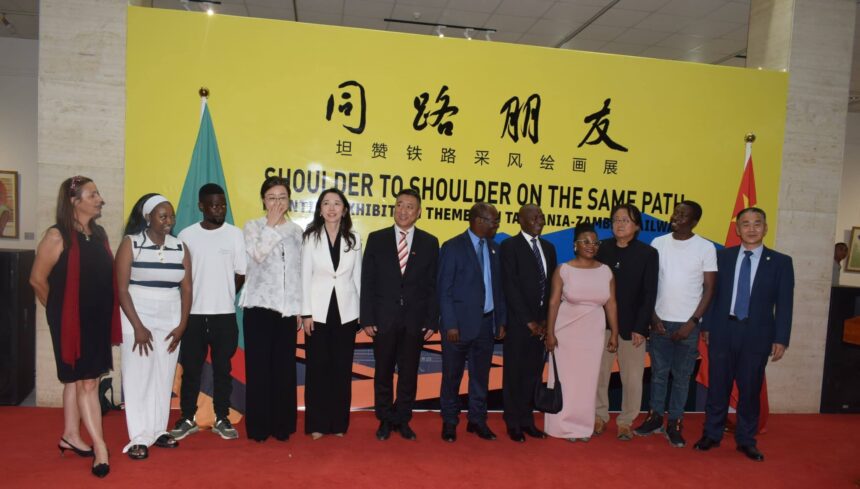
The Ministry of Tourism has officially launched the “Shoulder to Shoulder on the Same Path” joint art exhibition, marking a significant cultural and historical moment for Zambia and the People’s Republic of China. The exhibition celebrates 50 years since the completion of the Tanzania-Zambia Railway, widely known as TAZARA, a landmark project built on cooperation and shared vision. Held at the Lusaka National Museum, the event brings together art, history, and diplomacy in a single space. It highlights the deep and enduring friendship between the two nations through creative expression. The launch reinforces the role of culture in preserving history and strengthening international relations.
The exhibition features contemporary artworks created by both Zambian and Chinese artists who reinterpret the story of TAZARA through visual storytelling. These works focus on themes of resilience, sacrifice, and international solidarity that defined the construction of the railway. The collaboration between artists from both countries reflects a shared effort to keep historical memory alive in a modern and accessible form. Visitors are offered a cultural journey that connects past achievements with present-day partnerships. The exhibition also demonstrates how art can serve as a bridge between nations and generations.
Speaking at the launch, Minister of Tourism Rodney Sikumba, through Tourism Director Dr. Andrew Chilufya, described the event as more than artistic collaboration. He said it represents a powerful expression of shared history and future ambition between Zambia and China. He emphasized that the theme “Shoulder to Shoulder on the Same Path” captures the essence of cooperation and unity in achieving development goals. According to the Minister, the TAZARA project remains one of the strongest examples of what can be achieved through solidarity and shared purpose. His remarks highlighted the importance of remembering historical partnerships that continue to influence modern development.
The Minister praised the collaboration between the National Museums Board through the Lusaka National Museum and the National Museum of China. He described the partnership as a model for cultural diplomacy that can guide future international cooperation. He noted that museums play an important role in fostering dialogue, strengthening relationships, and inspiring younger generations. He encouraged both institutions to continue building on this partnership to deepen mutual understanding between the two countries. This cooperation also positions cultural institutions as active contributors to international engagement and education.
Mr. Sikumba also reaffirmed the government’s commitment to using culture as a tool for tourism growth, job creation, and inclusive economic development. He stated that national policies such as the National Tourism Policy and the Cultural Policy support the preservation and sustainable use of cultural heritage. These frameworks are designed to ensure that cultural assets contribute meaningfully to economic progress. He also emphasized the importance of integrating cultural initiatives into broader development strategies. This approach helps position tourism as a key pillar of national growth.
The Minister commended the participating Zambian and Chinese artists for their creativity and contribution to preserving the TAZARA narrative. He noted that their work brings fresh perspective to a historical project that continues to shape regional identity. The artworks provide younger generations with a visual and emotional understanding of the railway’s significance. He also highlighted the importance of creative collaboration in strengthening national identity and cultural pride. According to him, artists play a vital role in shaping how history is remembered and shared.
Chinese Ambassador to Zambia Han Jing also addressed the gathering and described the exhibition as part of the China-Africa Year of People-to-People Exchanges. He paid tribute to the thousands of Chinese engineers and workers who contributed to the construction of the TAZARA Railway alongside their Zambian and Tanzanian counterparts. He described the railway as a lasting monument to friendship and cooperation between China and Africa. His remarks emphasized the human effort and shared sacrifice behind the historic project. He also reaffirmed the importance of continuing this spirit of collaboration in modern development.
Ambassador Han further revealed that revitalisation of the TAZARA line is progressing, guided by commitments made by leaders from Zambia, China, and Tanzania during the 2024 FOCAC Summit. He stated that construction is expected to begin within the year and be completed within three years. The upgraded railway is expected to transform Zambia into a major transport and logistics hub in the region. It will improve connectivity and open new opportunities for trade and investment across Southern Africa. This development is seen as a continuation of the original vision behind TAZARA.
He also highlighted plans for the TAZARA Prosperity Belt, which will include industrial parks, logistics centres, agro-processing hubs, and manufacturing zones along the railway corridor. These developments are expected to create jobs, attract investment, and bring infrastructure closer to communities. The project is designed to support long-term economic transformation and regional integration. It also reflects a shift toward using infrastructure as a driver of inclusive growth. The revitalisation effort builds on the historical foundation of cooperation between the two countries.
As the exhibition opened to the public, the Minister of Tourism emphasized the importance of international partnerships in shaping Zambia’s future tourism industry. He noted that cultural diplomacy plays a key role in expanding tourism offerings and strengthening national identity. The exhibition stands as a symbol of how shared history can inspire future collaboration and economic opportunity. It also demonstrates how cultural initiatives can support broader development goals. The “Shoulder to Shoulder on the Same Path” exhibition ultimately reinforces the value of unity, cooperation, and shared progress between Zambia and China.