







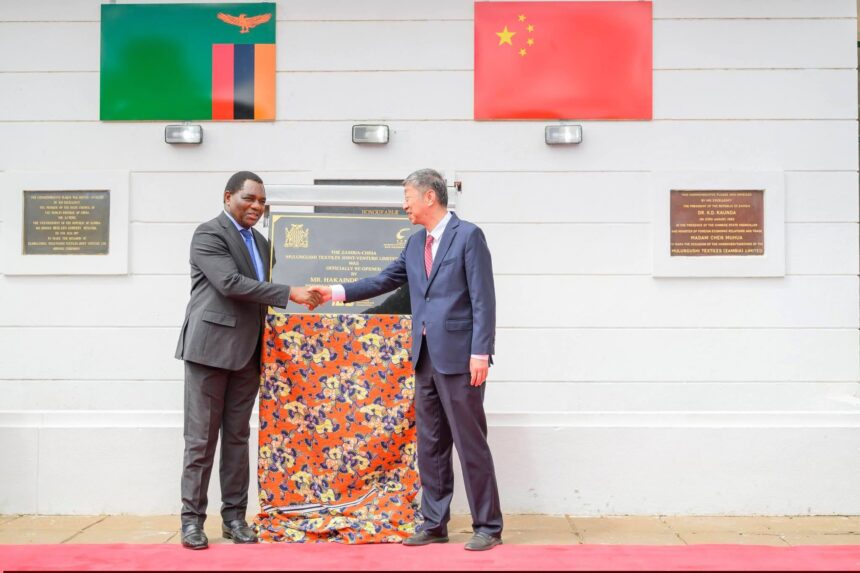
Yesterday morning marked a defining moment for Zambia’s industrial sector as Hakainde Hichilema officially commissioned the Zambia–China Mulungushi Textiles factory in Kabwe. The reopening comes after nearly two decades of inactivity, restoring one of the country’s once-prominent manufacturing hubs. This development reflects a renewed push toward industrialisation and economic recovery, with the government prioritising production-led growth. The event drew attention from key stakeholders, industry leaders and local communities who have long awaited the revival of the facility. The commissioning signals a shift from reliance on imports toward strengthening domestic manufacturing capacity.
The Mulungushi Textiles factory operates as a joint venture between Zambia and China, highlighting continued bilateral cooperation in infrastructure and industrial development. A total investment of 140 million US dollars has been injected into the project, demonstrating strong financial commitment to reviving the sector. This funding has enabled the rehabilitation of machinery, modernisation of production processes and upgrading of the facility to meet current industry standards. The scale of investment also reflects confidence in Zambia’s potential as a manufacturing hub within the region. The partnership is expected to serve as a model for future collaborations aimed at boosting local industries.
One of the most immediate impacts of the factory’s reopening is job creation, with over 500 direct employment opportunities expected to be generated. Beyond the factory floor, the project is set to empower more than 2,500 cotton farmers across Zambia by creating a stable demand for locally grown raw materials. This integration of agriculture and manufacturing strengthens the entire value chain, ensuring that benefits extend beyond urban industrial centres into rural communities. By linking farmers to a reliable market, the initiative supports income stability and encourages increased cotton production. This approach aligns with broader national goals of inclusive economic growth and rural development.
During the commissioning, President Hichilema described the reopening as the fulfilment of a long-standing commitment to revitalise Zambia’s industrial base. He emphasised that the project is not only about restoring infrastructure but also about creating meaningful employment and improving livelihoods. The factory is expected to produce a wide range of goods, including cotton fabrics, chitenge materials, curtains and other textile products. This diversification of output will help meet local demand while reducing dependence on imported textiles. It also positions Zambia to explore export opportunities within regional and international markets.
The President also stressed the importance of promoting local industries through deliberate government policies that prioritise domestically produced goods. He urged businesses, institutions and consumers to support Zambian products as a way to strengthen the national economy. This call reflects a broader strategy to build resilience by reducing reliance on imports and encouraging local entrepreneurship. Supporting homegrown industries can drive innovation, create jobs and improve trade balances. Such policies are critical in ensuring that investments like Mulungushi Textiles deliver long-term economic benefits.
In addition, President Hichilema called on citizens and stakeholders to actively partner with the government in driving development, particularly in Kabwe and surrounding areas. He highlighted the need for collective responsibility in achieving national growth, stressing that sustainable progress requires collaboration between the public and private sectors. Community involvement is expected to play a key role in ensuring the success and longevity of the factory. By fostering a shared sense of ownership, the initiative can create a more stable and supportive environment for industrial expansion. This collaborative approach strengthens trust and accountability across all levels of society.
The revival of Mulungushi Textiles represents more than the reopening of a factory; it marks the restoration of livelihoods, industry and national pride. For many Zambians, the facility stands as a symbol of what the country can achieve through strategic investment and partnerships. The project demonstrates how targeted interventions can revive dormant assets and transform them into engines of economic growth. As production begins and supply chains are re-established, the long-term impact will become more visible across multiple sectors. This milestone sets the tone for Zambia’s broader industrial ambitions and signals a determined move toward sustainable economic development.