







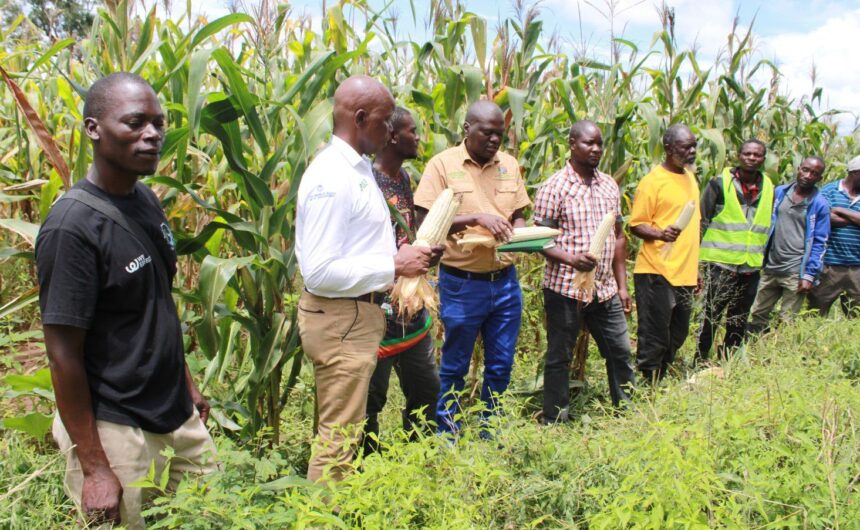
Farmers in Mchimadzi Agricultural Camp, Nyimba District, participated in a farmer-to-farmer exposure visit designed to promote Climate-Smart Agriculture (CSA) practices. The event was hosted by lead farmer Charles Tembo, who has successfully implemented CSA techniques such as ripping and agroforestry under the Eastern Province Jurisdictional Sustainable Landscape Programme (EP-JSLP). These practices aim to improve soil health, increase crop productivity, and promote sustainable land management. By sharing his experience with fellow farmers, Mr. Tembo provided a practical demonstration of how CSA can enhance farm resilience against climate variability. His initiative reflects a growing trend in Zambia toward sustainable agriculture that balances productivity with environmental stewardship.
Mr. Tembo has cultivated approximately 10 hectares of maize, soya beans, and other crops using ripping, which loosens compacted soil to enhance water infiltration and root development. Agroforestry practices he employs integrate tree planting with crops, improving soil fertility, reducing erosion, and supporting carbon retention. Hosting the exposure visit, Mr. Tembo highlighted that seeing peers embrace sustainable farming methods is motivating and encourages broader adoption of CSA technologies. He acknowledged the technical and financial support from the Ministry of Agriculture and the EP-JSLP programme, which is funded by the World Bank and implemented in partnership with Community Markets for Conservation (COMACO) and BioCarbon Partners (BCP). The event demonstrated the value of hands-on learning and knowledge sharing among farmers.
Officials from the Ministry of Agriculture attended the visit to emphasize the importance of CSA in the region. Kelvin Chinama stated that exposure visits help farmers understand how climate-smart practices conserve soil, boost productivity, and integrate agroforestry for carbon retention. Mwaaba Lubasi revealed that around 60 percent of lead and follower farmers in Nyimba District have already adopted CSA techniques under the EP-JSLP initiative. Senior Agricultural Officer Faindani Nyirenda, EP-JSLP Communications Officer Creavat Chituta, and representatives from local leadership also attended, reinforcing government and community support for sustainable agriculture. Their presence signaled institutional commitment to scaling CSA adoption across the district.
The farmer-to-farmer exposure initiative focuses on strengthening peer learning and knowledge transfer within the farming community. By observing successful practices in real-world settings, follower farmers gain practical insights that improve decision-making on their own farms. These visits also foster collaboration and exchange of ideas, helping farmers collectively address challenges such as soil degradation, unpredictable rainfall, and crop pests. CSA practices like ripping and agroforestry not only improve productivity but also contribute to climate resilience and long-term sustainability. Programs like EP-JSLP serve as crucial platforms for building local capacity, connecting farmers with technical resources, and encouraging environmentally responsible farming.
The Mchimadzi exposure visit underscores the potential of farmer-led initiatives to transform agricultural practices in Zambia. By highlighting practical applications of CSA, lead farmers inspire wider adoption and demonstrate tangible benefits for crop yields and soil conservation. Support from government and international partners strengthens these efforts, ensuring that climate-smart approaches reach more communities. The event reinforces the idea that sustainable agriculture depends on knowledge sharing, innovation, and collaboration among stakeholders. With continued engagement and peer learning, Nyimba District is positioned to advance food security, enhance farm resilience, and contribute to environmental sustainability.