




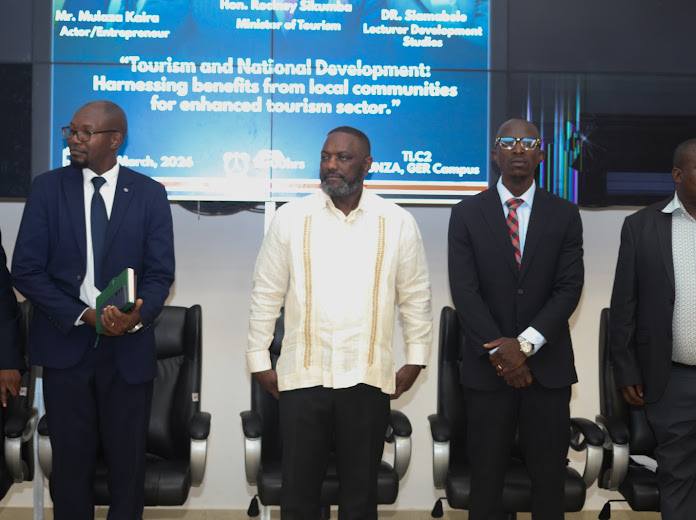
Zambia’s tourism sector continues to gain momentum, but government leaders insist that its long term success depends heavily on the active involvement of local communities. Minister of Tourism Rodney M. Sikumba recently reinforced this message during a Public Lecture at the University of Zambia titled “Tourism and National Development: Harnessing Benefits from Local Communities for an Enhanced Tourism Sector.” The minister explained that communities living around major tourism destinations must not only witness the growth of the sector but must also benefit directly from it. According to Sikumba, tourism development should translate into improved livelihoods, stronger local economies and better opportunities for people who safeguard Zambia’s natural and cultural heritage. His remarks reflected the government’s broader commitment to ensuring that tourism growth remains inclusive and sustainable.
During his lecture, Sikumba shared recent data demonstrating the significant progress Zambia’s tourism sector has made over the past few years. International tourist arrivals increased from 554,290 in 2021 to more than 2.2 million visitors in 2025, showing strong recovery and renewed global interest in Zambia as a travel destination. Domestic tourism has also expanded considerably, with visits to national parks, museums and heritage sites rising from 235,392 to 566,523 within the same period. The minister explained that these numbers indicate growing confidence in Zambia’s tourism potential. He emphasized that sustaining this momentum requires a development model that integrates communities directly into the tourism value chain. In his view, tourism growth should strengthen both the national economy and the well being of local populations.
Sikumba also highlighted the policy framework guiding the development of Zambia’s tourism industry. Government initiatives are aligned with Vision 2030, the Eighth National Development Plan and the Tourism Master Plan covering the period from 2018 to 2038. These policies aim to position tourism as a major contributor to national development by encouraging investment, improving infrastructure and strengthening community participation. By focusing on inclusive growth, the government hopes to ensure that tourism opportunities reach rural communities located near wildlife areas, cultural heritage sites and other attractions. The minister stressed that sustainable tourism development requires clear policies that balance economic expansion with environmental protection and community empowerment.
Local communities also play a critical role in wildlife conservation and environmental protection across Zambia’s tourism landscape. Sikumba pointed to the Zambia Wildlife Act No. 14 of 2015 and the recently introduced Community Based Natural Resources Management Policy as key frameworks supporting this effort. Through Community Resource Boards, local residents actively participate in conservation activities, anti poaching operations and strategies to manage human wildlife conflict. The number of these boards has grown from 58 in 2021 to 85 in 2025, reflecting increased community engagement in protecting natural resources. Government support has also expanded, with funding rising from ZMW 9.6 million to ZMW 22.3 million during the same period to strengthen these structures.
Beyond conservation, communities contribute significantly to Zambia’s tourism identity through culture and heritage. Traditional ceremonies continue to draw both domestic and international tourists while celebrating the country’s cultural diversity. Events such as the Nc’wala Ceremony, Kuomboka Ceremony, Ukusefya Pa Ng’wena Ceremony and Umutomboko Ceremony showcase local traditions and provide opportunities for communities to benefit economically from cultural tourism. Sikumba explained that these cultural events are powerful tools for promoting Zambia’s national identity while supporting tourism marketing efforts. He encouraged citizens to support domestic tourism through the “Take a Holiday Yamu Loko” campaign and to promote the national branding initiative “Zambia Moves You,” launched by President Hakainde Hichilema.
The minister also called on universities and research institutions to strengthen their role in tourism development through research, innovation and training. Academic institutions can help generate ideas that improve tourism management, conservation strategies and community based business models. Sikumba emphasized that communities are the custodians of Zambia’s landscapes, traditions and heritage, and therefore must play a central role in shaping the sector’s future. He stressed that government does not want communities to remain passive observers while others benefit from the resources that belong to them. Instead, communities should become owners, partners and innovators within the tourism industry.
As Zambia’s tourism sector continues to expand, the government sees community involvement as a cornerstone of long term sustainability. By ensuring that local populations participate in conservation, cultural tourism and economic opportunities, the country can build a tourism industry that benefits everyone. Sikumba concluded by urging collaboration between government, academic institutions and industry stakeholders to accelerate tourism transformation. According to the minister, strengthening the tourism sector will ultimately contribute to broader national development and economic growth. With communities placed at the center of tourism strategies, Zambia is positioning itself to build a more inclusive and resilient tourism industry for the future.