






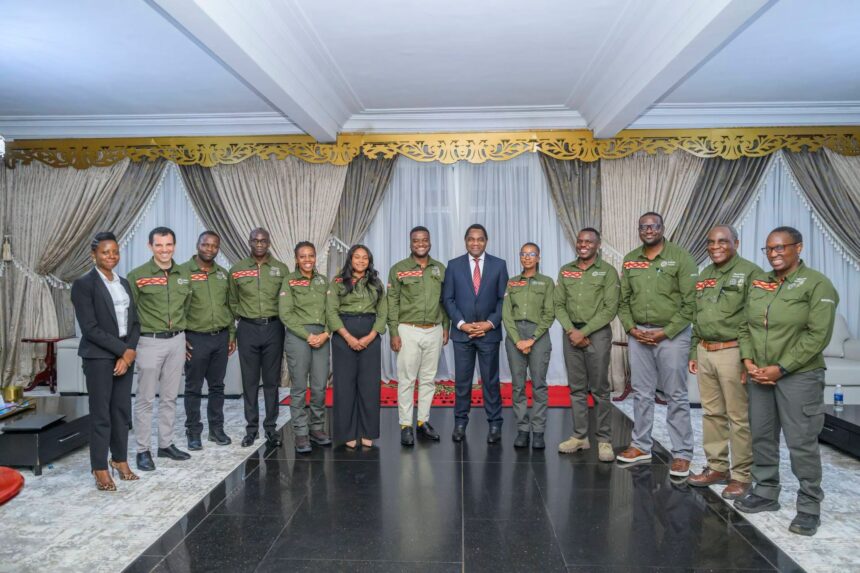
Zambian President Hakainde Hichilema has reaffirmed his government’s commitment to increasing mining production, attracting investment and creating jobs following a meeting with the KoBold team at State House. The team presented on advanced mining exploration science, highlighting the potential of technology to help identify and develop Zambia’s mineral resources. The engagement reflects the government’s continued focus on strengthening the mining sector as a key driver of economic growth under the Grow Zambia agenda. Hichilema also stressed that mining licences must be used productively rather than held for speculative purposes. His message reinforces the government’s position that investment and mineral development should translate into tangible economic benefits for the country and its people.
The meeting with KoBold focused on the role of advanced scientific methods and technology in unlocking Zambia’s mineral potential. Modern mineral exploration can use geological data, computational tools and other scientific techniques to help identify areas that may contain valuable mineral deposits. These methods can support exploration teams in assessing promising locations and deciding where further investigations may be worthwhile. Although exploration results require detailed verification before a deposit can be developed commercially, improved technology can help companies make more informed decisions. For Zambia, greater use of advanced exploration methods could support efforts to expand mineral discovery and strengthen the country’s position as a destination for mining investment.
Hichilema said the engagement supported his administration’s commitment to increasing mining production and ensuring that the sector contributes more substantially to national development. Mining remains an important part of Zambia’s economy, particularly because of the country’s copper resources and the wider opportunities associated with mineral exploration and extraction. Expanding production can generate export earnings, create employment and support businesses that supply equipment, transport, engineering and other services to mining companies. However, achieving these benefits requires investment, reliable infrastructure, effective regulation and responsible management of mineral resources. The government’s engagement with technology-focused mining teams reflects an interest in identifying practical ways to support exploration and production while strengthening the sector’s contribution to economic growth.
The President also emphasised that mining is central to the Grow Zambia agenda, which places economic development and increased productive activity among the government’s priorities. He said his administration had worked to resolve historical challenges that constrained the mining industry, arguing that obstacles should not prevent development and investment. A stable and predictable operating environment can help mining companies make long-term investment decisions, particularly because mineral exploration and mine development often require substantial capital and years of planning. Addressing delays and uncertainty can also help projects move from exploration to development when commercial deposits are confirmed and the necessary approvals are secured. The government’s stated position is that Zambia must create conditions that encourage serious investors to commit resources and expand productive activity.
Hichilema also delivered a firm message on the management of mining licences, warning that the government would not encourage the hoarding of licences for speculative purposes. Mining licences provide rights under the country’s legal and regulatory framework, but their value to the wider economy depends partly on whether they support meaningful exploration and development. When licence holders fail to advance legitimate projects, potentially valuable mineral areas may remain undeveloped while investment and employment opportunities are delayed. The President made the government’s position clear with the phrase, “use it or lose it,” signalling that licences should serve productive purposes rather than simply be held in anticipation of future gains. The statement places renewed emphasis on accountability among licence holders and the need to ensure that mineral rights contribute to Zambia’s economic objectives.
The policy message could have important implications for companies and individuals holding mining licences in Zambia. Investors may need to demonstrate that their licences are linked to genuine exploration plans, development activity or other commitments consistent with the applicable legal requirements. At the same time, clear rules and fair procedures will be important in determining how licence holders are assessed and what action may follow when obligations are not met. Responsible investors generally benefit from a regulatory environment that rewards productive activity while providing certainty about their rights and responsibilities. Any implementation of the President’s position will need to follow the relevant mining laws and regulatory processes, rather than relying on the statement alone.
KoBold’s presentation on advanced mining exploration science also highlights the growing role of technology in the search for mineral resources. Exploration companies increasingly use large geological datasets and computational analysis to help identify patterns that may point to mineral deposits. These approaches can help researchers narrow their search areas and guide further fieldwork, sampling and drilling. Technology does not guarantee the discovery of commercially viable minerals, since geological conditions, deposit quality, development costs and other factors still determine whether a project can proceed. However, combining scientific analysis with field investigation can improve the information available to exploration teams and potentially support more efficient decisions about where to invest.
For Zambia, improving mineral exploration could support broader ambitions to expand copper production and develop other mineral resources where commercially viable deposits exist. Increased mining activity can create opportunities for local employment, contractors, transport companies and suppliers of goods and services. It can also generate public revenue through the applicable taxes, royalties and other payments, helping the government finance national development priorities. These benefits depend on projects becoming commercially productive and operating within appropriate environmental, safety and regulatory standards. The country’s challenge is therefore not only to attract exploration companies, but also to convert successful discoveries into responsible mining operations that deliver lasting value to local communities and the national economy.
Hichilema concluded his message by reaffirming his determination to attract investment, increase production, create jobs and deliver prosperity for Zambians. The meeting with KoBold fits into this broader ambition by bringing advanced exploration science into discussions about the future of the country’s mining industry. The President’s remarks also make clear that investment must be accompanied by productive use of mineral rights and a willingness to develop resources rather than hold them indefinitely for speculative gain. For mining companies, the message is that Zambia wants investment that produces measurable economic activity and supports national development. As the government pursues its Grow Zambia agenda, the combination of technology-driven exploration, productive mining licences and sustained investment will remain important to the country’s efforts to expand its mineral sector and create economic opportunities for its people.