




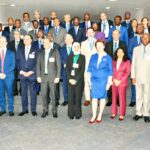



Young African journalists have been urged to use their profession to tell Africa’s stories accurately, highlight the continent’s challenges and showcase its achievements in a professional and ethical manner. The call was made during the 63rd Training Course for Young African Journalists, held in Cairo, Egypt, under the “Mahfouz Al-Ansari Session.” The three-week programme brought together young media practitioners from different parts of the continent to strengthen their professional knowledge and exchange experiences. It also provided an opportunity for participants to examine developments affecting journalism and the wider role of the media in African societies. The training highlighted the responsibility carried by journalists when reporting on issues that shape public understanding of the continent.
The programme was organised by the Union of African Journalists (UAJ) in collaboration with Egypt’s Supreme Council for Media Regulation (SCMR). It brought together 18 young journalists from 15 African countries, alongside five Egyptian journalists and three heads of journalists’ unions. The diverse participation created an environment where journalists could share perspectives shaped by different national media landscapes and professional experiences. Participants were able to learn from one another while examining common challenges facing journalists across Africa. The presence of journalists and union leaders also strengthened opportunities for professional networking and future cooperation within the African media sector.
UAJ President Mohammad Fayez Farahat encouraged the participating journalists to take pride in their profession and recognise journalism as a noble field with an important role in society. His message placed emphasis on the responsibility journalists have to provide reliable information and contribute meaningfully to public discourse. Journalism plays an important role in helping communities understand political, economic, social and cultural developments that affect their daily lives. Young journalists therefore need to approach their work with professionalism, independence and a strong commitment to ethical reporting. Building these qualities early in their careers can help strengthen public confidence in the media and improve the quality of information available to audiences.
The training also provided a platform for participants to discuss emerging developments and challenges affecting journalism in Africa. The media environment continues to change as journalists adapt to digital platforms, rapidly changing audience habits and the growing demand for immediate information. These developments create opportunities for journalists to reach wider audiences but also increase the need for careful verification and responsible reporting. Young journalists must be able to distinguish credible information from unverified claims while maintaining professional standards across traditional and digital media platforms. The discussions during the programme gave participants an opportunity to consider these challenges while learning from the experiences of journalists working in different African countries.
A key focus of the programme was the importance of telling Africa’s stories accurately and responsibly. African journalists play a central role in documenting developments within their communities and ensuring that local experiences receive appropriate attention. Reporting should not focus only on the challenges facing the continent but should also highlight progress, innovation, achievements and positive developments. Balanced journalism can provide audiences with a more complete understanding of Africa and its diverse societies. Participants were therefore encouraged to return to their respective countries with a renewed commitment to reporting stories that reflect both the realities and achievements of their communities.
The programme also promoted cultural exchange among the participating journalists. Bringing together media practitioners from 15 African countries allowed participants to gain a better understanding of different cultures, professional environments and approaches to journalism. Sharing experiences can help journalists identify common challenges while also learning how colleagues in other countries respond to similar situations. Cultural exchange can further strengthen mutual understanding among African media professionals and encourage greater collaboration across national borders. These connections can remain valuable beyond the training programme as journalists continue to develop their careers and contribute to the continent’s media industry.
Professional networking was another important element of the three-week programme. Journalism can benefit from strong professional relationships that allow reporters, editors, media organisations and journalists’ unions to exchange knowledge and opportunities. The participation of young journalists alongside experienced union leaders created space for mentorship and meaningful professional interaction. Such networks can help emerging journalists gain access to new perspectives while encouraging cooperation on issues affecting the media across Africa. Strengthening these relationships can also contribute to a more connected African journalism community that is better equipped to address shared professional challenges.
The call for ethical journalism was particularly important because journalists have significant influence over how audiences understand events and issues. Accurate reporting requires journalists to verify information, provide context and avoid deliberately misleading audiences. Ethical journalism also requires professionals to consider the potential impact of their reporting on individuals, communities and society. Young journalists entering an increasingly fast-paced media environment must maintain these standards even when there is pressure to publish quickly. The training reinforced the need for professional responsibility as journalists continue to navigate changing technologies and evolving expectations from audiences.
Participants were encouraged to return home and apply the knowledge and experience gained during the programme. The expectation is that the lessons from the training will extend beyond the participants themselves and contribute to stronger journalism in their respective countries. Young journalists can use the skills gained during the programme to improve their reporting, strengthen their research and engage more effectively with the communities they serve. They were also encouraged to continue reporting Africa’s challenges while giving appropriate attention to its successes and achievements. This balanced approach can help produce journalism that informs audiences without reducing the continent’s story to a single narrative.
The training concluded with the presentation of certificates to the participating young African journalists in recognition of their successful completion of the three-week programme. The certificates marked the completion of an intensive period of learning, discussion and professional exchange. More importantly, the programme gave the journalists an opportunity to reflect on their responsibilities as media practitioners and storytellers. Their next challenge will be to translate the knowledge gained in Cairo into stronger reporting and ethical journalism in their respective countries. The 63rd Training Course for Young African Journalists has therefore reinforced the importance of investing in the next generation of African media professionals who can tell the continent’s stories with accuracy, balance, professionalism and integrity.