







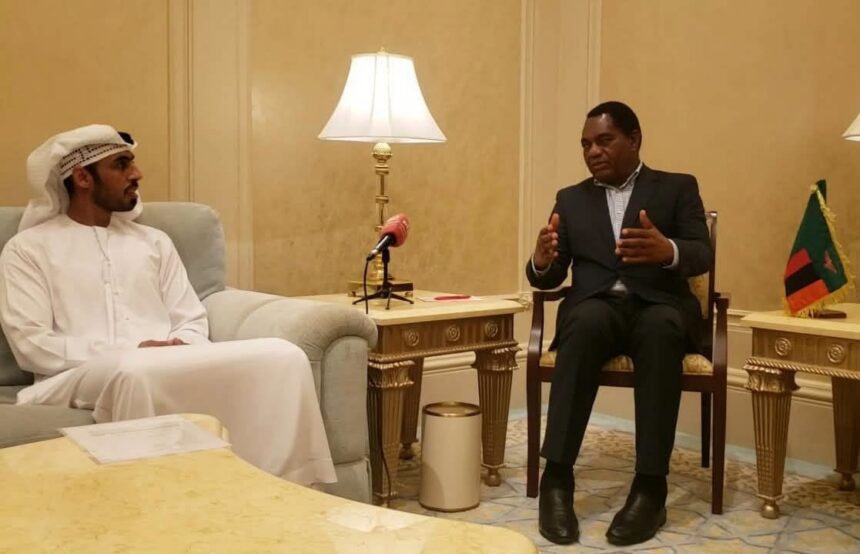
President Hakainde Hichilema has placed copper production at the centre of Zambia’s economic growth strategy as his administration advances the Grow Zambia agenda. During a working visit to Abu Dhabi, the President met Ali Rashed Alrashdi, Chief Executive Officer of International Resources Holding, or IRH, which owns Mopani Copper Mines together with Zambia’s state-owned ZCCM-IH. The meeting focused on the future of Mopani Copper Mines and its role in expanding Zambia’s copper production. Hichilema said raising national copper output to three million tonnes a year is central to the government’s economic agenda. The discussions also highlighted the need for mining companies to ensure that Zambians receive greater opportunities and economic benefits from the country’s mineral resources.
The three million tonne copper target forms part of the wider Grow Zambia agenda announced by President Hichilema at the start of his second term. The economic programme includes ambitious production targets across several sectors, with copper identified as a major driver of growth, investment, employment and government revenue. Zambia is one of Africa’s major copper producers and the mining industry remains an important part of the national economy. Reaching three million tonnes of annual copper production would therefore require substantial increases across several major mining operations. Mopani Copper Mines is expected to play an important role in that expansion because of its established mining operations, mineral resources and existing infrastructure on the Copperbelt.
Mopani Copper Mines has a long history in Zambia’s mining industry and operates in the Copperbelt, one of the country’s most important mining regions. Its ownership structure changed significantly in 2024 when IRH became the strategic partner in the mine, with ZCCM-IH retaining its interest. The partnership has placed renewed attention on investment, production growth and the modernisation of Mopani’s operations. Zambia’s Ministry of Mines and Mineral Development has previously reported improvements at Mopani, including increased employment, higher ore production and a larger share of local suppliers. These developments form part of the broader effort to restore production capacity and position the mine for further expansion.
President Hichilema’s meeting with the IRH chief executive also reflects the government’s focus on translating mining investment into wider economic participation. Increasing copper production alone does not automatically ensure that local businesses and communities capture a larger share of the economic value created by mining. Mining operations require goods, services, equipment, transport, engineering, construction, professional services and other inputs that can create opportunities for Zambian companies. The government therefore continues to emphasise the implementation of Zambia’s Local Content law. The objective is to increase the participation of Zambian citizens and businesses throughout the mining value chain while strengthening domestic economic activity.
Local content has become an increasingly important part of Zambia’s mining policy as the country seeks to expand copper production. Mopani has already introduced programmes aimed at developing local suppliers and strengthening participation by small and medium-sized enterprises. In 2026, the company announced plans to expand its localised Supplier Development Programme and onboard additional local companies into its supply chain. Such initiatives can help businesses build the capacity, technical standards and financial systems needed to compete for mining-related contracts. The wider significance is that increased mining production can generate economic activity beyond the mine itself when local companies are able to supply a meaningful share of the goods and services required by mining operations.
The government’s emphasis on local content also connects the copper production target with employment and enterprise development. Large mining projects can create direct jobs within mines while also supporting indirect employment among suppliers, contractors and service providers. Local procurement can keep more mining-related expenditure within Zambia and create opportunities for businesses to invest, hire workers and develop technical capabilities. However, achieving these outcomes depends on consistent implementation of the law, access to finance, reliable infrastructure and the ability of local companies to meet the operational requirements of mining companies. The policy challenge is therefore not simply to increase the number of local suppliers but to build a competitive Zambian mining supply chain capable of supporting a larger industry.
Mopani’s production expansion will also depend on continued investment and exploration. Zambia’s three million tonne target requires existing mines to improve output while new mineral resources and additional mining capacity are developed. President Hichilema has previously urged mining companies to explore their licence areas and identify additional resources that could support higher production. At the Abu Dhabi meeting, the focus on Mopani’s contribution to the national copper target reinforced the importance of unlocking the mine’s production potential. The company has extensive mining assets and its future performance will depend on investment decisions, operational efficiency, exploration results and the availability of infrastructure and other inputs required for mining.
The role of IRH is significant because the company is responsible for supporting Mopani’s investment and growth alongside ZCCM-IH. The partnership was established during a period when Zambia was seeking to revitalise major mining assets and attract capital into the sector. Government officials have previously said that the strategic partnership included a substantial recapitalisation commitment and the settlement of outstanding obligations to suppliers and contractors. Such investment can help mining operations improve equipment, infrastructure and production capacity. The effectiveness of these investments will ultimately be reflected in operational performance, production levels and the economic opportunities generated around the mine.
Zambia’s copper ambitions also come at a time when the global energy transition is supporting long-term demand for copper. Copper is widely used in electrical systems, power infrastructure, construction, telecommunications and technologies associated with electrification. This gives Zambia an opportunity to strengthen its position as a major copper-producing country, although higher production requires sustained investment and careful management of the mining sector. The country must balance production growth with environmental responsibilities, worker safety, community interests and responsible management of mineral resources. For the Grow Zambia agenda, the challenge is therefore to increase copper output while ensuring that the resulting economic activity has a measurable impact on Zambian households and businesses.
President Hichilema’s message in Abu Dhabi placed this wider objective directly on the agenda of discussions with one of the companies connected to a major Zambian copper asset. His government wants Mopani to contribute to the national three million tonne production ambition while ensuring that the benefits of mining extend beyond shareholders and investors. The emphasis on local content indicates that the administration sees mining as more than a source of export earnings and foreign investment. It also views the sector as a potential platform for developing local businesses, creating employment and expanding domestic industrial capacity. This approach makes the relationship between mining companies, government and local suppliers an important part of Zambia’s economic strategy.
The meeting also demonstrates the importance of direct engagement between the Zambian government and international investors involved in the mining sector. Mopani represents a major national asset, while IRH brings international capital and investment capacity to the partnership with ZCCM-IH. Continued dialogue can help address issues related to production, investment, regulation and local participation. For investors, a predictable policy environment and clear regulatory framework remain important considerations when making long-term mining decisions. For the Zambian government, maintaining investment while ensuring that national laws and economic objectives are respected remains a central policy concern.
The three million tonne copper ambition is a significant target and will require coordinated action across Zambia’s mining industry. Mopani can contribute through increased production, exploration, investment and stronger participation by Zambian suppliers. Other major copper producers will also need to expand their operations if the country is to reach the national target. Government policy, mining investment, infrastructure development and local enterprise participation will therefore need to work together. The outcome will depend not only on stated ambitions but also on whether production capacity, investment commitments and local economic participation continue to increase over the coming years.
President Hichilema’s Abu Dhabi engagement with Ali Rashed Alrashdi places Mopani Copper Mines firmly within Zambia’s wider economic growth programme. The discussion combined two priorities, increasing copper production and ensuring that more Zambians benefit from mining activity. The three million tonne annual copper target provides a clear measure of the production ambition under the Grow Zambia agenda, while the Local Content law provides a framework for increasing domestic participation in the sector. Mopani’s future investment and production performance will therefore have implications that extend beyond the mine itself. As Zambia seeks to expand its copper industry, the central question will be whether increased mineral production can translate into sustained investment, stronger local businesses, more employment and broader economic benefits for the Zambian people.