






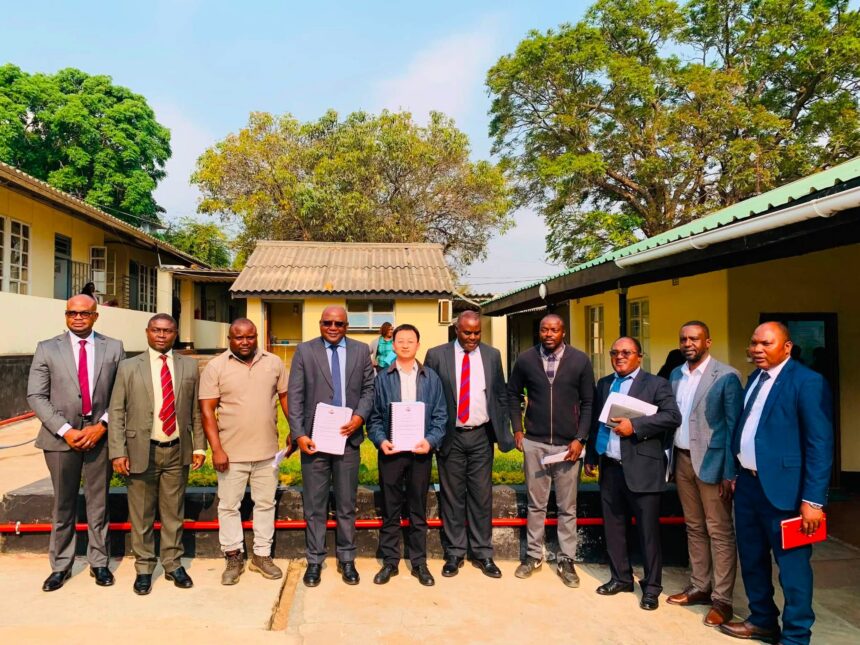
The Road Development Agency (RDA) has signed a K177.6 million contract to design and expand the Shimabala Toll Plaza along the Lusaka-Kafue Road, marking an important investment in Zambia’s transport infrastructure. The project aims to ease congestion, reduce waiting times and improve traffic flow along the Southern Corridor, one of the country’s most important routes for passenger and commercial transport. The nine-month design and build contract has been awarded to China Railway Seven Group Limited in a joint venture with Grand Seven Limited. The project will start with three months of design and review before moving into six months of construction. Once completed, the expanded facility is expected to improve the movement of vehicles, strengthen tolling operations and support the efficient transportation of people and goods.
Speaking during the contract signing ceremony, RDA Director and Chief Executive Officer Eng. Nelson Chuma described the Shimabala Toll Plaza expansion as a significant step towards modernising Zambia’s road infrastructure. He said the project would improve the efficiency of one of the country’s key tolling facilities while responding to the increasing pressure created by growing traffic volumes. The Shimabala Toll Plaza was commissioned in 2018, when traffic levels were considerably lower than they are today. Over the years, rising vehicle numbers have contributed to congestion, delays and longer waiting times for motorists using the facility. The expansion is therefore designed to address an infrastructure challenge that has become increasingly important for road users and the wider economy.
Eng. Chuma explained that the original configuration of three tolling lanes in each direction, combined with limited approach roads, had come under increasing pressure as traffic volumes grew. The existing layout was designed for traffic conditions that have since changed significantly. As more motorists and commercial vehicles use the Lusaka-Kafue Road, the capacity of the toll plaza has struggled to keep pace with demand. Queues at the facility can create delays that extend beyond the toll plaza and affect the efficiency of the wider Southern Corridor. Increasing the number of lanes and extending the approach roads are intended to create more space for vehicles and improve the overall movement of traffic through the facility.
The expansion will involve increasing the number of tolling lanes and extending the approach roads on both sides of the plaza. These changes are expected to improve traffic flow by giving vehicles more space to approach and pass through the tolling facility. The project is also expected to reduce waiting times for motorists and improve the efficiency of revenue collection. Faster toll processing can benefit private motorists as well as commercial operators who depend on predictable travel times to move goods between major economic centres. The improvements will therefore have significance beyond the physical expansion of the toll plaza because they could contribute to a more efficient transport system along the corridor.
The nine-month contract has been structured to allow sufficient time for design development, review and construction. China Railway Seven Group Limited and Grand Seven Limited will spend the first three months undertaking the design work before submitting the designs to the RDA for review and approval. Construction will then take place over the following six months once the designs have received the required approval. This phased approach allows the RDA to assess the proposed works before physical construction begins. Eng. Chuma has urged the contractor to mobilise promptly, meet the agreed timelines and maintain high standards of quality and safety while delivering the project within budget and according to specifications.
The RDA has also emphasised the importance of oversight and value for money throughout the project. Eng. Chuma said the agency’s team would provide rigorous supervision to ensure that the investment delivers the expected benefits. Strong project oversight will be important because the expansion must be completed while maintaining the operation of a busy transport corridor. Construction activities will need to be carefully managed to minimise disruption to motorists and ensure that safety remains a priority. The RDA’s approach reflects the need to balance infrastructure development with the immediate requirements of road users who rely on the Lusaka-Kafue Road every day.
National Road Fund Agency Chief Executive Officer Mr Daniel Mtonga said the expansion would provide much-needed relief to motorists using the Lusaka-Kafue Road. He explained that when the Shimabala Toll Plaza was commissioned in 2018, its designed traffic capacity was approximately 7,500 vehicles per day. At the time, actual traffic volumes stood at around 5,000 vehicles per day, leaving capacity for future growth. Traffic volumes have since increased beyond the facility’s original capacity, creating operational challenges for the agency responsible for managing the toll facility. The expansion is therefore intended to bring the infrastructure closer to the current realities of traffic demand.
The increase in traffic also highlights the need for Zambia to combine physical infrastructure upgrades with new technology. Mr Mtonga disclosed that the National Road Fund Agency plans to pilot an express tolling system using Radio Frequency Identification technology. Shimabala is expected to be among the pilot toll stations for the new system. Under the proposed arrangement, motorists would use an electronic tag that can be detected by a transponder installed at the toll station. This would allow vehicles using the express tolling system to pass without stopping, potentially reducing delays and improving the overall efficiency of toll collection.
The planned RFID system could become an important component of the modernisation of Zambia’s tolling network. Traditional toll collection can require vehicles to stop or slow down significantly while payments are processed, particularly when traffic volumes are high. An electronic system that identifies vehicles automatically could reduce the time required for each transaction. The Shimabala expansion will provide an opportunity to dedicate additional lanes to the new technology, allowing the physical infrastructure and digital tolling system to work together. If the pilot performs effectively, similar technology could potentially support improved traffic management at other busy toll plazas across the country.
Road Transport and Safety Agency Director and Chief Executive Officer Eng. Amon Mweemba welcomed the project and described Shimabala as a critical gateway to Zambia’s Southern Corridor. The corridor connects Lusaka with Livingstone and provides important links to major markets in Botswana, Zimbabwe and South Africa. It also supports tourism, regional trade and the movement of commercial goods across national borders. Congestion at a strategic point on such a corridor can have consequences for businesses and travellers that extend well beyond the immediate area. Improving the capacity of Shimabala Toll Plaza could therefore strengthen the efficiency of an important route connecting Zambia to regional markets.
Eng. Mweemba noted that congestion at the toll plaza had become a major traffic management challenge, with motorists sometimes spending hours in queues because of inadequate capacity. He also pointed to continued growth in the country’s vehicle population, particularly during the first half of 2026. Rising vehicle ownership and increased movement of commercial traffic place additional pressure on road infrastructure and require authorities to plan for both current and future demand. The introduction of modern drive-through tolling technology could help address some of these pressures by reducing the time vehicles spend at toll stations. RTSA has also pledged to work closely with the RDA and the contractor to manage traffic during construction and keep the road operational throughout the expansion works.
The involvement of RTSA will be important because construction at a busy toll plaza can create temporary traffic management challenges. Work zones, changes to road layouts and construction vehicles can affect traffic flow if they are not carefully coordinated. Maintaining access along the Lusaka-Kafue Road will be essential because the route supports significant passenger and commercial traffic. Cooperation between RTSA, RDA and the contractor can help reduce disruption while ensuring that construction activities meet safety requirements. Effective traffic management during the six-month construction phase will also help protect motorists, workers and other road users.
China Railway Seven Group Chief Executive Officer Roy Guo expressed gratitude to the Zambian Government, RDA and other partners for entrusting the company with the project. He described the contract as more than a contractual obligation, saying it also reflects the growing partnership between Zambia and China in infrastructure development. China Railway Seven Group has undertaken several infrastructure projects in Zambia and has expressed its intention to contribute further to the country’s development. The Shimabala project will provide another opportunity for the company to apply its technical capabilities to a major transport infrastructure requirement. Its performance will be important in determining whether the project is completed within the agreed timeframe, budget and quality standards.
The Shimabala Toll Plaza expansion also has implications for Zambia’s broader economic development. Efficient transport infrastructure helps businesses move goods between production centres, markets and border points with greater predictability. Reduced delays can lower some of the costs associated with fuel consumption, vehicle operation and extended travel times. For regional traders and freight operators, improvements along the Southern Corridor could support more reliable connections to markets in neighbouring countries. Better road infrastructure can also support tourism by improving access between major cities and destinations along the corridor.
The project’s combination of physical expansion and modern tolling technology represents a broader shift towards improving efficiency across Zambia’s road network. Increasing tolling capacity can address immediate congestion, while RFID-based express tolling could help reduce processing times in the longer term. Together, these measures could improve the experience of motorists and strengthen the operational performance of toll facilities. The success of the approach will depend on effective construction, reliable technology, appropriate traffic management and continued investment in road infrastructure. Authorities will also need to monitor the system after implementation to determine whether it delivers the expected reductions in congestion and travel time.
The K177.6 million Shimabala Toll Plaza expansion is a significant infrastructure project that responds directly to rising traffic volumes and the growing demands placed on the Lusaka-Kafue Road. The nine-month design and build programme provides a defined pathway from design and approval to construction, while the involvement of RDA, NRFA and RTSA brings together the institutions responsible for infrastructure, tolling and road safety. The planned increase in tolling lanes and approach roads should improve traffic capacity, while the introduction of RFID express tolling could provide an additional boost to traffic flow. By addressing both physical capacity and tolling technology, the project has the potential to reduce congestion and improve the movement of people and goods along the Southern Corridor. If delivered within budget, on schedule and to the required standards, the Shimabala Toll Plaza expansion will represent an important step in modernising Zambia’s transport infrastructure and supporting more efficient economic activity.