
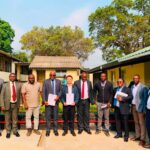

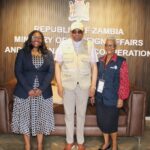


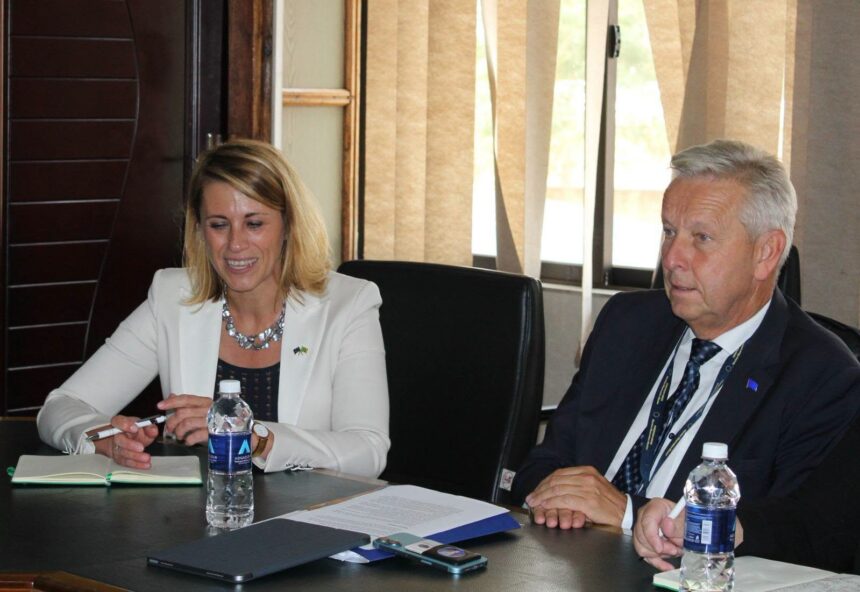
The European Union Election Observation Mission to Zambia has strengthened international engagement with the country’s electoral process after paying a courtesy call on Ms Etambuyu Anamela Gundersen, Permanent Secretary for International Relations and Cooperation at the Ministry of Foreign Affairs and International Cooperation. The delegation visited Charter House in Lusaka as Zambia prepares for the 2026 General Elections. The meeting provided an opportunity for the EU-EOM and the Zambian Government to discuss preparations for the elections and the importance of protecting democratic values. The European Union’s decision to observe the elections also reflects its continued interest in supporting credible electoral processes in Zambia. The engagement comes as national institutions, political stakeholders and international observers prepare for an important period in the country’s democratic calendar.
The EU-EOM delegation comprised Members of the European Parliament and was led by Mr Reinhold Lopatka, Head of Delegation of the European Parliament, together with Ms Karolina Stasiak, EU Ambassador to Zambia. Their participation brings international experience to the observation process and creates an opportunity for the European Union to assess Zambia’s electoral environment directly. Election observation missions can provide independent assessments of electoral preparations, political participation and the conduct of voting. They can also help identify areas that may require improvement and provide recommendations for future elections. The presence of the EU-EOM therefore adds another international dimension to the monitoring of Zambia’s 2026 General Elections.
Welcoming the EU-EOM to Zambia, Ms Gundersen said President Hakainde Hichilema had made a firm commitment to ensuring that all Government entities work towards delivering a free, fair and peaceful election. The commitment places emphasis on the responsibility of public institutions to operate within the law and support an electoral environment where citizens can exercise their democratic rights. A peaceful election also requires political parties, candidates, supporters and members of the public to respect the rules governing the electoral process. Government institutions have an important role in maintaining public order while ensuring that citizens can participate in lawful political activities. The engagement with the EU-EOM provides an opportunity for Zambia to communicate these commitments directly to international observers.
Ms Gundersen also highlighted Zambia’s long-standing tradition of peaceful elections and reaffirmed that Government institutions and other stakeholders are working within the law to uphold the country’s democratic values. Maintaining peace remains an important priority as Zambia approaches the 2026 General Elections. Electoral periods can bring heightened political activity, making cooperation among political parties, security agencies, election authorities, civil society organisations and citizens essential. Respect for the law can help reduce tensions and create conditions in which voters can participate without fear or intimidation. Zambia’s record of peaceful elections provides an important foundation as the country prepares for another national electoral process.
The Permanent Secretary expressed appreciation to the European Union Election Observation Mission for accepting Zambia’s invitation to observe the 2026 General Elections. She said the Mission’s participation demonstrates the European Union’s commitment to supporting Zambia’s democracy. International election observation can contribute to public confidence by providing an independent assessment of the electoral process. It also gives observers an opportunity to engage with national institutions and stakeholders before, during and after polling. Zambia’s invitation to international observers demonstrates its willingness to engage with external partners as the country prepares for the elections.
The EU-EOM’s involvement is also important because election observation does not end with the assessment of voting day activities. Observers can examine different aspects of an electoral process and identify issues that may affect the overall credibility and effectiveness of elections. Their assessments can provide useful information for electoral institutions and policymakers when planning future reforms. International observers can also highlight practices that support participation, transparency and accountability. The involvement of the European Union therefore has the potential to contribute to Zambia’s broader efforts to strengthen electoral institutions beyond the 2026 election period.
Ms Gundersen further emphasised that the Government takes recommendations from election observation missions seriously. She explained that these recommendations provide valuable input for strengthening electoral processes and informing subsequent elections. This approach allows Zambia to use lessons from previous electoral experiences when considering improvements to its democratic institutions and procedures. Recommendations can address a wide range of issues, depending on the findings of observers and the circumstances of each election. Giving serious consideration to such recommendations can help national stakeholders identify practical measures that may improve future electoral processes.
The meeting also reaffirmed the long-standing partnership between Zambia and the European Union. The EU-EOM expressed gratitude to the Government of Zambia for inviting the Mission to observe the 2026 General Elections. The relationship between Zambia and the European Union extends across areas of mutual interest, including governance, development and cooperation. Electoral observation provides another platform through which the two sides can engage on democratic governance and institutional development. The Mission’s presence in Zambia therefore forms part of a wider relationship built on continued cooperation between the country and the European Union.
The participation of Members of the European Parliament and the EU Ambassador to Zambia also demonstrates the importance attached to the observation mission. Their engagement with Zambian authorities can help facilitate dialogue on the electoral environment and provide an opportunity to exchange views on democratic governance. The Mission’s work will also depend on engagement with a range of stakeholders involved in the electoral process. These interactions can provide observers with information needed to develop a balanced understanding of the election environment. Such an approach can strengthen the quality and relevance of the Mission’s eventual assessment.
As Zambia moves closer to the 2026 General Elections, the Government’s engagement with international observation missions will remain an important part of the electoral process. The courtesy call by the EU-EOM provided a platform for the Zambian Government to reaffirm its commitment to free, fair and peaceful elections. It also allowed the European Union to express its appreciation for the invitation and reinforce its support for Zambia’s democratic development. The Mission’s observations and recommendations could provide useful guidance for strengthening electoral processes both during the current election cycle and in the future. The engagement at Charter House ultimately reflects Zambia’s continued cooperation with international partners and its stated commitment to protecting democratic values as the country prepares for the 2026 General Elections.