







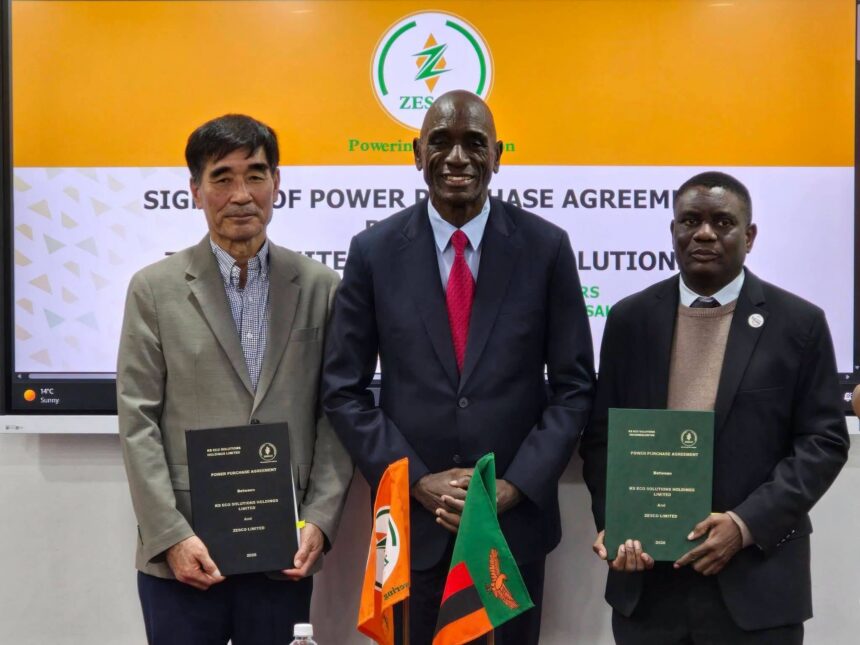
A major step in Zambia’s energy sector has been achieved through a historic Power Purchase Agreement between ZESCO Limited and KS Eco Solutions Holdings Limited for the development of a 500MW solar power project. The agreement marks one of the largest renewable energy commitments in the country’s recent history and reflects a growing shift toward clean energy investment. The signing ceremony was witnessed by the Ministry of Energy, represented by Director Planning and Information Sineva Kambenja on behalf of Permanent Secretary for Electricity Arnold Simwaba. The event signals strong government backing for private sector participation in Zambia’s energy transformation.
The agreement was formally signed by Justin Loongo and Ma Hong-il, reinforcing a partnership built on long-term energy development goals. The project is positioned as a direct outcome of government reforms aimed at opening up the energy sector to more independent power producers. These reforms focus on improving electricity supply stability while attracting foreign investment into large scale infrastructure. The collaboration also highlights confidence in Zambia’s regulatory environment and its ability to support complex energy projects. It further demonstrates a shared commitment to expanding renewable energy capacity in Southern Africa.
The 500MW solar project will include battery energy storage systems designed to strengthen grid reliability and improve power stability across demand cycles. This addition is critical in managing fluctuations in solar generation and ensuring continuous supply during peak consumption periods. The integration of storage technology places the project among modern utility scale renewable developments that prioritize both generation and reliability. It also supports Zambia’s broader efforts to reduce dependence on traditional energy sources. The project is expected to contribute significantly to a more resilient national power infrastructure.
Economic and developmental benefits from the project are expected to be substantial for Zambia. The investment will help diversify the national energy mix by increasing the share of renewable power in the grid. It is also expected to strengthen national energy security by reducing vulnerability to drought related hydropower shortages. In addition, the project is likely to boost renewable energy generation capacity while attracting further foreign direct investment into the sector. These combined effects are expected to support long term economic growth and industrial development.
Diplomatic stakeholders have also highlighted the broader significance of the agreement. Zambia’s Ambassador to the Republic of Korea, Andrew Bwezani Banda, described the project as a defining milestone in bilateral relations between South Korea and Zambia. The partnership is seen as an example of how energy cooperation can strengthen international ties while delivering practical infrastructure outcomes. It also reflects South Korea’s growing role in supporting renewable energy expansion across Africa through strategic investments and technology transfer.
The 500MW solar investment stands as a key development in Zambia’s long term energy roadmap. It aligns with national priorities of expanding clean energy access and ensuring stable electricity supply for households and industries. The combination of large scale solar generation and battery storage is expected to improve grid performance and reduce power interruptions. It also positions Zambia as a stronger player in regional renewable energy development. The project signals a forward looking approach to energy planning that balances sustainability, reliability and economic growth.