







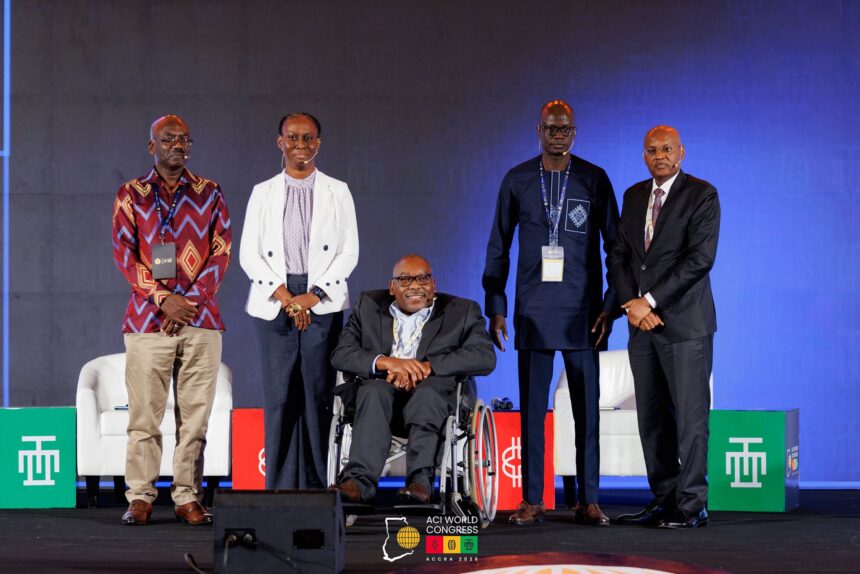
As digital finance continues to reshape economies around the world, Zambia is actively participating in discussions on how emerging technologies can support economic growth while safeguarding financial stability. This was evident at the recently concluded ACI World Congress in Accra, Ghana, where Zambia was represented by Isaac Muhanga, Financial Markets Chief Operations Officer at the Bank of Zambia. He joined senior officials from the central banks of Tanzania, Uganda, and Zimbabwe to discuss the future of stablecoins in Africa and their potential role in transforming financial services across the continent. The discussions focused on practical use cases for stablecoins and how African central banks can develop regulations that support innovation without compromising monetary stability. For Zambia, these conversations are increasingly relevant as the country seeks to modernize its financial sector and strengthen regional trade links.
During the panel discussion, participants were asked to identify the most urgent and practical use case for stablecoins in Africa and explain how central banks should regulate the technology to suit African economic realities. The panelists agreed that cross-border payments and near-instant settlement systems represent the most credible opportunity for stablecoin adoption. Across Africa, businesses and individuals often face high transaction costs, long settlement periods, and limited access to foreign currency when conducting transactions across borders. These challenges are also familiar to many Zambian businesses, particularly those involved in regional trade. Stablecoins have the potential to reduce these barriers by enabling faster and more affordable cross-border transactions.
The discussion highlighted small and medium-sized enterprises as some of the biggest potential beneficiaries of improved cross-border payment systems. In Zambia, SMEs play a vital role in economic growth, employment creation, and trade. However, many entrepreneurs face difficulties accessing affordable foreign exchange and managing the costs associated with international transactions. Stablecoins could help address these challenges by providing alternative payment channels that improve efficiency and reduce costs. This would allow businesses to expand their reach and participate more effectively in regional and international markets.
Panelists also noted that many African countries, including Zambia, have already made progress in developing domestic digital payment systems. Existing electronic money platforms and payment infrastructure continue to improve financial inclusion and interoperability within national borders. However, challenges remain when transactions move beyond domestic systems and into regional or international markets. It is in these areas where stablecoins may offer the greatest value. Rather than replacing existing systems, stablecoins could complement them by providing solutions where traditional payment networks face limitations.
Another important issue discussed was the growing interest in fiat-backed stablecoins. Panelists observed that some stablecoins function in ways that are similar to mobile money platforms that many Africans already use daily. However, the impact of these digital assets depends largely on what currency backs them. Stablecoins linked to domestic currencies may have different implications compared to those backed by major international currencies such as the United States dollar. For countries like Zambia, this distinction is important because it influences how stablecoins affect monetary policy, financial stability, and public confidence in the national currency.
The panel also raised concerns about the risks associated with widespread stablecoin adoption. One of the major concerns for central banks is the possibility of digital dollarization, where people choose to hold foreign-backed stablecoins instead of local currencies. Such a trend could weaken the effectiveness of monetary policy and reduce central banks’ ability to manage inflation, interest rates, and overall economic stability. For Zambia and many other African countries, maintaining confidence in domestic currencies remains a key priority. The panel emphasized that these risks must be carefully managed through appropriate regulatory measures.
To address these concerns, participants recommended strong safeguards for stablecoin issuers and operators. These include maintaining secure reserves to back issued stablecoins, guaranteeing users the right to redeem their holdings, and introducing measures that limit the risk of replacing domestic currencies. The panel stressed that regulatory frameworks should explicitly address issues related to monetary sovereignty before stablecoins are adopted on a larger scale. Such safeguards would help protect consumers while ensuring that innovation does not undermine financial stability. Effective regulation was viewed as a critical requirement for building trust in emerging financial technologies.
The discussion also focused on broader financial technology and banking innovation. Rather than restricting new technologies, panelists encouraged central banks to adopt a supervisory approach that allows innovation to develop within clear regulatory boundaries. They argued that outright bans often prevent countries from benefiting from technological advancements that could improve efficiency and financial inclusion. For Zambia, this approach aligns with ongoing efforts to strengthen the financial sector through innovation while maintaining robust oversight. A balanced regulatory framework can encourage investment and technological development while protecting consumers and the broader economy.
The overall consensus from the panel was that African central banks should begin by testing stablecoins in cross-border settlement scenarios that complement existing domestic payment systems. This approach would allow regulators to evaluate the technology’s benefits while limiting potential risks. Pilot projects could help demonstrate whether stablecoins genuinely improve transaction speed, reduce costs, and support trade across borders. For Zambia, such innovations could contribute to greater regional economic integration and improve opportunities for businesses engaged in international commerce. The discussions at the ACI World Congress highlighted the importance of carefully managed innovation and reaffirmed the need for African countries to work together in shaping the future of digital finance.