






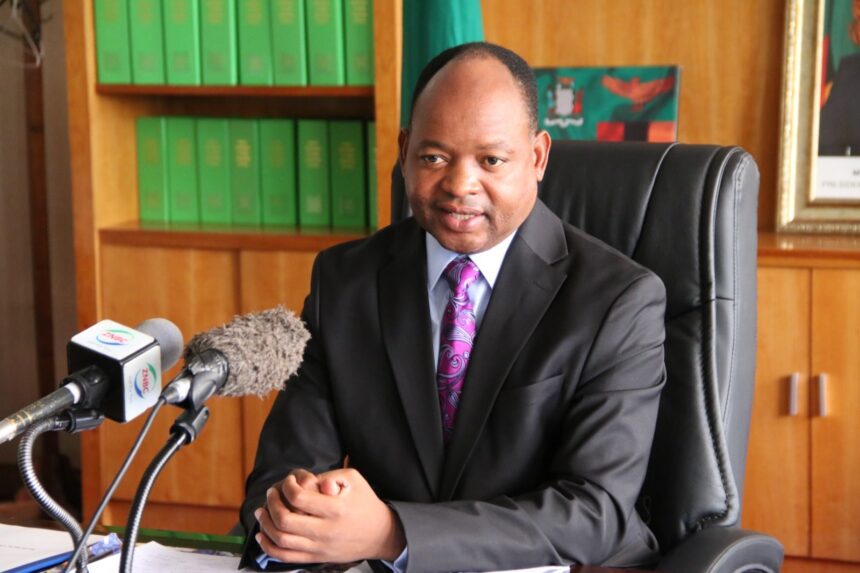
Last night, Zambia’s Minister of Information and Media and Chief Government Spokesperson Hon. Cornelius Mweetwa appeared on ZNBC TV1’s Sunday Interview programme to outline the government’s performance and priorities as the country moves closer to the August general elections. The discussion focused on governance, economic recovery, decentralisation, anti-corruption efforts and political stability. He used the platform to assess the first five years of the administration led by President Hakainde Hichilema. The interview also served as a reflection on key policy achievements and ongoing reforms across multiple sectors. The government positioned its record as one of recovery, stability and institutional strengthening.
A central theme of the interview was economic recovery through debt restructuring and fiscal reforms under the leadership of President Hakainde Hichilema. Mweetwa stated that the government inherited what he described as a severely constrained economy and unsustainable debt burden. He argued that the successful debt restructuring programme created critical fiscal space for national development priorities. According to him, this space has enabled increased investment in free education, health services and infrastructure development. He also linked the reforms to improved public service delivery and stronger financial planning within government institutions. The administration presented these developments as evidence of a stabilising economy and renewed investor confidence.
The interview further highlighted decentralisation and the Constituency Development Fund as key drivers of local development. Mweetwa explained that the expansion of the Constituency Development Fund has allowed communities to directly influence development projects in their areas. He noted that this has improved access to education facilities, bursaries and local infrastructure such as schools and health posts. The government also credited decentralisation with reducing delays in project implementation by shifting decision making closer to communities. He added that these reforms have strengthened accountability at local levels of governance. The overall message was that development is becoming more inclusive and community driven under the current administration.
Political stability and electoral conduct formed another major focus of the discussion. Mweetwa stated that Zambia has experienced greater political tolerance and peaceful elections during the UPND administration. He contrasted recent by-elections with past periods that were marked by violence and heightened political tension. He emphasised that all political parties have been allowed to conduct public activities without restriction. He also acknowledged isolated incidents involving harassment of journalists or political intolerance but said these have been condemned and addressed by law enforcement. The government positioned itself as committed to maintaining a peaceful democratic environment ahead of the upcoming elections.
On governance and accountability, Mweetwa addressed concerns surrounding the fight against corruption. He dismissed claims that anti-corruption efforts are selectively targeting opposition figures. Instead, he argued that most investigations involve former public officials who previously held senior positions in government. He stated that President Hichilema has consistently warned against corruption and interference with investigative institutions. He also pointed to the establishment of the Financial Crimes Court and expansion of the judiciary as evidence of strengthened accountability systems. These measures, according to him, are intended to speed up corruption cases and improve efficiency in the justice system. The government maintains that its anti-corruption agenda is broad, institutional and non-partisan.
The appearance of Hon. Cornelius Mweetwa on ZNBC TV1’s Sunday Interview programme reinforced the government’s narrative of reform, recovery and stability under President Hakainde Hichilema’s leadership. The discussion highlighted progress in debt restructuring, decentralisation, public service delivery and governance reforms. It also underscored the administration’s focus on political tolerance and peaceful democratic processes as the country approaches elections. At the same time, the government emphasised its continued commitment to fighting corruption and strengthening institutions of accountability. The overall message presented was one of continuity, national unity and a development agenda aimed at sustaining long term economic and political stability.