






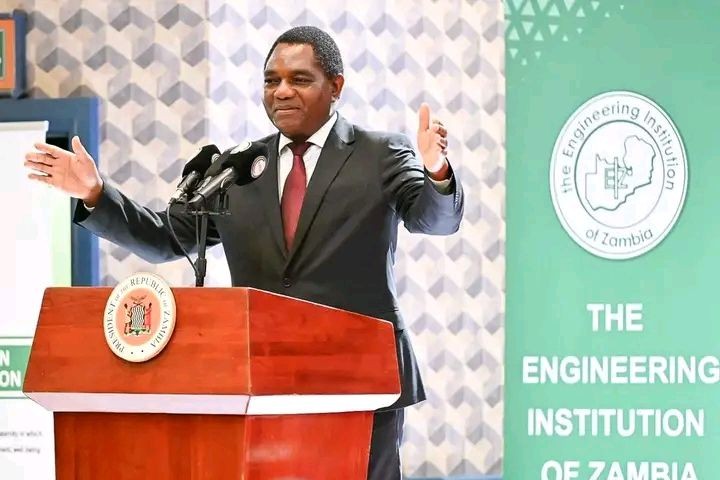
President Hakainde Hichilema has called on Zambian engineers to position themselves at the centre of the country’s expanding economic and infrastructure development agenda. Speaking in Livingstone at the 69th Annual General Meeting and Symposium of the Engineering Institution of Zambia (EIZ), he highlighted the growing opportunities emerging across multiple sectors of the economy. He stressed that these opportunities must be matched with strong professional standards, innovation, and ethical conduct. The President noted that engineering is no longer limited to technical execution but has become a key driver of national transformation. His message focused on aligning professional expertise with Zambia’s long-term development goals.
During his address, President Hichilema emphasized that the country’s infrastructure and industrialisation programmes are creating new avenues for engineers to participate in national growth. He encouraged professionals in the sector to take advantage of projects in energy, transport, housing, water systems and digital infrastructure. These developments, he explained, are designed to stimulate economic activity and improve public service delivery. He also pointed out that engineers play a critical role in ensuring that these projects are delivered efficiently and sustainably. The President’s remarks reflected a broader government strategy of leveraging local expertise to accelerate development outcomes.
The President further stressed the importance of quality and accountability in all engineering work. He urged professionals to uphold high standards that align with global best practices while ensuring value for money in public and private projects. According to him, infrastructure development must not only focus on speed but also on durability and long-term impact. He challenged engineers to avoid shortcuts and instead commit to excellence in planning, design and execution. This approach, he said, is essential for building trust in national development projects and ensuring long-lasting results.
President Hichilema also highlighted the role of innovation in shaping the future of Zambia’s engineering sector. He encouraged professionals to embrace new technologies and modern methods that can improve efficiency and reduce costs. He noted that innovation is key to solving complex challenges in urban development, energy production and environmental management. The President added that Zambia must move towards solutions that are locally developed and contextually relevant. He stressed that engineers have a responsibility to lead this transformation by adopting forward-thinking approaches in their work.
Another key point in his address was the importance of using domestic resources and expertise wherever possible. The President urged engineers to support local participation in major projects and reduce reliance on external contractors when capacity exists within the country. He explained that this approach strengthens the local economy and builds long-term technical capacity. By prioritising local skills and materials, Zambia can retain more value from its development projects. This strategy also supports job creation and helps grow a more self-reliant engineering sector.
He also reminded engineers that their work has a direct impact on national development and public welfare. From roads and bridges to energy systems and water supply networks, engineering projects shape the daily lives of citizens. The President emphasized that poor quality work can have long-term negative consequences, while well-executed projects can transform communities. He called on professionals to view their roles as nation-building responsibilities rather than routine technical tasks. This perspective, he said, is essential for achieving sustainable development.
The symposium brought together engineers and allied professionals from across the country to discuss the future of the sector. It served as a platform for sharing ideas, addressing challenges, and exploring opportunities within Zambia’s evolving economic landscape. Participants engaged on issues such as infrastructure delivery, regulatory standards and technological advancement. The presence of government leadership at the event underscored the importance of collaboration between public institutions and professional bodies. It also reinforced the role of the Engineering Institution of Zambia in shaping national development discourse.
President Hichilema’s message reflected a broader vision of transforming Zambia into a competitive and industrialised economy. Engineering, he noted, sits at the heart of this transformation due to its influence on nearly every sector. From modernising border infrastructure to expanding energy capacity and digital systems, engineers are central to implementation. The President encouraged the profession to take ownership of these opportunities and contribute meaningfully to national progress. His remarks highlighted the link between technical expertise and economic growth.
The address in Livingstone reinforced the government’s commitment to building a development model rooted in professionalism, innovation and integrity. It also sent a clear message that Zambia’s infrastructure ambitions require strong collaboration between government and the engineering community. By urging engineers to embrace both opportunity and responsibility, the President positioned the sector as a key partner in national transformation. The emphasis on ethical standards and innovation sets a benchmark for future projects. As Zambia continues to expand its infrastructure base, the role of engineers will remain central to achieving sustainable and inclusive development outcomes.