







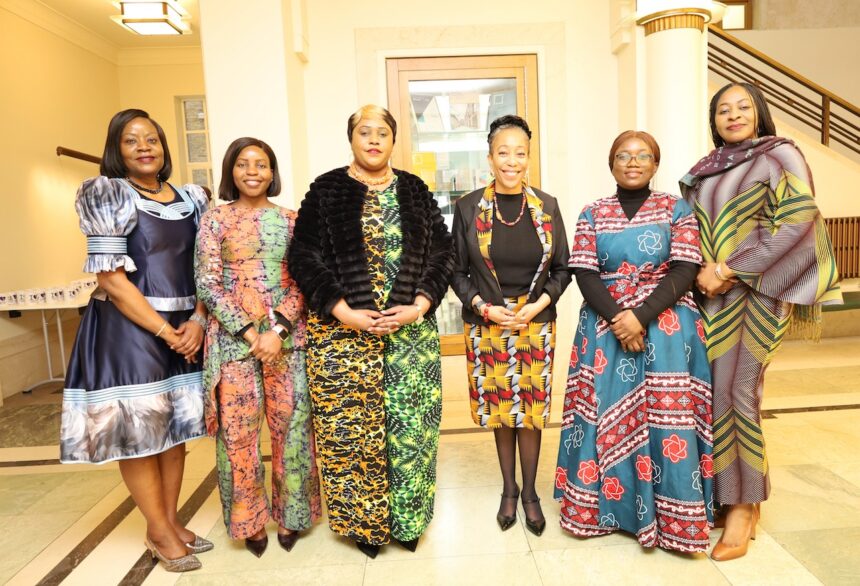
Zambia’s High Commissioner to the United Kingdom, Her Excellency Macenje Mazoka, joined female diplomats from the Zambian High Commission and women leaders of the London Borough of Hackney to mark International Women’s Day 2026. The event, held at Hackney Council Hall, celebrated the theme “Give to Gain,” highlighting women’s leadership and active participation in promoting gender equality, justice, health, and social inclusion. H.E. Mazoka used her keynote address to emphasize that giving extends beyond financial contributions to include mentoring, amplifying women’s work, opening doors to opportunities, and advocating for fair policies and budgets. She argued that the most meaningful contributions come when influence, credit, or space is shared with emerging leaders who drive real change. The gathering provided a platform to acknowledge achievements while reflecting on ongoing challenges facing women globally and in Zambia.
In her speech, H.E. Mazoka detailed how Zambia has made significant strides in empowering women across politics, governance, and professional sectors. Women now serve as cabinet ministers, members of parliament, ambassadors, permanent secretaries, and senior civil servants, demonstrating visible progress in leadership roles. She highlighted achievements in science, technology, and health, noting that Zambian women lead research teams, engineering projects, and clinical services. This progress, she emphasized, was not accidental but the result of collective action by women who organized, advocated, and persisted, supported by male allies who enacted reforms and allocated resources. Yet, she acknowledged that barriers remain, with women still overrepresented in informal and low-paid work and underrepresented in secure and senior positions, reflecting ongoing work needed to achieve equality.
H.E. Mazoka also addressed the cultural and systemic challenges that hinder women’s advancement, cautioning against attitudes rooted in fear of being replaced or overshadowed. She stressed that personal success is hollow if it comes at the expense of others, asserting that dimming another woman’s light does not enhance one’s own. Instead, she called for leaders to become catalysts for institutional transformation, fostering structures of solidarity rather than pursuing success in isolation. She urged women to build staircases, ramps, and lifts so that others can ascend, emphasizing mentorship, advocacy, and the practical sharing of influence as critical tools for societal change. Her message reinforced that leadership is not just about personal achievement but about enabling collective progress.
The High Commissioner concluded by connecting the “Give to Gain” principle to actionable strategies in governance, policy, and daily decision-making. She explained that giving wisely and courageously strengthens organisations, improves community wellbeing, fosters justice, and creates opportunities for future generations of women. By encouraging women to mentor, advocate, and open doors, she framed giving as an investment in systemic transformation rather than individual recognition. H.E. Mazoka’s address called on all leaders, women and men alike, to translate this principle into tangible actions that advance equality and shared success. The International Women’s Day 2026 celebration in London underscored both the progress achieved and the work still required to ensure that women everywhere can thrive and lead without barriers.
The event highlighted that meaningful change arises when achievements are leveraged to uplift others, creating sustainable pathways for women to succeed. H.E. Mazoka’s message reinforced that real gain comes not from solitary advancement but from collective empowerment and institutional reform. By applying the “Give to Gain” ethos, organisations, communities, and societies benefit from stronger leadership, equitable policies, and the enduring success of women and girls across generations. The celebration in Hackney served as a reminder that while progress has been made, continuous effort, solidarity, and courageous action are essential to achieving lasting gender equality.