




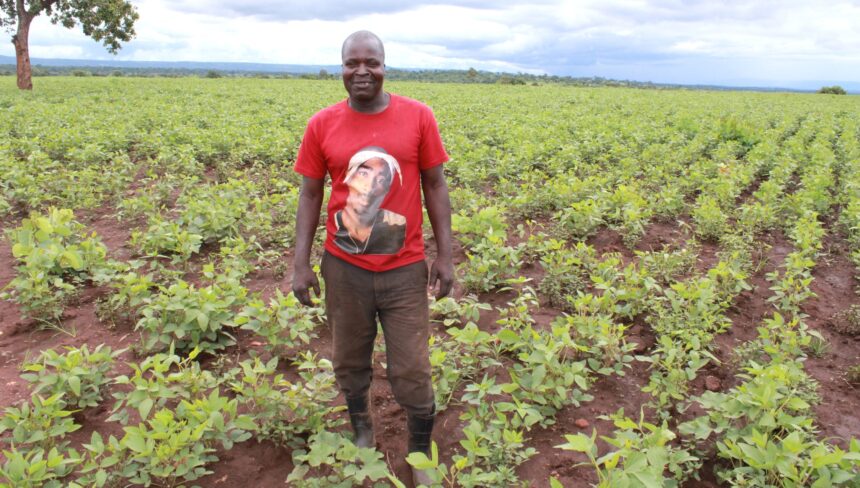
At 51 years old, Mr. Nyanyika Daka of Chowaching’oma Agricultural Camp in Chief Ndakes’ area of Nyimba District has become a model for climate-smart agriculture. His journey demonstrates how knowledge, innovation, and commitment can transform small-scale farming into a sustainable and profitable venture. Mr. Daka began farming in 1995 when the area was largely bushy, and climate-smart practices were unknown to him. Over the years, he learned from lead farmers and extension officers, gradually adopting modern farming techniques that have significantly increased his productivity. His story reflects the broader impact of the Eastern Province Jurisdictional Sustainable Landscape Programme-EP-JSLP, which builds on earlier initiatives like the Zambia Integrated Forest Landscape Programme-ZIFLP to support farmers in adopting sustainable agricultural methods.
Mr. Daka’s adoption of ripping, a climate-smart technique, has been a turning point in his farming career. This method improves soil structure, conserves moisture, and enhances crop yields, particularly for soya beans, which Mr. Daka now prioritizes on his farm. Through consistent training and guidance, he expanded his land under cultivation from four hectares to ten hectares, integrating both soya bean and maize production under climate-smart practices. His farm now employs three workers and supports his family of six children, providing the financial means for their education up to tertiary level. By embracing these innovative methods, Mr. Daka has demonstrated that smallholder farmers can achieve both increased productivity and improved livelihoods.
The support from extension officers and lead farmers has been instrumental in Mr. Daka’s success. They provide continuous training in climate-smart agriculture and agroforestry, which improves soil fertility and ensures environmental sustainability. His work showcases how strategic mentorship and practical guidance can transform follower farmers into leaders in sustainable farming. Mr. Daka highlights that ripping has proven highly effective for soya bean production, increasing yields while protecting the land from erosion and nutrient loss. His example has inspired other farmers in Nyimba District to adopt similar practices to enhance productivity and secure their livelihoods.
Beyond the economic benefits, Mr. Daka emphasizes the social impact of his farming practices. The income generated from his farm has allowed him to support his family and contribute to the local community by employing workers. He encourages fellow farmers to embrace climate-smart methods, noting that proper knowledge and commitment can turn small-scale farming into a commercial enterprise. Mr. Daka also calls on the EP-JSLP project and the Ministry of Agriculture to continue providing technical support and training, ensuring that more farmers can benefit from sustainable agriculture. His approach underscores the importance of combining innovation, mentorship, and community support to achieve lasting results in farming.
Mr. Daka’s achievements have been recognized by officials, including Senior Agricultural Officer Mr. Faindani Nyirenda, who praised his dedication and urged him to continue inspiring other farmers. His journey from a follower farmer to a successful cultivator of ten hectares exemplifies the potential of climate-smart agriculture to transform rural economies. By integrating modern techniques with traditional knowledge, Mr. Daka has improved both his productivity and his family’s wellbeing. His story serves as a powerful reminder that sustainable farming practices, when properly implemented, can generate economic, social, and environmental benefits. The success of farmers like Mr. Daka highlights the transformative power of climate-smart agriculture in Zambia and beyond.