






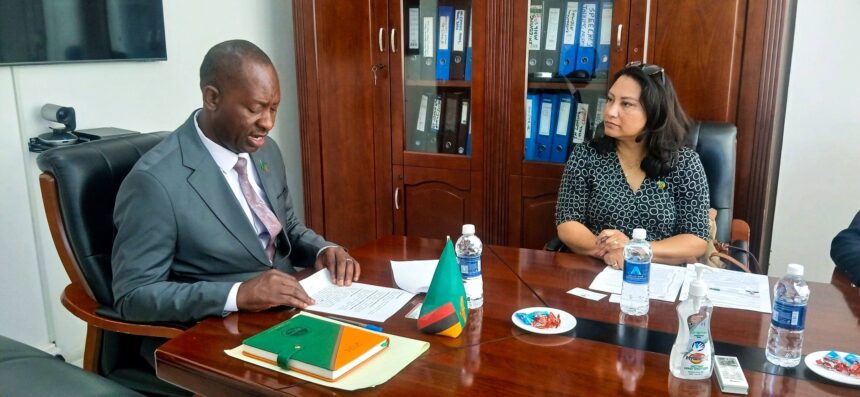
The Minister of Green Economy and Environment recently welcomed the High Commissioner of Australia, Her Excellency Minoli Perera, to discuss ways to enhance collaboration between Zambia and Australia on climate change, renewable energy, sustainable mining, and environmental governance. The meeting highlighted Zambia’s commitment to pursuing a climate-resilient and environmentally sustainable development path while ensuring economic inclusivity for its citizens. During the courtesy call, the Minister outlined key climate-related challenges facing the country, including deforestation, extreme weather events, and gaps in climate financing. He emphasized that addressing these challenges requires coordinated action, innovative solutions, and international partnerships. The engagement underscores Zambia’s proactive approach to global environmental priorities while aligning national strategies with sustainable development goals.
Her Excellency Minoli Perera commended President Hakainde Hichilema for his decisive leadership during the 2023-2024 drought, noting the government’s effective response and resilience-building measures. She observed that Zambia’s economic stability reflects public confidence in the government’s capacity to manage climate and environmental risks. The High Commissioner also highlighted the importance of strategic partnerships in tackling climate change and promoting renewable energy, environmental governance, and sustainable natural resource management. Both parties recognized that collaboration could accelerate Zambia’s transition to a green economy while promoting economic growth and job creation. The discussion reinforced the value of combining technical expertise, financial support, and policy frameworks to achieve meaningful environmental outcomes.
Potential areas for cooperation identified during the meeting include renewable energy development and energy diversification, strengthening climate science and meteorological services, sustainable mining practices, and improved environmental governance. Forestry management and carbon markets were also discussed as opportunities for joint initiatives that could mitigate deforestation and enhance carbon sequestration. Climate finance and green investment were highlighted as essential tools to fund sustainable infrastructure, clean energy projects, and resilience programs. Capacity building and the development of green skills were recognized as critical to ensuring that local communities and professionals can participate effectively in the green economy. These targeted areas reflect a comprehensive approach to climate action that balances economic development with environmental stewardship.
The Minister emphasized Zambia’s dedication to deepening cooperation with Australia to advance sustainable development and climate resilience across multiple sectors. He stressed that collaborative efforts would support Zambia’s long-term environmental goals while fostering innovation and economic opportunities. Strengthening partnerships on renewable energy, environmental management, and climate finance will help Zambia meet international climate commitments and improve local livelihoods. Both sides agreed to maintain ongoing dialogue and implement joint programs that leverage expertise, resources, and technology for sustainable outcomes. This approach demonstrates Zambia’s readiness to engage with international partners and integrate global best practices into national climate strategies.
The meeting between Zambia and Australia represents a significant step toward building resilient, environmentally sustainable, and economically inclusive solutions to climate challenges. By focusing on renewable energy, sustainable mining, forestry, and climate finance, the two countries aim to strengthen capacity, enhance governance, and accelerate the transition to a green economy. The partnership highlights the importance of collaboration in addressing complex climate issues and underscores Zambia’s commitment to proactive environmental management. With coordinated planning, technical support, and investment, Zambia is positioned to achieve meaningful progress in climate adaptation, energy diversification, and sustainable development. This cooperative framework sets a model for future international partnerships that combine environmental stewardship with socio-economic advancement.