




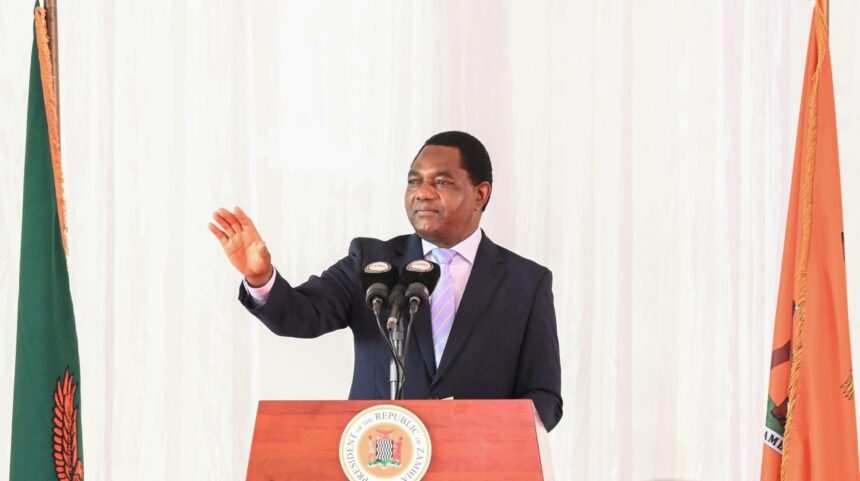
President Hakainde Hichilema delivered a detailed briefing at State House, providing citizens with an update on Zambia’s economic recovery, energy challenges, food security, public service reforms, and national dialogue. He highlighted that the country has emerged from a difficult period marked by debt distress, severe drought, and reduced electricity generation, and is now making measurable progress across multiple sectors.
On debt management, the President reported that the government successfully secured a debt treatment arrangement covering most eligible obligations, creating room for renewed investment. He noted that international rating agencies have recognized the improvements, and investor engagement is increasing in mining, agriculture, manufacturing, and energy. Several mines have resumed production, and new capital is flowing into expansion projects currently underway.
In agriculture, President Hichilema emphasized that Zambia has moved from one of the harshest droughts in recent years to recording the largest maize harvest since independence. He credited farmers, churches, civil society, and local leaders for maintaining food supplies during the drought. The country now consumes approximately 2.7 million tonnes of maize annually and has produced surplus, enabling exports through regional corridors. He confirmed that the Food Reserve Agency is procuring 1.6 million tonnes to protect farmers from low prices and that funds are being mobilized to complete outstanding payments.
Regarding energy, the President explained that the drought caused significant reductions in hydropower generation, resulting in national electricity shortages. The government is implementing short-, medium-, and long-term measures to restore supply. New solar projects are under development in multiple regions, with each constituency set to receive at least two megawatts to support schools, clinics, and small industries. Coal projects are expected to add further capacity, and private investors are contributing new megawatts to the national grid.
President Hichilema also addressed public service reforms, noting that thousands of teachers, nurses, doctors, and military officers have been recruited through transparent processes. The government has avoided removal mechanisms that previously caused insecurity in the civil service and reinstated officers where justified. Constituency development funds are being uniformly disbursed to allow communities to execute local projects without delays.
Education initiatives include the return of free education, benefiting more than two million children, and the removal of examination fees to ease financial burdens on families. Vocational and academic tracks are being strengthened to help learners pursue areas aligned with their skills and interests. Infrastructure development in universities and colleges is being revived to address accommodation shortages.
On political matters, the President acknowledged rising tensions and affirmed citizens’ right to protest while emphasizing compliance with the Public Order Act. He warned that unauthorized demonstrations could endanger participants and encouraged political groups to use dialogue platforms instead of confrontational actions. President Hichilema highlighted that misinformation circulating online has fueled unnecessary anxiety and urged citizens to verify facts before sharing them.
The President reaffirmed the government’s commitment to justice sector reform and maintaining a merit-based public service. He called on political leaders to discourage violence and promote competition based on ideas rather than confrontation. He stressed that national progress in food security, energy, debt restructuring, and investment relies on maintaining peace and order.
President Hichilema concluded by encouraging citizens to actively participate in national dialogue and collaborate to improve governance and development outcomes. He assured the nation that the government will continue providing updates on economic, social, and political matters and remains committed to engagement with all sectors of society.