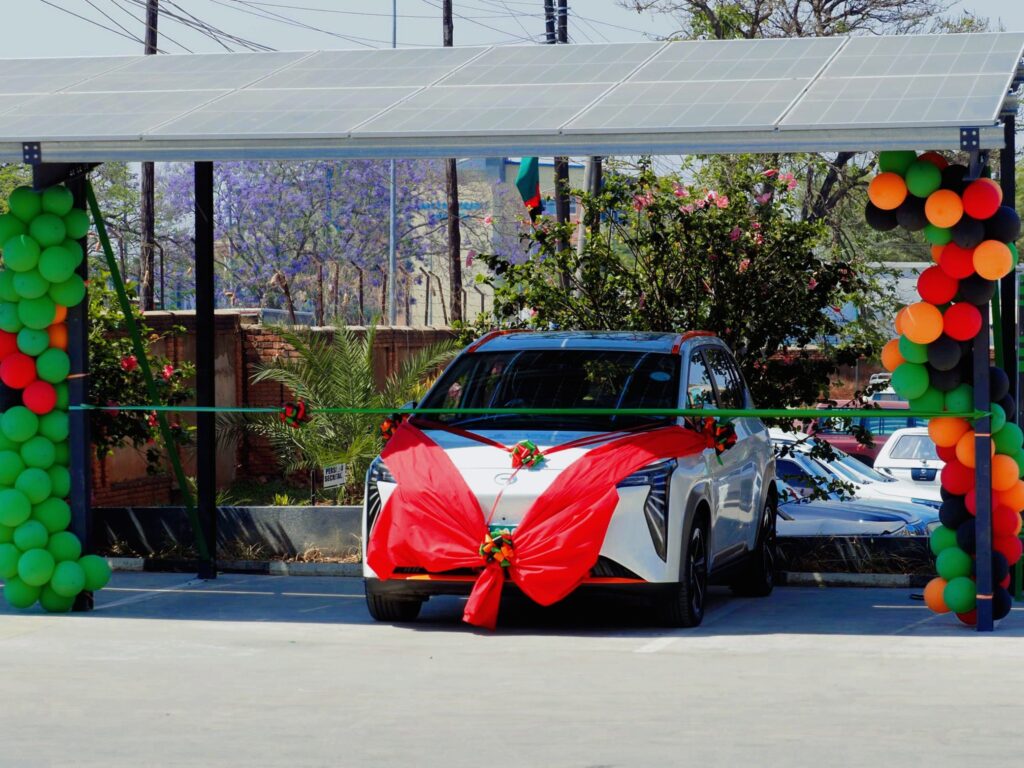







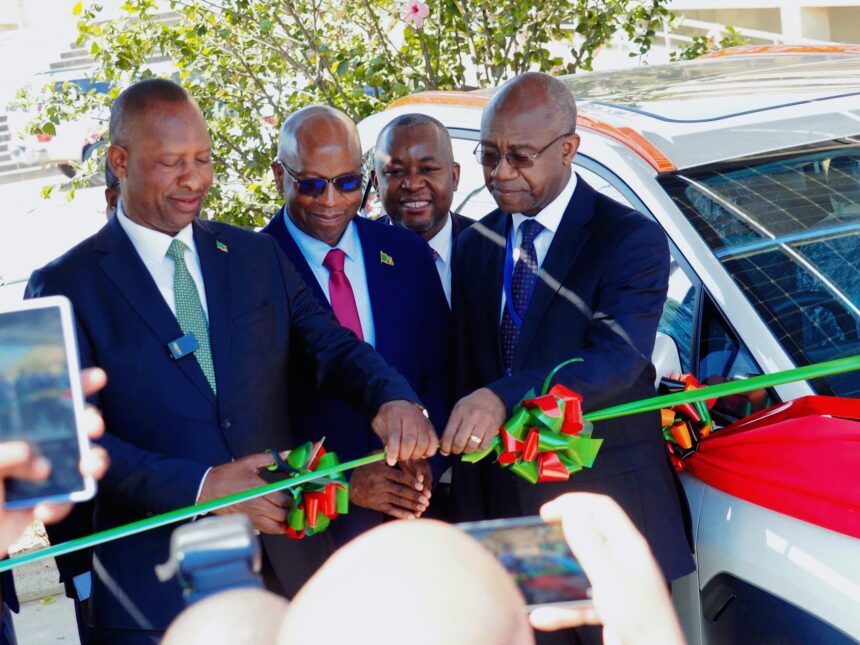
The Ministry of Green Economy and Environment has unveiled Zambia’s first electric vehicle, marking a significant step towards a sustainable and low-emission economy. The event took place during the Inaugural Chief Executives Forum for the Electric Vehicle Ambassador Zambia Initiative.
Minister of Green Economy and Environment Mike Mposha said the unveiling signals not only a technological milestone but also a new investment narrative for Zambia. He emphasized that under President Hakainde Hichilema’s leadership, the government is positioning Zambia as a regional climate investment hub, driven by clean technology, renewable energy, and sustainable finance.
Mposha explained that Zambia has adopted a whole-of-government approach to green mobility, anchored in the Eighth National Development Plan, the Nationally Determined Contribution, and the Green Growth Strategy. The government has also introduced fiscal incentives, including the removal of all import duties except VAT on electric vehicles, and VAT waivers for locally produced units.
He revealed that the Energy Regulation Board (ERB) has established licensing standards for electric vehicle charging stations to ensure safety and regulatory clarity. He further called on the banking, insurance, and pension sectors to develop green asset financing, EV leasing models, and climate credit lines, stating that “the future of finance is green.”
Mposha reaffirmed Zambia’s readiness to work with development partners and international financiers to mobilize resources from the Green Climate Fund and Climate Investment Funds. These resources will support early-stage EV investments and expand charging infrastructure. He described e-mobility as a triple dividend that drives economic growth, reduces carbon emissions, and promotes social inclusion through cleaner cities and green jobs.
The Minister highlighted that electric mobility is a modernization strategy, not a cost, and aligns with President Hichilema’s vision of transforming Zambia into a green industrial economy by 2030. “As we unveil this electric vehicle today, we are not only unveiling a car; we are unveiling a vision,” he said, describing Zambia as Africa’s green investment frontier.
Secretary to the Cabinet Patrick Kangwa stated that the launch demonstrates the government’s commitment to embedding sustainability and innovation at the core of national development. He called on the private sector to invest in EV charging infrastructure, assembly plants, and battery recycling, and urged stakeholders to collaborate through technology transfer and blended finance to scale green investments.
Permanent Secretary in the Ministry of Green Economy and Environment Douty Chibamba said the procurement of electric vehicles is a practical demonstration of the government’s Green Economy Agenda. He disclosed that a pilot study shows an electric vehicle can travel from Lusaka to Kitwe (357 km) on a single full charge costing only K200, compared to K1,500–K2,000 for a petrol-powered vehicle of similar size. He added that EVs run entirely on renewable energy and highlighted the ministry’s installation of a solar-powered charging station, demonstrating Zambia’s ability to harness solar and hydro resources.
Chibamba emphasized that Zambia’s transition to e-mobility is guided by standards, infrastructure, and policy coherence. ERB has developed technical and safety standards for charging stations, while the Electric Mobility Policy and Strategic Framework under the Ministry of Transport and Logistics is nearing completion. The initiative aligns with the 8NDP, the Green Growth Strategy, and Zambia’s NDC, which targets a 47 percent reduction in greenhouse gas emissions by 2030.
The Minister urged regulators, businesses, and development partners to collaborate, making Zambia’s e-mobility story a model for Africa—technically sound, economically competitive, and environmentally transformative.