



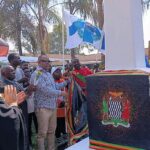



Minister of Water Development and Sanitation, Hon. Eng. Collins Nzovu, MP, provided a comprehensive update today on the government’s response to the Sino Metals pollution incident and ongoing water supply challenges affecting Lusaka and the Copperbelt.
The Minister highlighted key interventions following pollution caused by Sino Metals Leach Ltd. He confirmed that the Attorney General has cleared a contract for an independent assessment, ensuring a reliable scientific basis for the government’s next steps. Zambia Environmental Management Agency (ZEMA) and Applied Sciences Technology Limited have signed the contract, with work beginning immediately. Minister Nzovu stressed that remedial costs remain the responsibility of Sino Metals Leach Zambia Limited under the “Polluter Pays” principle.
Preliminary investigations conducted by Nkana Water, ZEMA, WARMA, independent consultants, and analysis from Alfred H. Knight laboratory indicate that 51,800 cubic metres of material were discharged (31,300 cubic metres liquid, 17,700 cubic metres solid), far lower than the widely cited but unofficial 1.5 million cubic metres. Visible pollution, such as tailings near Kalusale compound in Chambishi, has already been reclaimed, while a comprehensive assessment by the independent assessor will guide the government’s final position. The Minister called for calm and constructive dialogue, urging civil society, academia, and the diplomatic community to support environmental restoration efforts.
Minister Nzovu also outlined urgent measures to address erratic water supply in Lusaka, Chingola, Chililabombwe, Mufulira, and Ndola. In Lusaka’s Mtendere East and Kalikiliki, Lusaka Water Supply and Sanitation deployed water bowsers, interconnected supply lines, replaced a leaking 300m³ reservoir, and implemented fair rationing until supply stabilizes. In Chingola, K5.7 million was released for the Chiwempala Water Supply Restoration Project benefiting 15,000 residents. New bulk supply lines have been commissioned in multiple townships, with ongoing pipeline construction in Nchanga South and Town Centre.
Chililabombwe has seen Mulonga Water construct a new reservoir, rehabilitate the Kafue Intake and treatment plant, and upgrade bulk supply lines. Replacement of a 5.5 km DN500 pipeline costing K87 million remains a priority. In Mufulira, rehabilitation of Kafue and Chibolya plants is underway, and a 2.1 km pipeline in Kankoyo is nearly complete. Mopani Copper Mine’s intake is being restored, with full resolution dependent on replacing an 8.5 km DN450 pipeline at an estimated K110 million. To mitigate the impact of load-shedding, three standby generators have been installed at booster stations in Chingola, Mufulira, and Kasompe.
In Ndola, the Constituency Development Fund financed new connections for hundreds of households: Chipulukusu (800+ households, K1.3 million invested), Nkwazi (250 households + 14 churches), Kabushi (390 households, K2 million invested), and Bwana Mkubwa (two solar boreholes benefiting 1,000+ households). Minister Nzovu urged residents to safeguard water infrastructure, avoid vandalism, and pay bills to ensure sustainable access. He emphasized that these interventions reflect the government’s commitment to equitable and reliable water supply nationwide, aligning with President Hakainde Hichilema’s priorities on water and energy security.
The combined focus on environmental management and water supply demonstrates the government’s strategy to protect public health and strengthen Zambia’s resource sustainability across affected regions.