





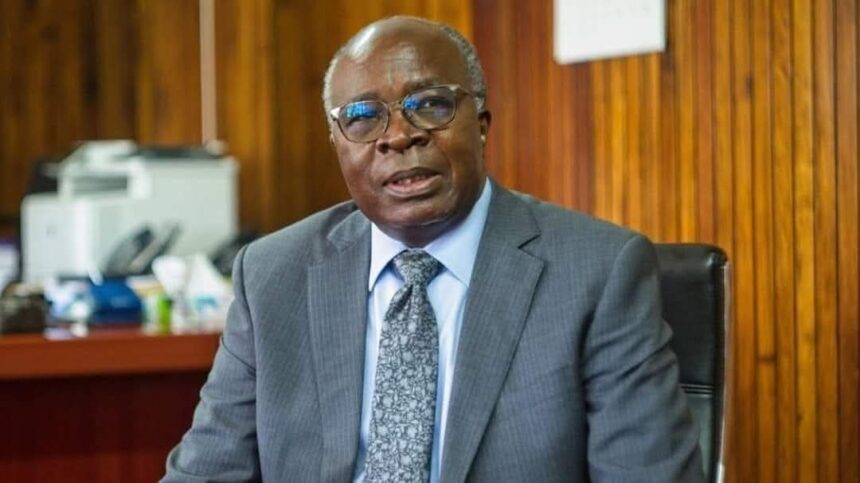
Minister of Finance and National Planning, Dr. Situmbeko Musokotwane, has announced that Zambia’s economy is firmly on a path of recovery and inclusive growth, with notable progress recorded in the second quarter of 2025 under the 8th National Development Plan (8NDP).
Speaking at the National Development Coordinating Committee (NDCC) Meeting, Dr. Musokotwane highlighted that ongoing government reforms are yielding results, with a focus on youth and women empowerment, private sector-led growth, and strategic investments across key sectors.
“Our reforms are working, and Zambia is on a clear recovery path. We are committed to sustaining this momentum, empowering youth and women, strengthening private sector growth, and working hand-in-hand with our development partners and investors. The progress achieved so far demonstrates our national resilience, and together, we will build a prosperous Zambia where every citizen shares in the benefits of growth,” Dr. Musokotwane stated.
Agriculture saw major gains, with veterinary laboratories operationalised in Choma and Chipata, fish production reaching 39,000 metric tonnes, and over 530 farmers linked to export markets, surpassing the initial target of 25. Additionally, 1,038 farms were allocated in farm blocks, 26 boreholes drilled for resettlement schemes, and the Farmer Input Support Programme (FISP) fully migrated to the E-Voucher system across all 116 districts.
To strengthen value chain development, 56,666 farmers received production training, 19,517 were trained in rice and cassava processing, and 17,149 in food packaging, significantly exceeding initial targets.
In mining, the High-Resolution Geophysical Survey now covers 23.6 per cent of national territory, while the Zambia Gold Company purchased 13.9 kg of gold from artisanal miners, with plans to scale up aggregator systems.
Tourism infrastructure improvements included the rehabilitation of over 1,300 km of access roads in parks and tourist zones, surpassing the target of 840 km. Progress continues on the Lusaka–Ndola Road under the public-private partnership model, with several key sections nearing completion.
In the energy sector, renewable projects added 125MW to the national grid through the commissioning of the Chisamba and Mailo solar plants. Over 19,600 new electricity connections were made, while 14 communication towers and 525 Starlink units expanded rural connectivity and access to digital services.
Digital governance advanced with 368 government services now available online via ZamPortal, generating K1.1 billion in non-tax revenue in just six months. On enterprise development, 1,453 MSMEs received business support, five top-performing SMEs each received USD 20,000, and 6,184 new business names along with 4,903 companies were registered. The CEEC’s District Value Chain Programme is projected to create over 65,000 jobs and K150 million in annual exports.
Social development achievements included support for over 42,400 students through bursaries and loans, training for 3,883 youths, and business grants for 3,048 individuals. Education initiatives re-enrolled 8,626 out-of-school children and enrolled 83,829 secondary students under the free education policy. Women’s empowerment programmes reached 23,930 beneficiaries, with 16,098 trained in life and business skills, and women-led enterprises supported with financing and access to public tenders.
Social protection was expanded, with 1.4 million households enrolled in the Social Cash Transfer Programme and over 2.2 million people receiving emergency cash during the 2024 drought. The Food Security Pack supported 40,000 vulnerable farmers, while maternal health access improved, with 88.7 per cent of pregnant women accessing antenatal services and 90 per cent of essential medicines available in health centres.
Environmental initiatives included 673 boreholes drilled, 227 piped water schemes benefiting over 280,000 people, and over 2,500 villages attaining Open Defecation Free status. Reforestation efforts planted 455,104 seedlings and established 1,049 hectares of forest plantations.
Provincial governments collected K72.3 million in non-tax revenue under fiscal decentralisation. Youth and women empowerment programmes were implemented across all provinces, and 18 Community Forest Management Groups were formed.
Governance reforms advanced with consolidated laws published up to 2019, with efforts ongoing for 2020–2025. Public awareness campaigns aired 118 documentaries, 73,200 citizens accessed digital CDF data, and 13 government institutions plus nine local authorities were connected to the Government Wide Area Network. Infrastructure upgrades included a new local court in Matero and the recruitment of 850 qualified staff into local authorities. The Anti-Corruption Commission achieved a 67 per cent conviction rate in prosecuted cases.
Dr. Musokotwane reaffirmed the Government’s commitment to accountability, transparency, decentralisation, private sector and diaspora participation, digital service delivery, rural connectivity, and social protection.
“The New Dawn Administration, ably led by our Republican President Mr. Hakainde Hichilema, will continue driving the country towards a prosperous, resilient, and inclusive future,” he said.