





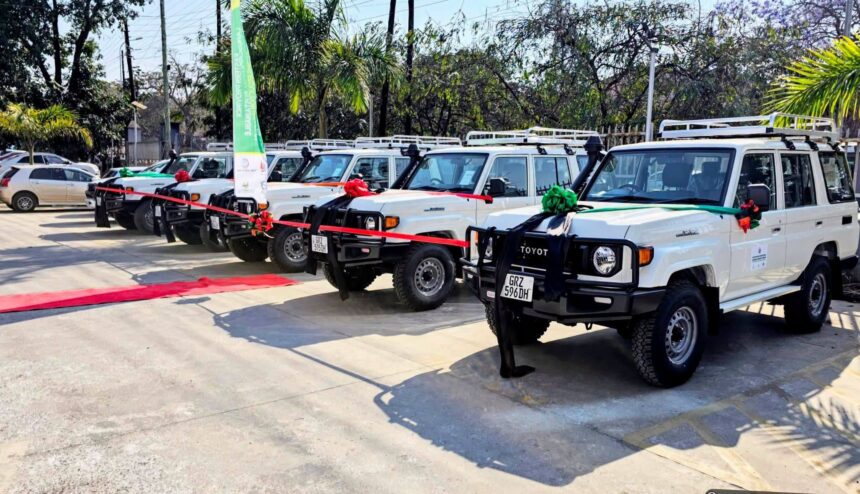
The Ministry of Green Economy and Environment has strengthened the implementation of Zambia’s Eastern Province Jurisdictional Sustainable Landscape Programme, EP-JSLP, through the handover of five Toyota Land Cruiser vehicles to institutions responsible for carrying out the initiative. The vehicles, valued at more than US$321,000, are expected to improve field operations, monitoring and data collection across the emission reduction project. The investment comes as Zambia works to address deforestation, forest degradation and other environmental pressures while supporting sustainable land use. The EP-JSLP has set an ambitious target of approximately 20 million tonnes of verified emission reductions by 2030. The new vehicles are expected to give implementing institutions greater capacity to reach remote communities and monitor activities that contribute to this target.
Speaking during the handover ceremony in Lusaka, Ministry of Green Economy and Environment Permanent Secretary Dr. Douty Chibamba said the vehicles would strengthen the operational capacity of institutions implementing the programme. Many of the activities under the EP-JSLP take place in rural and remote areas where field teams need reliable transport to reach communities, collect information and monitor project activities. Improved mobility can help officials conduct more regular assessments and respond more effectively to challenges affecting forests, agricultural land and local communities. The vehicles will therefore serve as practical tools for implementing the programme rather than simply providing additional transport resources. Their deployment is expected to support better coordination between government institutions and communities involved in sustainable land management and emission reduction activities.
Four of the five Toyota Land Cruiser vehicles will be deployed directly to the Eastern Province Jurisdictional Sustainable Landscape Programme in Eastern Province. The remaining vehicle will be allocated to the Zambia Environmental Management Agency, ZEMA, in Lusaka to support its responsibilities connected to the initiative. This allocation is designed to ensure that both field-based and national-level functions have access to appropriate logistical support. Eastern Province will require substantial field capacity because the programme involves activities across communities and landscapes where environmental monitoring can be challenging. At the same time, the vehicle assigned to ZEMA will strengthen coordination and environmental management functions at the national level.
Dr. Chibamba also stressed the importance of responsible management of the vehicles after the handover. He urged government institutions to ensure that the vehicles are properly maintained, accurately accounted for and used strictly for their intended project purposes. Effective asset management will be important because the vehicles represent a significant financial investment and are expected to support the programme over several years. Proper maintenance can also reduce unnecessary operational costs and help ensure that field teams remain mobile when they need to conduct monitoring and community engagements. Accountability will be particularly important in ensuring that the resources provided for environmental programmes deliver measurable benefits to the communities and landscapes they are intended to serve.
The EP-JSLP is focused on reducing greenhouse gas emissions through a combination of sustainable land management and community-based environmental interventions. Its activities include climate-smart agriculture, community forest management and other approaches designed to reduce deforestation and forest degradation. These interventions recognise the connection between agricultural practices, forest conservation, livelihoods and climate change. Farmers and rural communities depend heavily on natural resources, which makes their participation essential to the success of efforts aimed at protecting forests and improving land productivity. By combining environmental protection with sustainable economic activities, the programme seeks to reduce emissions while supporting communities that depend on the land.
The programme’s target of approximately 20 million tonnes of verified emission reductions by 2030 demonstrates the scale of the initiative. Reaching such a target requires accurate monitoring, reliable data collection and consistent implementation across participating areas. Field teams need to establish whether interventions are producing measurable changes and whether emission reductions can be verified using appropriate systems and information. The new vehicles can support this process by making it easier for technical teams to visit project sites, engage communities and gather information from areas that may be difficult to access. Better field logistics can therefore contribute to the credibility and effectiveness of the programme’s emission reduction efforts.
The World Bank is supporting the EP-JSLP as part of broader efforts to promote sustainable development and climate resilience in Zambia. World Bank Agriculture Economist Michael Kabwe commended the Ministry for the progress made in implementing the programme in Eastern Province. His comments highlight the importance of continued collaboration between the Zambian Government and development partners as environmental and agricultural programmes expand. Kabwe also reaffirmed the World Bank’s commitment to supporting Zambia in areas including sustainable forest management and climate-smart agriculture. Continued technical and financial support can help strengthen the systems required to implement these interventions and measure their long-term results.
Climate-smart agriculture is particularly relevant to the programme because agricultural production and environmental conservation are closely connected in rural communities. Sustainable farming practices can help farmers improve productivity while reducing pressure to clear additional forest land for cultivation. Better soil management, improved agricultural techniques and more efficient use of natural resources can contribute to stronger resilience against climate-related challenges. When these approaches are combined with community forest management, they can create a broader framework for protecting landscapes while supporting local livelihoods. The success of these interventions will depend on continued engagement with communities and ensuring that local people have the knowledge, resources and incentives needed to adopt sustainable practices.
The involvement of ZEMA also highlights the importance of environmental oversight and coordination in achieving the programme’s objectives. Environmental management requires reliable information about land use, forest conditions and activities that may contribute to degradation. Strong monitoring systems can help authorities identify challenges and assess whether interventions are delivering the expected environmental results. By improving access to field transport, the institutions involved can increase the frequency and effectiveness of site visits and data collection. This can ultimately support better decision-making and strengthen Zambia’s ability to demonstrate progress towards its climate and environmental goals.
The handover of the five Toyota Land Cruiser vehicles represents a practical investment in the infrastructure needed to implement the Eastern Province Jurisdictional Sustainable Landscape Programme effectively. While vehicles alone cannot achieve the programme’s emission reduction target, they can address an important operational challenge by improving access to remote project areas. Their value will depend on how effectively institutions maintain, manage and deploy them to support field activities. With continued support from the World Bank and cooperation among government agencies, communities and other stakeholders, the EP-JSLP can strengthen Zambia’s efforts to manage forests and agricultural landscapes more sustainably. The initiative demonstrates the importance of combining financial investment, field capacity, community participation and strong environmental monitoring to achieve long-term climate and development outcomes.