







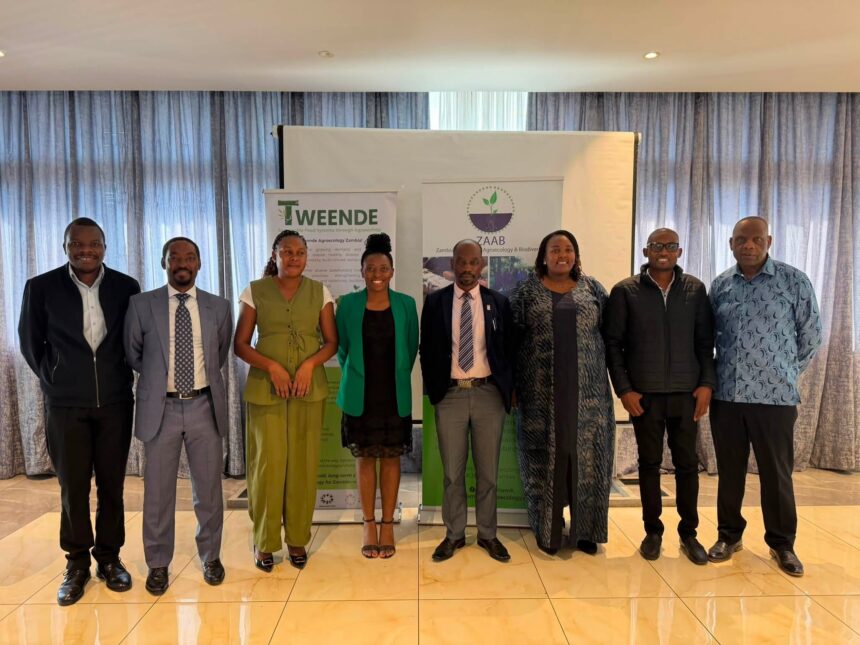
The Zambia Alliance for Agroecology and Biodiversity (ZAAB), in partnership with Mulungushi University, Solidaridad and Grassroots Trust, yesterday convened the Tweende Multi-Stakeholder Dialogue on Agroecology in Lusaka. The dialogue brought together farmers, researchers, government representatives, civil society organisations and development partners to reflect on progress made through the Tweende Towards Agroecology Project. The gathering marked the conclusion of Phase 1 of the project, which has focused on strengthening agroecological practices through farmer-to-farmer learning, participatory research and stakeholder engagement. Participants used the occasion to share experiences from communities involved in the project and consider how successful approaches can be sustained. The discussions also highlighted the importance of placing farmers at the centre of decisions affecting Zambia’s food and farming systems.
The Tweende Towards Agroecology Project has been implemented through activities in Mpanshya, Kasenengwa and Itebe, where farmers and other stakeholders have participated in practical learning and research processes. Farmer-to-farmer learning has provided an opportunity for communities to exchange knowledge based on their own experiences and farming conditions. Participatory research has also created space for farmers to contribute to the identification of challenges and the development of approaches relevant to their communities. This combination of local knowledge, research and stakeholder engagement has helped create a more collaborative approach to agroecology. The conclusion of Phase 1 therefore provides an opportunity to assess what has worked, identify areas requiring further attention and determine how lessons from the participating communities can inform future efforts.
Throughout the Lusaka dialogue, participants reflected on the outcomes of the project and the experiences of communities involved in its implementation. Farmers were able to share perspectives on the approaches they have encountered and the lessons they have gained during the project. Researchers and other stakeholders contributed their observations on the importance of evidence, local knowledge and participatory approaches when developing sustainable farming solutions. Government representatives and development partners also provided perspectives on the role of policy and institutional support in creating an environment where agroecological practices can grow. These discussions helped provide a broader understanding of the opportunities and challenges associated with advancing agroecology in Zambia.
The dialogue also provided an opportunity to discuss challenges encountered during the implementation of Phase 1. Understanding these challenges is important because successful approaches cannot simply be replicated without considering the conditions in which farmers operate. Factors such as access to knowledge, resources, markets, research support and appropriate policies can influence the ability of farmers to adopt and maintain sustainable practices. By openly discussing implementation challenges, stakeholders can identify practical areas where future programmes may require stronger support. The lessons emerging from the project can therefore contribute to improving future interventions and ensuring that agroecology initiatives respond to the realities faced by farming communities.
A central theme of the dialogue was the need to sustain and scale promising approaches emerging from the project. Participants considered how successful experiences from Mpanshya, Kasenengwa and Itebe could inform broader efforts to strengthen resilient food systems. Scaling agroecological approaches requires more than introducing individual farming techniques because it also depends on knowledge sharing, research, institutional support and enabling policies. Strong connections between farmers, researchers, government institutions and development organisations can help ensure that useful practices receive the support needed to expand. The dialogue created a platform for stakeholders to explore these connections and consider how collaboration can continue beyond the completion of Phase 1.
The discussions reaffirmed the importance of connecting farmers’ knowledge with formal research and supportive public policy. Farmers possess practical knowledge developed through years of working with their land, crops, livestock and local environments. Researchers can complement this knowledge by generating evidence, documenting experiences and examining approaches that may improve agricultural outcomes. Government policy can then help create conditions that support the adoption of sustainable practices while addressing broader food and agricultural priorities. Bringing these different forms of knowledge together can produce more relevant approaches than relying on a single source of expertise.
The role of farmers was particularly important in the discussions surrounding the future of agroecology in Zambia. The dialogue reaffirmed that farmers should remain central to research, decision-making and policies that shape their food and farming systems. This approach recognises that agricultural policies and programmes have a direct impact on communities and should therefore reflect the experiences and priorities of the people who implement them. Meaningful farmer participation can also improve the relevance and acceptance of agricultural interventions because communities have an opportunity to influence decisions that affect their livelihoods. Keeping farmers at the centre of these processes can strengthen collaboration and support the development of more inclusive food systems.
Agroecology can also contribute to efforts to build resilience within Zambia’s food systems by encouraging approaches that consider environmental, social and economic factors together. Farmers face changing conditions that can affect productivity, household incomes and access to food, making resilience an important consideration in agricultural development. Approaches that draw on local knowledge, research and sustainable resource management can help communities respond to these challenges. However, farmers need appropriate support if they are expected to adopt and maintain new or improved practices. The multi-stakeholder model demonstrated through the Tweende project provides a framework for bringing together the different actors required to support this process.
The participation of organisations such as ZAAB, Mulungushi University, Solidaridad and Grassroots Trust demonstrates the value of partnerships in advancing agroecology. Civil society organisations can support community engagement and knowledge exchange, while universities can contribute research and evidence. Development partners can provide technical and other forms of support, while government institutions can help connect community experiences with national agricultural priorities and public policy. Collaboration between these groups can strengthen the impact of individual initiatives by bringing together complementary skills and resources. The Tweende dialogue therefore served not only as a reflection on Phase 1 but also as a platform for considering how partnerships can continue to support sustainable agriculture.
As Phase 1 of the Tweende Towards Agroecology Project comes to an end, the experiences and recommendations shared during the dialogue provide an important foundation for continued collaboration. The knowledge generated through farmer-to-farmer learning, participatory research and stakeholder engagement can inform future work in the participating communities and potentially beyond them. Continued engagement will be important to ensure that useful approaches are not lost once the initial phase of the project concludes. Stakeholders will also need to maintain strong links between farmers, researchers, policymakers and development partners as efforts to strengthen sustainable food systems continue. The lessons from the first phase can therefore serve as a basis for improving future initiatives and supporting broader discussions around agroecology in Zambia.
The Tweende Multi-Stakeholder Dialogue ultimately demonstrated that advancing agroecology requires cooperation across communities, research institutions, government, civil society and development partners. The conclusion of Phase 1 represents an important milestone, but it also opens the door to further work aimed at strengthening resilient, inclusive and sustainable food systems in Zambia. ZAAB’s appreciation of the participating communities, partners and stakeholders recognises the collective effort that made the project and the dialogue possible. The continued involvement of farmers will remain essential as stakeholders seek to build on the knowledge and experiences generated through the initiative. With stronger collaboration and sustained attention to farmer-led knowledge, research and supportive policy, the lessons from the Tweende project can contribute to Zambia’s ongoing efforts to develop sustainable and resilient agricultural systems.