





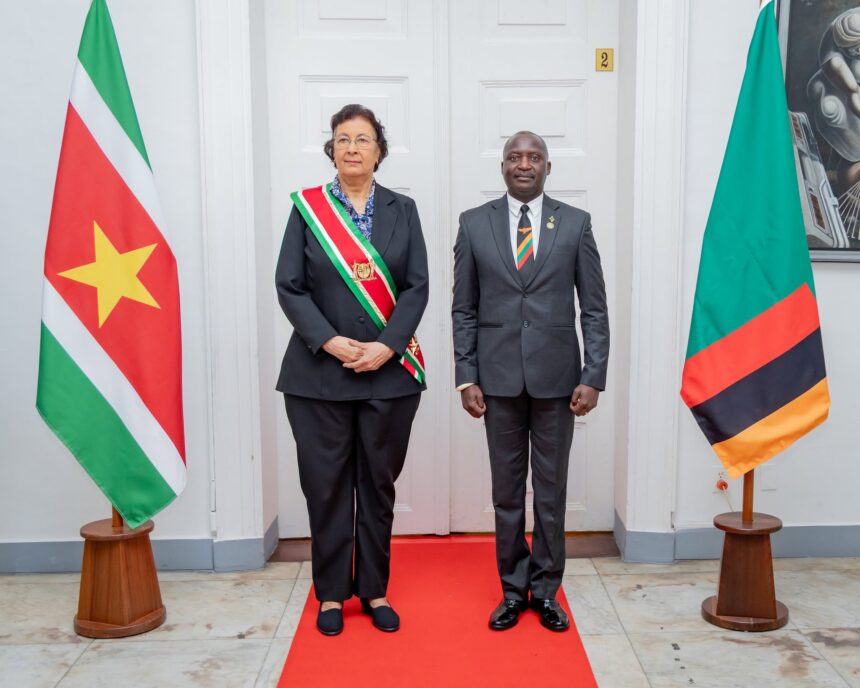
Zambia and Suriname are taking steps to strengthen diplomatic and economic relations following the official accreditation of Lieutenant General Sitali Dennis Alibuzwi (Rtd) as Zambia’s Non-Resident Ambassador Extraordinary and Plenipotentiary to Suriname. Ambassador Alibuzwi presented his Letters of Credence to Her Excellency Jennifer Geerlings-Simons, President of the Republic of Suriname, during a ceremony at the Presidential Palace in Paramaribo. The diplomatic engagement signals Zambia’s commitment to expanding its international partnerships while identifying new opportunities for cooperation with Suriname. Ambassador Alibuzwi conveyed Zambia’s determination to build a stronger bilateral partnership that delivers practical benefits for both countries. The discussions also highlighted the potential for deeper cooperation in sectors that can support economic growth, investment and sustainable development.
During the presentation ceremony, Ambassador Alibuzwi conveyed President Hakainde Hichilema’s eagerness to work closely with Suriname across several key economic sectors. Energy, mining, agriculture, manufacturing and tourism were identified as important areas where both countries could explore opportunities for increased cooperation. These sectors are central to Zambia’s economic development ambitions and also present potential areas for investment and knowledge exchange with Suriname. Greater collaboration could create opportunities for businesses in both countries to explore new markets, develop partnerships and expand commercial activity. The ambassador’s message therefore placed economic diplomacy at the centre of Zambia’s engagement with Suriname.
Ambassador Alibuzwi also highlighted Zambia’s economic and political outlook, pointing to President Hakainde Hichilema’s re-election as a factor supporting investor confidence and policy continuity. He noted that continued political stability and macroeconomic measures can provide a stronger environment for investors seeking opportunities in Zambia. The sustained stabilisation of the Zambian Kwacha against the United States dollar was also highlighted as part of the country’s broader economic developments. Investor confidence remains important as Zambia seeks to attract capital into productive sectors and expand economic activity. Presenting these developments to Surinamese authorities provides an opportunity to strengthen awareness of Zambia’s investment potential and encourage greater commercial engagement.
Zambia’s strategic geographical position was another important issue raised during the diplomatic engagement. Ambassador Alibuzwi emphasised the significance of regional connectivity, particularly through the development of the Lobito Corridor. The corridor has the potential to improve the movement of goods and strengthen connections between markets in Southern Africa and international trade routes. Improved transport and logistics infrastructure can reduce barriers to trade while creating new opportunities for businesses involved in mining, agriculture, manufacturing and other sectors. Zambia’s growing connectivity therefore provides an important foundation for expanding its role in regional and international commerce.
The Lobito Corridor also has wider implications for Zambia’s ambitions to strengthen its position as a regional trade and logistics hub. Efficient transport links can help businesses move commodities and manufactured products more effectively while opening access to international markets. For investors, improved connectivity can make supply chains more efficient and support the development of projects that depend on reliable transportation networks. The corridor could also strengthen economic links between Zambia and other countries across Southern Africa. By highlighting this infrastructure development during discussions with Suriname, Zambia is positioning its regional connectivity as part of a broader investment and trade proposition.
President Jennifer Geerlings-Simons, who accepted Ambassador Alibuzwi’s credentials alongside Suriname’s Minister of Foreign Affairs, International Business, and International Cooperation, Melvin Bouva, expressed strong interest in enhancing relations between the two countries. Her response demonstrated Suriname’s willingness to explore new areas of cooperation with Zambia and expand existing bilateral engagements. The Surinamese leadership identified trade, agriculture, investment, culture and education as important areas where both countries could develop stronger partnerships. These sectors provide opportunities for cooperation that extend beyond traditional diplomatic relations. They could also support greater people-to-people connections, business engagement and knowledge exchange between Zambia and Suriname.
Agriculture represents one potential area where the two countries could benefit from increased cooperation. Both Zambia and Suriname have agricultural resources and opportunities that could support collaboration in areas such as production, investment, technology and skills development. Partnerships between agricultural institutions and businesses could encourage the exchange of knowledge and strengthen value chains. Investment in agriculture could also contribute to food security, employment and economic diversification. Further discussions between the two governments and private sector stakeholders could help identify specific projects capable of turning this potential into practical outcomes.
Trade and investment are also expected to remain central to the developing relationship between Zambia and Suriname. Stronger commercial ties could encourage companies from both countries to explore opportunities in new markets and establish business partnerships. Government agencies responsible for investment promotion can play an important role by providing information, facilitating contacts and helping investors understand available opportunities. The focus on investment also aligns with Zambia’s broader efforts to attract capital into sectors capable of generating employment and supporting economic growth. For Suriname, deeper engagement with Zambia could provide access to opportunities within the Southern African market and create a stronger foundation for wider regional cooperation.
Cultural and educational cooperation could further strengthen the relationship by creating connections between institutions and people in both countries. Academic exchanges, professional programmes and cultural initiatives can help citizens gain a better understanding of each country’s history, society and development priorities. These relationships can complement economic and diplomatic engagement by creating long-term links beyond government institutions. Education partnerships can also support knowledge transfer and professional development in areas of shared interest. Cultural diplomacy, meanwhile, can help build greater awareness and goodwill between the Zambian and Surinamese people.
Following his accreditation, Ambassador Alibuzwi is expected to begin a series of bilateral engagements in Paramaribo involving government ministries, national investment authorities and representatives of the business sector. These meetings will provide an opportunity to move from broad diplomatic commitments towards specific areas of cooperation. Discussions with investment authorities and private sector representatives can help identify projects, trade opportunities and partnerships that offer measurable benefits to both countries. Continued engagement will also be important for maintaining momentum following the presentation of credentials. The success of the diplomatic initiative will ultimately depend on the ability of both sides to convert shared interests into practical programmes and commercial relationships.
The accreditation of Ambassador Sitali Dennis Alibuzwi marks an important step in Zambia’s efforts to strengthen its engagement with Suriname and expand opportunities for bilateral cooperation. The discussions in Paramaribo have identified several promising areas, including energy, mining, agriculture, manufacturing, tourism, trade, investment, culture and education. Zambia’s economic outlook and strategic position through initiatives such as the Lobito Corridor also provide important talking points as both countries consider new commercial opportunities. Suriname’s stated interest in broadening bilateral relations creates a foundation for further diplomatic, economic and institutional engagement. As Ambassador Alibuzwi begins his scheduled meetings with government and business stakeholders, the focus will now shift towards turning these commitments into practical partnerships that can deliver lasting benefits for Zambia and Suriname.