
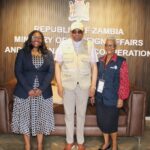


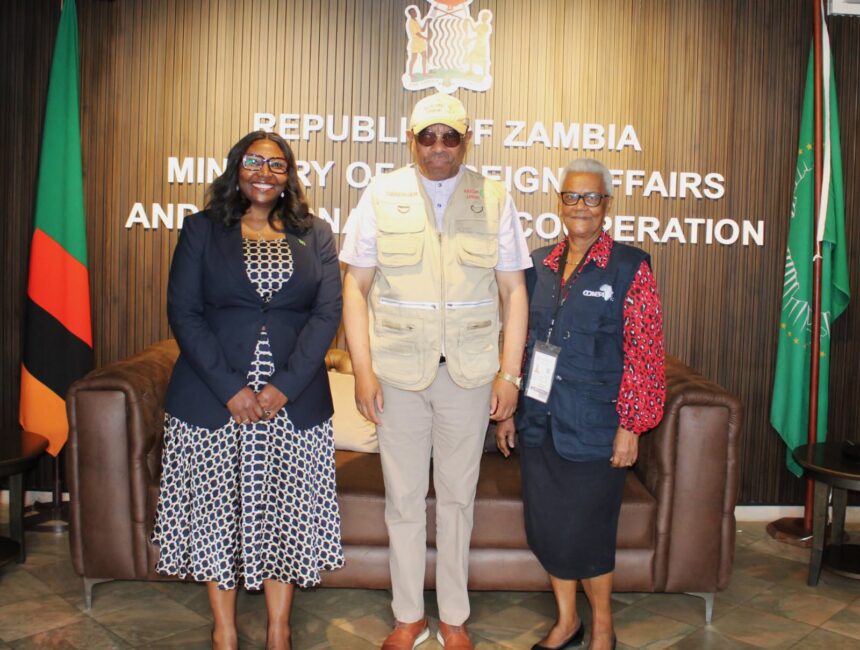
The African Union and Common Market for Eastern and Southern Africa Election Observation Mission to Zambia has commenced its activities ahead of the country’s General Elections scheduled for 13 August 2026. The AU-COMESA Election Observation Mission paid a courtesy call on Ms Etambuyu Anamela Gundersen, Permanent Secretary for International Relations and Cooperation at the Ministry of Foreign Affairs and International Cooperation, at Charter House in Lusaka on 11 August. The engagement provided an opportunity for the Mission and the Zambian Government to discuss preparations for the elections and the importance of maintaining a peaceful democratic environment. The Mission brings together observers from across Africa with experience in elections, governance, human rights and other areas relevant to democratic processes. Its deployment comes at a critical stage as Zambia prepares for voters to exercise their democratic rights across the country.
The AU-COMESA Election Observation Mission is led by His Excellency Hailemariam Dessalegn Boshe, former Prime Minister of the Federal Democratic Republic of Ethiopia. He is accompanied by Ambassador Marie-Pierre Lloyd, a member of the COMESA Committee of Elders from the Republic of Seychelles, along with other members of the Mission. The leadership structure brings together senior African figures with experience in governance and regional affairs. Their presence is intended to support an impartial assessment of the electoral process and provide an independent regional perspective on the conduct of the elections. The Mission’s work is also part of broader continental efforts to strengthen democratic institutions and encourage credible electoral processes across Africa.
Receiving the Mission, Permanent Secretary Gundersen reiterated President Hakainde Hichilema’s assurance that the Government will ensure the elections are conducted in a free, fair and transparent manner. The assurance comes as political parties, candidates, election officials, civil society organisations and voters prepare for polling day. A free and fair election requires citizens to participate without intimidation while political actors and institutions operate within the established legal framework. Transparency is also important because it helps strengthen public confidence in the electoral process and its outcome. The Government’s engagement with the AU-COMESA Mission provides an opportunity for international and regional observers to assess preparations and the environment in which voters will exercise their rights.
Gundersen also assured the Mission that the Government is addressing isolated pockets of violence that have emerged during the electoral period. She said measures have been taken to ensure that law enforcement officers are adequately trained to respect the rights of citizens to assemble and exercise their democratic rights within the confines of the law. The role of security agencies is particularly important during elections because their conduct can influence public confidence and the ability of citizens to participate freely. Training officers on citizens’ rights can help promote responsible policing while maintaining public order. Addressing incidents of violence and ensuring lawful political participation will remain important factors as Zambia moves through the final stages of the electoral process.
The Permanent Secretary commended the AU-COMESA Election Observation Mission for its role in supporting Zambia’s democratic processes and strengthening democracy across the continent. She said the findings and recommendations produced by the Mission would contribute to efforts to strengthen Zambia’s democratic institutions. Election observation missions can provide an external assessment of different stages of an electoral process, including the political environment, voter participation and the conduct of polling. Their recommendations can also identify areas that may require further attention after elections. For Zambia, the involvement of regional and continental observers provides an opportunity to draw lessons that can contribute to the continued improvement of future electoral processes.
His Excellency Boshe congratulated Zambia on sustaining peace and stability, which he said has created a conducive environment for credible elections. He also expressed confidence in Zambia’s capacity to manage any isolated incidents of violence that may occur during the electoral period. Maintaining peace will be particularly important as voters head to polling stations on 13 August and as results are processed thereafter. Political parties, candidates, supporters and citizens all have a role to play in preserving calm and respecting the democratic process. The Mission’s presence across the country is expected to provide additional regional observation while reinforcing the importance of peaceful participation.
The AU-COMESA Election Observation Mission is drawn from 27 countries and comprises 93 Short-Term Observers. The observers include ambassadors accredited to the African Union, representatives from Election Management Bodies, civil society organisations, youth organisations and specialists in elections, human rights, gender and media. This broad composition gives the Mission access to expertise covering several aspects of the electoral process. The inclusion of specialists from different fields can help observers assess the election environment from multiple perspectives rather than focusing only on voting and counting procedures. The diversity of the Mission also reflects the importance of elections as a process involving institutions, communities, political actors, citizens and the media.
The Mission will be deployed across all 10 provinces of Zambia from 11 August to 14 August 2026. Observers will therefore be present during the final preparations for polling, election day and the immediate period following the vote. Their deployment across the country is intended to provide a broad assessment of the electoral environment rather than concentrating observation in Lusaka or other major centres. The presence of observers in different provinces can help the Mission gather information about how electoral preparations and voting are taking place in different communities. It also allows the Mission to consider regional variations when developing its findings and recommendations.
The participation of youth organisations, civil society representatives and gender experts within the Mission is significant because democratic participation extends beyond political parties and government institutions. Young people form an important part of Zambia’s electorate, while civil society organisations often play a role in voter education, civic participation and monitoring electoral developments. Gender expertise can also help assess whether women and other groups are able to participate meaningfully in the electoral process. Media experts can examine issues related to access to information and the broader communication environment surrounding the elections. Bringing these perspectives together can help provide a more comprehensive assessment of Zambia’s 2026 General Elections.
The Mission’s visit to the Ministry of Foreign Affairs and International Cooperation also highlights the importance of cooperation between Zambia and regional and continental organisations during elections. Election observation is intended to support democratic processes rather than replace the responsibilities of national institutions. Zambia’s election authorities, political parties, security agencies, civil society and voters remain central to the conduct of the elections. Regional observers can complement these national efforts by monitoring developments and providing an independent assessment based on established principles and standards. Continued engagement between the Mission and Zambian authorities can therefore help ensure that observers are able to carry out their responsibilities effectively.
As Zambia approaches polling day, the focus will remain on maintaining peace, protecting citizens’ democratic rights and ensuring that electoral procedures are implemented transparently. The Government’s assurances to the AU-COMESA Mission demonstrate its stated commitment to creating conditions that allow citizens to participate in the elections. At the same time, the Mission’s deployment across all 10 provinces will provide an opportunity to observe the electoral process from a broad national perspective. The Mission’s eventual findings and recommendations could provide useful guidance for strengthening Zambia’s democratic institutions and electoral practices. With 93 observers from 27 countries taking part, the AU-COMESA Election Observation Mission is positioned to play an important role in monitoring Zambia’s 2026 General Elections and supporting the country’s continued democratic development.