






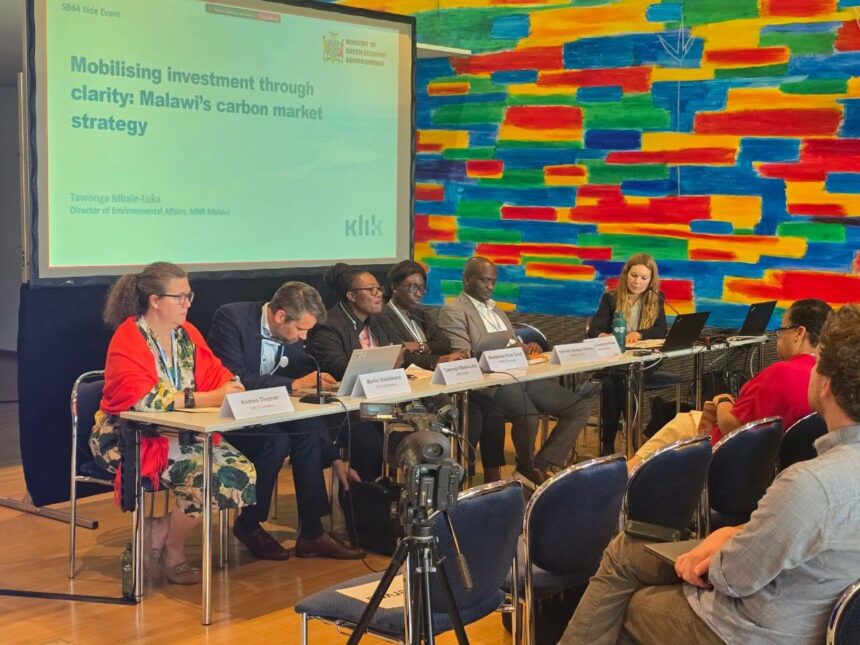
Zambia has strengthened its role in global climate negotiations through active participation at the 64th Subsidiary Body Meetings (SB64) of the United Nations Framework Convention on Climate Change in Bonn, Germany. On 1 July 2026, the Ministry of Green Economy and Environment, working in partnership with the KliK Foundation of Switzerland, hosted a high-level side event focused on the development of national carbon markets. The event was held under the theme “National Carbon Markets in Practice: The Role of Sectoral Clarity on Additional Climate Action Under Article 6.2.” It brought together policymakers, technical experts, and climate finance stakeholders from different regions. The discussions focused on how countries can structure carbon markets that support national climate goals while attracting private sector investment.
The side event featured shared experiences from Zambia, Malawi, Senegal, and Switzerland, creating a platform for practical knowledge exchange on carbon market implementation. Each country presented its progress and challenges in building carbon trading systems aligned with Article 6.2 of the Paris Agreement. The discussions examined how national frameworks can be designed to ensure environmental integrity while supporting economic development. Participants also explored how sectoral definitions influence the effectiveness of carbon market mechanisms. The exchange highlighted the importance of aligning carbon market activities with national climate targets to avoid duplication and inefficiencies.
A major focus of the discussions was the need for clear carbon market frameworks that define the roles of both public and private actors. Delegates emphasized that strong institutional arrangements are essential for ensuring transparency and accountability in carbon trading systems. Countries shared how they are developing coordination mechanisms between ministries, regulatory bodies, and climate finance institutions. The dialogue also addressed the importance of policy coherence to ensure that carbon market activities support broader national development strategies. These frameworks are seen as critical for building trust among international partners and investors.
The event also placed strong emphasis on sectoral clarity as a key driver of successful carbon market implementation. Participants discussed how clearly defined sectoral scopes help avoid overlap between different climate mitigation activities. This clarity ensures that carbon credits are accurately tracked and linked to specific emission reduction efforts. Countries noted that without clear sector definitions, it becomes difficult to measure progress or verify climate results. The discussions highlighted that improved sectoral planning can significantly enhance the credibility of Article 6.2 transactions.
Another key area of focus was the synchronization of Article 6 activities with national climate targets. Delegates stressed the importance of ensuring that carbon market projects are fully aligned with nationally determined contributions. This alignment helps countries avoid double counting of emission reductions while ensuring that carbon trading contributes meaningfully to climate goals. Participants also discussed how national strategies can be integrated into international carbon market systems. The discussions reinforced the need for strong governance structures that can coordinate climate action across multiple sectors.
A central takeaway from the event was the importance of clearly defined eligibility criteria for carbon projects in host countries. Participants agreed that transparent rules are essential for encouraging both public and private sector participation in carbon markets. Clear eligibility standards help investors understand which projects qualify for carbon credits and under what conditions. This reduces uncertainty and improves confidence in carbon finance systems. It also ensures that projects deliver real, measurable, and verifiable climate benefits.
The dialogue further emphasized that well-structured carbon markets can unlock significant climate finance opportunities for developing countries. By providing clear rules and predictable systems, countries can attract investment into renewable energy, forestry, and sustainable land use projects. These investments support both emission reductions and economic development at the local level. Zambia and its partners highlighted the importance of building systems that balance environmental integrity with development needs. This approach ensures that carbon markets deliver long-term benefits for communities and ecosystems.
Through its participation in SB64, Zambia continues to position itself as an active contributor to global climate solutions. The collaboration with Switzerland’s KliK Foundation reflects growing international support for structured and transparent carbon market systems. The discussions in Bonn demonstrated that effective carbon markets require strong institutions, clear policies, and coordinated action across sectors. Zambia’s engagement in these discussions reinforces its commitment to advancing climate resilience and sustainable development. The outcomes of the side event are expected to support future improvements in Article 6.2 implementation and strengthen global cooperation on climate action.