




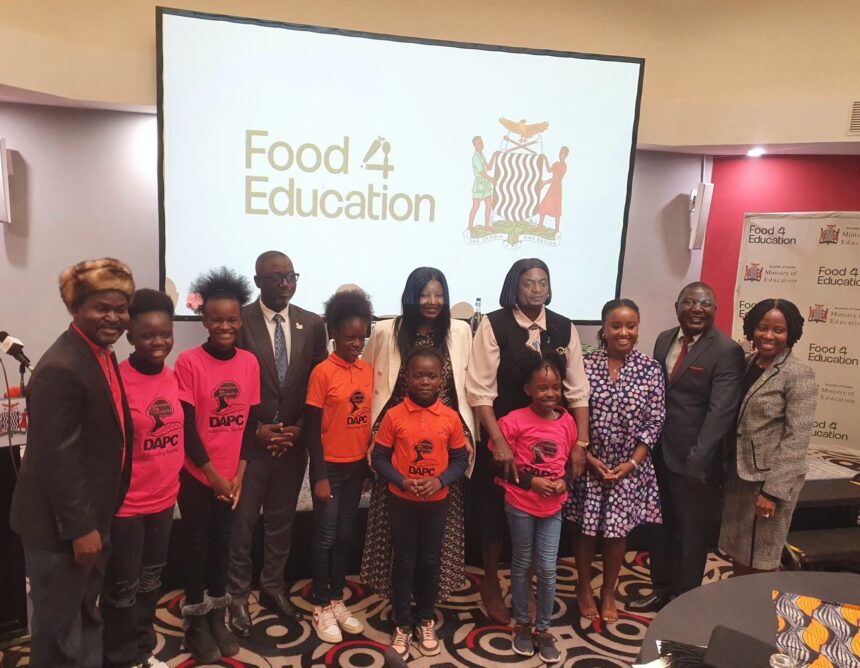
The Ministry of Education in Zambia has entered into a new memorandum of understanding with Food 4 Education aimed at strengthening the country’s school feeding programme through technical support, innovation, and knowledge sharing. The agreement is expected to improve how meals are delivered to learners across the country while also enhancing efficiency and accountability in programme management. The signing ceremony took place in Lusaka and brought together government officials and partners focused on child nutrition and education outcomes. This partnership reflects Zambia’s growing commitment to linking education with nutrition to improve learner performance. It also highlights a broader effort to build stronger systems that support vulnerable children in schools.
Speaking at the signing ceremony, Ministry of Education Permanent Secretary for Technical Services Kelvin Mambwe reaffirmed that the Ministry will continue to lead the school feeding programme while benefiting from the expertise of Food 4 Education. He noted that the organisation has extensive experience supporting similar programmes across Africa, which will help strengthen Zambia’s approach. Dr Mambwe emphasized the importance of improving local procurement systems to ensure communities are actively involved in supplying food for schools. He also pointed to the need for better data-driven decision-making to improve planning and resource allocation. According to him, stronger monitoring and accountability systems will help ensure that the programme delivers consistent results.
Dr Mambwe further explained that Zambia has a unique opportunity to improve learning outcomes through a well-structured school feeding system. He said that strengthening nutrition in schools contributes directly to better concentration and improved academic performance among learners. He also highlighted that such programmes have been proven across Africa to increase school enrolment and reduce dropout rates. In addition, he stressed the importance of building healthier and more productive future generations through consistent access to nutritious meals. His remarks reinforced the idea that school feeding is not only a welfare initiative but also a long-term investment in national development.
Food 4 Education Chief Executive Officer Wawira Njira outlined the key areas of focus under the four-year memorandum of understanding. She explained that the partnership will focus on policy and institutional coordination to ensure smoother implementation of school feeding systems. Other priority areas include programme design, operational systems, digital innovation, and improved financing models. Ms Njira also noted that infrastructure development will play a key role in ensuring safe and efficient meal preparation. The goal is to build systems that can operate at scale while maintaining quality and cost efficiency.
Ms Njira further revealed plans to develop model kitchens and centralised facilities that will support the preparation of nutritious meals for learners. These facilities will be designed to meet safety standards while improving efficiency in food production and distribution. She stated that data systems will be developed to allow real-time monitoring of food delivery and programme performance. The partnership will also involve working with development partners to mobilise additional resources. According to her, collaboration will be essential in ensuring long-term sustainability and impact of the programme.
Head of the Presidential Delivery Unit, Kusobile Kamwambi, highlighted the impact of the school feeding programme in returning more than 2.6 million learners to the education system. She noted that this growth has led to the expansion and scaling up of the programme to accommodate increased demand. Ms Kamwambi emphasized that the Presidential Delivery Unit is also supporting complementary initiatives such as digitalising schools, improving energy access, and expanding water and sanitation systems. These interventions are aimed at ensuring that free education is not only accessible but also delivered with quality. She stressed that these supporting systems are essential for creating a conducive learning environment.
Permanent Secretary in the Office of the Vice President Lillian Kapusana added that the memorandum of understanding represents a major step in strengthening school feeding systems in Zambia. She said the partnership will help position the country as a regional leader in school feeding innovation and child nutrition. According to her, improved coordination and technical support will enhance efficiency across all levels of programme delivery. She also noted that the initiative aligns with broader national goals of improving education outcomes and social development. The agreement is expected to bring lasting improvements to how schools support learners’ nutritional needs.
The new partnership between Zambia’s Ministry of Education and Food 4 Education marks a significant move toward improving both education and child nutrition outcomes. By combining government leadership with technical expertise from an experienced organisation, the programme is expected to become more efficient, scalable, and impactful. The focus on data systems, infrastructure, and community involvement reflects a modern approach to school feeding that prioritises sustainability. As implementation begins, the collaboration is set to strengthen learning environments across the country. Zambia’s commitment to improving school nutrition signals a long-term investment in the health, education, and future productivity of its young population.