






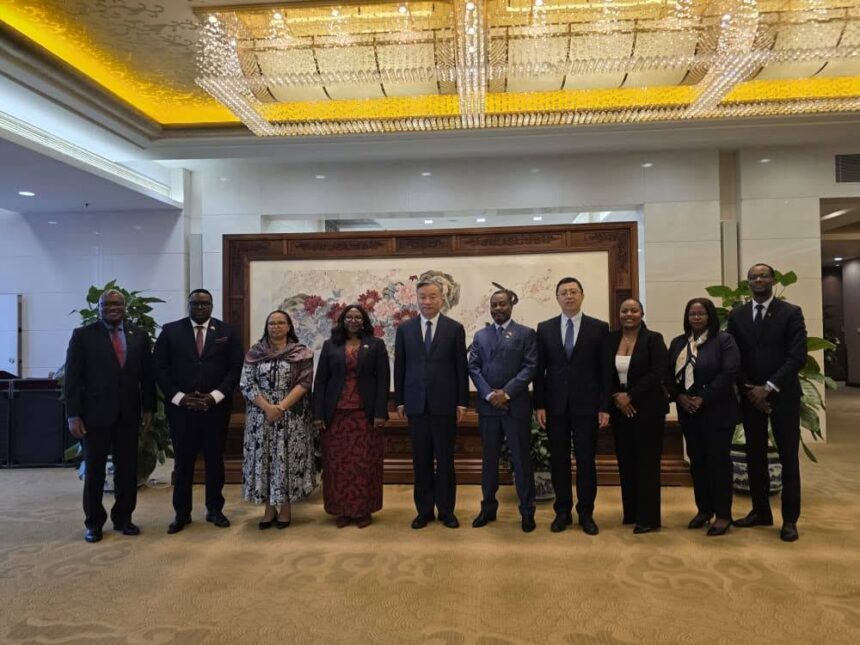
Zambia and China have marked a significant milestone in their long-standing diplomatic relationship by successfully holding the inaugural session of Political Consultations in Beijing. The engagement reflects the continued strengthening of bilateral ties that have existed since 1964 and have now been elevated to a Comprehensive and Cooperative Strategic Partnership. The discussions brought together senior government officials from both countries to deepen cooperation across political, economic, and development sectors. The meeting also reinforced shared ambitions for sustainable development, regional stability, and expanded economic collaboration. This new platform is expected to serve as a structured mechanism for regular dialogue and enhanced coordination between the two nations.
Speaking during the opening session, Ms. Etambuyu Anamela Gundersen, Permanent Secretary for International Relations and Cooperation at Zambia’s Ministry of Foreign Affairs and International Cooperation, highlighted the importance of Zambia’s enduring friendship with China. She noted that the relationship is built on mutual trust, respect, and a shared understanding of global priorities such as sustainable development and international peace and security. She emphasised that the Political Consultations provide an opportunity for both sides to exchange views on how to further strengthen bilateral relations. According to her, the platform will also support the expansion of trade, investment, and people-to-people exchanges between the two countries. Her remarks reflected Zambia’s commitment to deepening cooperation in a structured and mutually beneficial manner.
Ms. Gundersen further pointed out that Zambia and China have maintained strong diplomatic relations since establishing formal ties in 1964. She explained that the consultations offer a valuable opportunity to review progress and identify new areas of cooperation. The discussions are expected to enhance political dialogue while also promoting economic collaboration across key sectors. She stressed that closer engagement will help both countries respond more effectively to global and regional challenges. Her address highlighted the importance of continuity in diplomatic engagement and the need to translate high-level commitments into practical outcomes.
A key highlight of the discussions was the increased frequency of high-level exchanges between Zambia and China in recent years. Among the most notable engagements was President Hakainde Hichilema’s State Visit to China in 2023, which helped reinforce bilateral cooperation at the highest political level. In 2024, the President also attended the Forum on China-Africa Cooperation (FOCAC) Heads of State Summit, further strengthening Zambia’s engagement within broader Africa-China relations. Additionally, the visit of His Excellency Mr. Li Qiang, Premier of the State Council of China, to Zambia in November 2025 stood out as a major diplomatic milestone. During that visit, the two countries participated in the groundbreaking ceremony of the TAZARA revitalisation project, a key infrastructure initiative aimed at improving regional connectivity.
Ms. Gundersen also welcomed the elevation of bilateral relations to a Comprehensive Strategic Partnership in 2023, describing it as a turning point in Zambia-China cooperation. She noted that this upgrade has already delivered tangible benefits in multiple sectors of the economy. Zambia, she said, is particularly interested in expanding cooperation in strategic areas such as energy, infrastructure development, mining, and agriculture. These sectors are central to Zambia’s economic transformation agenda and align closely with China’s investment and development expertise. She emphasised that deeper collaboration in these areas will support job creation, industrial growth, and improved national productivity.
On the Chinese side, His Excellency Mr. Miao Deyu, Vice Minister of Foreign Affairs of the People’s Republic of China, described the Political Consultations as an important platform for advancing both bilateral and multilateral relations. He noted that the discussions provide an opportunity to address shared interests and global issues affecting peace and stability. He reaffirmed China’s commitment to working closely with Zambia in promoting development cooperation and strengthening diplomatic ties. His remarks underscored China’s view of Zambia as a key partner in Africa and an important participant in global development cooperation frameworks. The consultations therefore serve as a bridge for continuous dialogue and policy alignment between the two countries.
The two delegations discussed a wide range of issues of mutual interest, including ongoing joint projects in Zambia and opportunities for expanding trade cooperation. A key area of discussion was the implementation of zero tariffs by China on certain Zambian agricultural exports, a move expected to boost Zambia’s export capacity and support local farmers. The talks also covered regional and international cooperation, with both sides exchanging views on global economic trends and development challenges. Infrastructure development, energy expansion, and agricultural modernisation were identified as priority areas for enhanced collaboration. The discussions reflected a shared commitment to practical cooperation that delivers measurable benefits for both countries.
Overall, the inaugural Political Consultations in Beijing reaffirmed the strong and enduring friendship between Zambia and China. The meeting signaled a renewed commitment to building a more dynamic and results-oriented partnership focused on shared development goals. By establishing a formal platform for regular dialogue, both countries have strengthened their ability to coordinate on strategic issues and deepen cooperation across key sectors. The consultations also highlighted the importance of sustained high-level engagement in advancing bilateral relations. As Zambia and China continue to expand their partnership, the focus remains on translating diplomatic goodwill into tangible development outcomes that benefit both nations.