







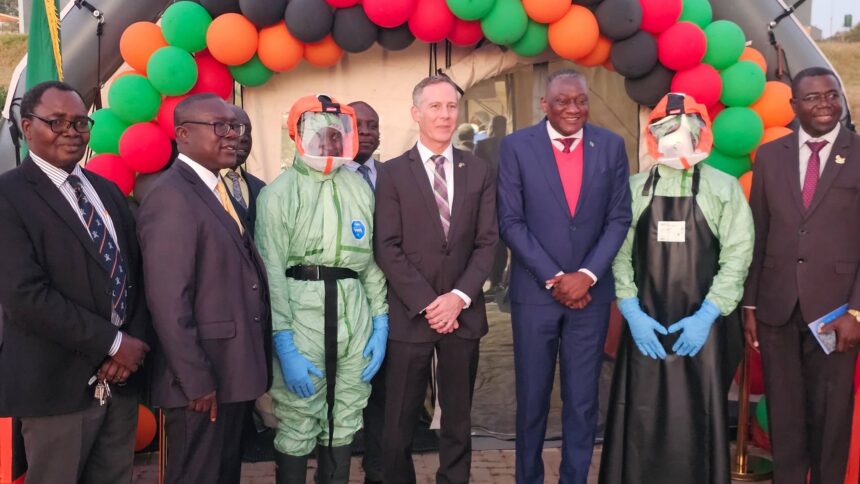
The Government of Zambia is accelerating its efforts to build a stronger and more responsive health system through major investments in surveillance infrastructure, laboratory capacity, emergency preparedness, workforce development, and multisectoral coordination under the One Health framework. This direction was reinforced during the official handover of mobile laboratories to the Zambia National Public Health Institute. These mobile units are designed to extend diagnostic services beyond fixed facilities and reach communities in remote and underserved areas. Health officials say the investment will improve how quickly the country detects and responds to disease threats. It also supports a broader national goal of building a resilient health system that protects all citizens.
Speaking at the handover ceremony, Dr Kennedy Lishimpi, Permanent Secretary for Technical Services at the Ministry of Health, emphasized the strategic value of the mobile laboratories. He noted that they will significantly improve access to quality laboratory services in hard-to-reach locations where fixed infrastructure is limited. He also highlighted that faster testing will reduce turnaround times and allow health teams to make quicker, evidence-based public health decisions. This capability is critical during outbreaks when delays in diagnosis can lead to wider spread of disease. The mobile units therefore represent a practical tool for strengthening national surveillance systems.
The deployment of mobile laboratories also strengthens Zambia’s readiness to respond to priority diseases and emerging public health threats. These units will support routine surveillance activities while also being rapidly deployed during emergency response operations. Health authorities view this flexibility as a major advantage in a country with diverse geographic and logistical challenges. Remote communities often face delays in accessing diagnostic services, which can weaken disease monitoring systems. With mobile labs in place, testing can be brought directly to the point of need, improving early detection and containment efforts.
Dr Lishimpi further stressed that the investment contributes directly to Zambia’s objective of building a resilient health system. He explained that resilience depends on the ability to detect, respond, and recover from health shocks without overwhelming existing services. The mobile laboratories add a layer of capacity that strengthens both routine health services and emergency preparedness. They also complement ongoing investments in fixed laboratory networks across the country. This combined approach ensures that no region is left without access to essential diagnostic support.
The Permanent Secretary commended the Zambia National Public Health Institute for its leadership in coordinating surveillance, emergency preparedness, and outbreak response activities. Since its establishment, the institute has played a central role in strengthening Zambia’s public health security architecture. It has improved coordination between national and subnational health structures while enhancing data-driven decision-making. Its work has also positioned Zambia as an active contributor to regional and global health security efforts. The introduction of mobile laboratories adds further strength to its operational capacity.
Strong collaboration among key stakeholders was also highlighted as a major driver of progress. The Ministry of Health, the Zambia National Public Health Institute, One Health line ministries, and cooperating partners have worked together to support the initiative. This multisectoral approach reflects the reality that public health threats often cross human, animal, and environmental boundaries. Coordinated action across these sectors improves surveillance accuracy and response efficiency. It also ensures that interventions are aligned and sustainable over time.
The One Health framework remains central to Zambia’s health security strategy. It integrates human health, animal health, and environmental health systems into a unified approach for managing disease risks. This model is especially important for controlling zoonotic diseases and emerging infections. The mobile laboratories strengthen this framework by improving field-level diagnostics and data collection. They also enable faster sharing of information between sectors involved in outbreak management.
The introduction of mobile laboratory units marks a significant step forward in Zambia’s public health development. It expands access to diagnostic services, improves response times, and strengthens national surveillance capacity. It also reflects a broader investment strategy focused on preparedness rather than reaction. With continued collaboration and sustained investment, Zambia is positioning itself to better manage current and future public health threats. The initiative reinforces a national commitment to protecting communities through stronger systems, better coordination, and timely scientific evidence.