






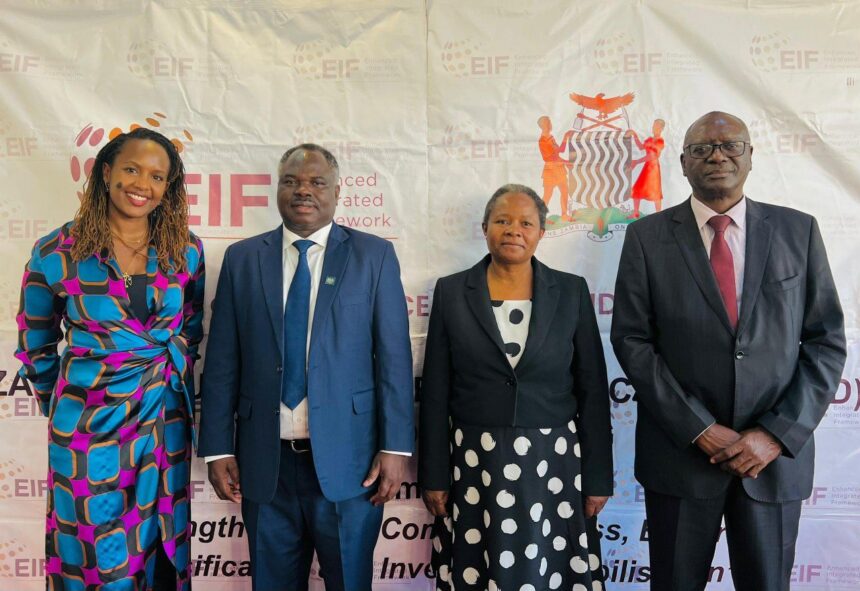
Government, private sector players, and development partners today validated the Zambia Enhanced Integrated Framework Phase III Country Programme Document, a five-year initiative valued at USD 3.5 million aimed at strengthening trade institutions and expanding export opportunities in regional and global markets. The programme represents a coordinated national effort to reposition Zambia’s trade sector through improved competitiveness, stronger value chains, and increased private investment. It will be implemented from 2026 to 2031 under the Ministry of Commerce, Trade and Industry through the National Implementation Unit under the Enhanced Integrated Framework Phase III. The initiative is designed to support export diversification and industrialisation while addressing long-standing structural challenges in trade development. It also reflects a broader commitment to inclusive economic growth and job creation across key productive sectors.
The programme is themed “Strengthening Trade Institutions and Beef Value Chain for Regional and Global Markets” and places strong emphasis on developing export-ready sectors that can compete effectively in regional and international markets. It responds directly to findings and recommendations from the Diagnostic Trade Integration Study Update and the WTO Trade Policy Review. It is also aligned with Zambia’s Eighth National Development Plan, which prioritises economic diversification, industrialisation, and private sector-led growth. Through this alignment, the programme aims to ensure policy consistency and coordinated implementation across government institutions and development partners. It further seeks to strengthen the link between trade policy and practical economic outcomes at enterprise and producer levels.
By 2031, the programme is expected to deliver significant measurable outcomes that will reshape Zambia’s export landscape. These include a 15 percent increase in non-traditional exports and support for 300 export-ready small and medium enterprises across priority sectors. It also targets the integration of 3,000 producers into structured value chains that can access regional and global markets more effectively. In addition, the programme is expected to mobilise over USD 30 million in private investment into export-oriented industries. It further prioritises increased participation of women- and youth-led enterprises in export markets to ensure inclusive economic participation.
Opening the validation meeting in Lusaka, Permanent Secretary for Commerce and Trade Ms. Lillian S. Bwalya described the document as a major milestone in Zambia’s economic transformation agenda. She stated that the Country Programme Document goes beyond a technical framework and represents a strategic roadmap for national development. According to her, trade must now be viewed as a driver of industrialisation, a catalyst for investment, and a platform for enterprise growth. She emphasised that the global economy is increasingly driven by competitiveness, innovation, efficiency, and institutional strength rather than reliance on natural resources alone. She also highlighted the importance of regional integration through COMESA, SADC, and the African Continental Free Trade Area as key platforms for expanding Zambia’s trade opportunities.
Ms. Bwalya further noted that the Enhanced Integrated Framework continues to play a critical role in supporting Least Developed Countries in building trade capacity. However, she explained that EIF Phase Three introduces a more focused shift toward catalytic financing and investment-driven programming. This approach prioritises enterprise competitiveness, private sector participation, and scalable economic transformation. She said the new phase is designed to ensure that trade programmes deliver tangible economic results rather than remain purely policy driven. Her remarks underscored the importance of aligning national programmes with global trade realities and investment trends.
EIF Executive Director Ms. Aissatou Diallo also addressed the meeting and emphasized that Phase Three places trade and investment at the centre of economic transformation. She explained that the approach focuses on country-owned programmes that can unlock investment, strengthen enterprises, and create sustainable opportunities for citizens. She described Zambia’s Country Programme Document as both ambitious and practical in its design and implementation focus. She highlighted its targeted emphasis on the beef value chain as a strategic area for value addition, competitiveness, and export growth. She also noted that the programme aligns with broader goals of export diversification, enterprise development, and investment promotion, including opportunities linked to value addition and critical minerals.
In a vote of thanks, Zambia Development Agency Director General Albert Halwampa reaffirmed the agency’s commitment to supporting the implementation of the programme. He described the validated framework as a forward-looking strategy that will strengthen trade competitiveness, export diversification, and investment mobilisation. He commended the Ministry of Commerce, Trade and Industry for its leadership in driving the preparation and validation process. He also acknowledged the contributions of development partners, technical experts, government institutions, and private sector representatives who participated in the process. He said their involvement demonstrated strong national ownership of Zambia’s trade and economic transformation agenda.
Mr. Halwampa further emphasized that the discussions highlighted the importance of collaboration in positioning trade and investment as key drivers of growth. He expressed particular support for the programme’s focus on investment facilitation and private sector development. He singled out the proposed Investor One Stop Shop as a major reform initiative that could improve investor experience and reduce administrative bottlenecks. He said it would also strengthen institutional coordination and lower transaction costs for investors entering the Zambian market. He added that such reforms would enhance Zambia’s competitiveness as an investment destination.
The validation of the Country Programme Document marks a significant step in Zambia’s long-term strategy to expand exports and attract investment into productive sectors. With its focus on value chains, enterprise development, and institutional strengthening, the programme is positioned to support structural transformation in the economy. It brings together government, private sector, and development partners under a unified framework aimed at delivering measurable economic impact. As implementation begins in 2026, attention will shift to how effectively the programme translates policy into results on the ground. Its success will depend on sustained coordination, strong institutional capacity, and active participation from all stakeholders involved in Zambia’s trade ecosystem.