







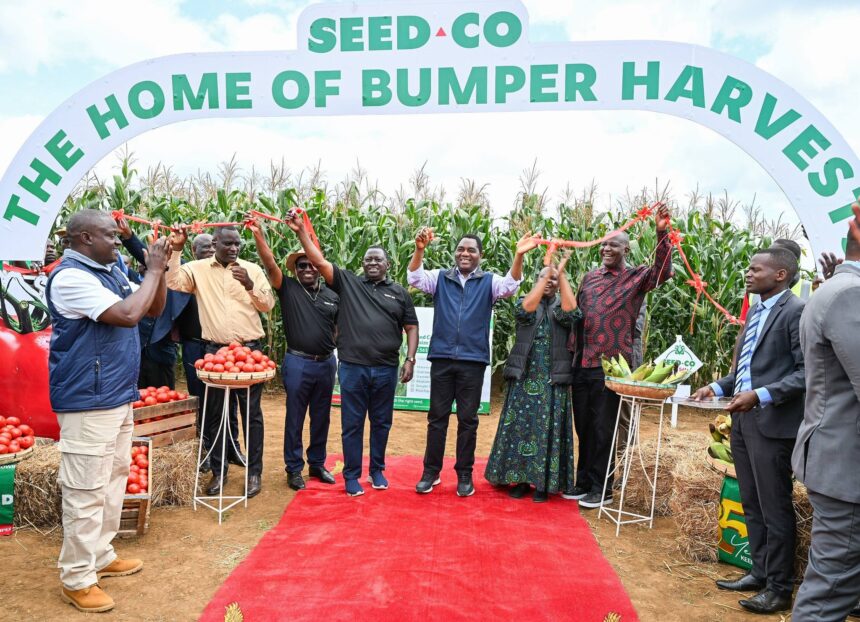
Yesterday afternoon, the Seed-Co National Field Day in Chilanga District provided a platform to showcase the country’s agricultural potential and reaffirm national targets for crop production. President Hakainde Hichilema used the occasion to emphasize the government’s goal of producing 10 million tonnes of maize and one million tonnes each of wheat and soya beans by 2031. The event brought together farmers, agricultural experts, and industry stakeholders to discuss strategies for improving yields, adopting modern farming techniques, and strengthening supply chains. Participants observed live demonstrations of high-yield crop varieties, improved seed technologies, and efficient farming practices aimed at boosting productivity. The field day underscored the importance of collaboration between government institutions and private sector innovators to drive sustainable agricultural growth.
Seed-Co’s role in enhancing farmer productivity was central to the discussions, with its innovative seed varieties and farming solutions highlighted as key drivers for achieving national production goals. The company has invested in research and development to create drought-resistant and high-yield maize, wheat, and soya bean seeds tailored to Zambia’s diverse agro-ecological zones. These innovations allow farmers to optimize land use, reduce losses from pests and unpredictable weather, and increase profitability. Training sessions at the field day focused on best practices for planting, fertilization, irrigation, and crop management. Such initiatives demonstrate how public-private partnerships can create an ecosystem that supports both smallholder farmers and commercial agricultural operations.
The event also addressed broader national food security concerns, noting that consistent production increases are vital to meet the nutritional needs of Zambia’s growing population. President Hichilema stressed that achieving these targets would reduce dependence on imports, stabilize food prices, and improve resilience against climate-related shocks. Attendees discussed the integration of digital tools, precision farming techniques, and sustainable practices to maximize efficiency while conserving resources. The field day reinforced the government’s commitment to supporting farmers through policy frameworks, subsidies, and extension services. It also provided a platform for farmers to share experiences, learn from peers, and adopt innovations that directly impact productivity.
The Seed-Co National Field Day serves as a model for agricultural engagement, highlighting the synergy between government initiatives and private sector expertise. By setting ambitious production targets and equipping farmers with the necessary tools, Zambia is positioning itself to achieve long-term food security and economic growth. President Hichilema’s participation reaffirmed the political will behind these efforts, sending a strong signal that agriculture remains a national priority. The event demonstrated that with continued investment in research, farmer education, and technology adoption, the country can achieve sustainable increases in maize, wheat, and soya bean production. As these strategies take root, Zambia is on track to meet its 2031 targets and ensure a stable, secure food supply for its citizens.