







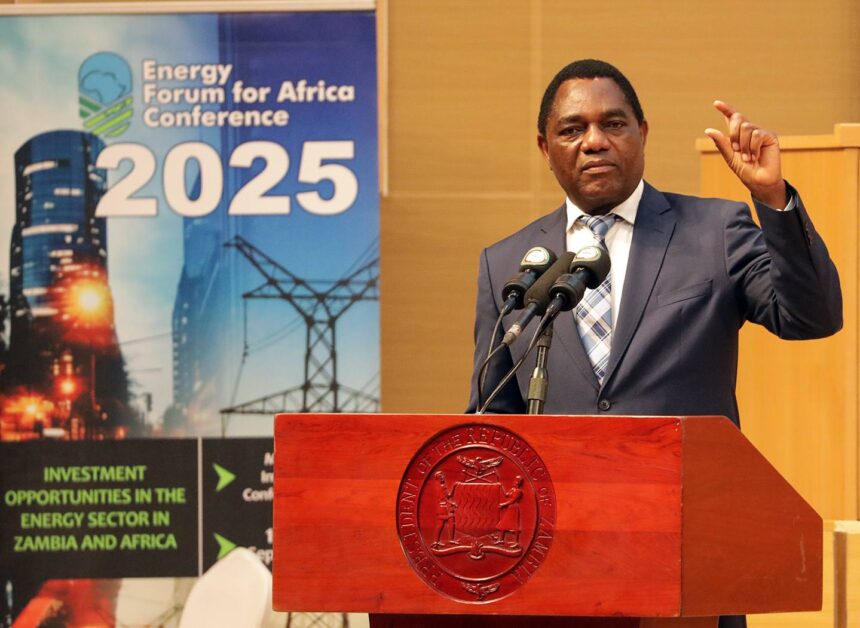
Yesterday, Lusaka hosted the official opening of the 2025 Energy Forum for Africa. The conference has attracted industry leaders, policy-makers, researchers, and innovators from across the continent and beyond. The forum focuses on addressing Africa’s energy challenges while exploring investment opportunities in Zambia and the broader region.
This year’s theme, Investment Opportunities in the Energy Sector in Zambia and Africa, highlights the urgent need for increased investment to address the continent’s energy deficit. President Hakainde Hichilema called on the global investment community to double their commitments to Africa’s energy sector.
“Our government continues to implement energy reforms designed to attract investment and improve the livelihoods of our people,” President Hichilema said. He emphasized that the ultimate goal of the conference is the generation and distribution of power. He urged participants to present a clear checklist of specific deliverables at the end of the meeting.
President Hichilema underlined the critical role of electricity in Zambia’s economy. He stated that mines, businesses of all sizes, and households rely on reliable energy. “Energy and electricity in particular is everything. Our mines, our big, small and medium businesses, all need electricity, and more importantly, our people need electricity for their homes,” he said.
The forum also serves as a platform for discussing practical strategies to power domestic and commercial activities sustainably. Delegates are expected to propose actionable solutions that can improve electricity generation, distribution, and access across the region.
The 2025 Energy Forum for Africa positions Zambia as a hub for energy investment and innovation. By fostering dialogue between public and private stakeholders, the conference aims to accelerate energy development, improve access, and drive economic growth across the continent.
President Hichilema concluded by reaffirming Zambia’s commitment to creating a robust energy sector that supports both economic and social development.