





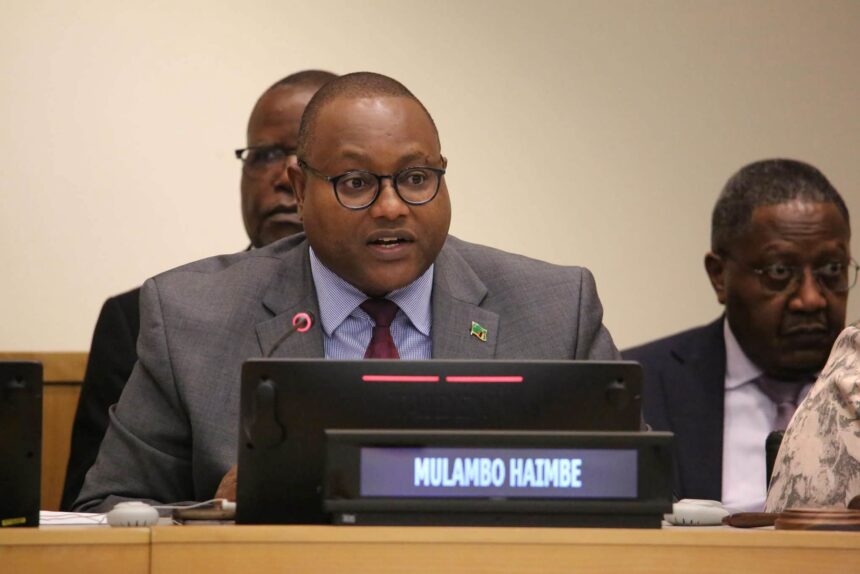
Zambia has reaffirmed its commitment to the implementation of the Pact for the Future, with Foreign Affairs and International Cooperation Minister Mulambo Haimbe stressing that the global agreement can only succeed through collective responsibility. Haimbe made the remarks during a high-level event examining Africa’s progress, challenges and opportunities two years after the adoption of the Pact for the Future. The event brought together African leaders, regional institutions, United Nations officials, ministers, youth representatives and civil society organisations to assess how commitments made at the global level can translate into practical results. Discussions focused on issues including sustainable development, peace and security, digital transformation, development financing and the role of young people in shaping the future. Zambia’s participation also highlighted the country’s growing engagement in international discussions on digital cooperation and reform of the global financial system.
The Pact for the Future was adopted by the United Nations General Assembly in 2024 as a framework aimed at strengthening multilateral cooperation and responding to major global challenges. Its areas of focus include sustainable development, international peace and security, digital transformation, financing for development and the interests of youth and future generations. The agreement reflects the view that many challenges facing countries cannot be addressed effectively through isolated national action. Climate change, technological development, debt, poverty and international security all have cross-border dimensions that require cooperation between governments and institutions. For Zambia and other African countries, implementation is particularly important because global commitments must ultimately produce practical improvements in development, investment, technology access and living conditions.
Speaking at the event, Haimbe said the Pact for the Future represented a collective commitment and that its implementation must also be treated as a collective responsibility. His remarks placed emphasis on moving beyond the adoption of international agreements toward concrete national and regional action. The Minister stressed the importance of bringing the Pact home by translating its commitments into measurable outcomes. This approach requires governments and international institutions to identify practical priorities and establish mechanisms for tracking progress. It also places responsibility on countries to connect global commitments with national development strategies and the Sustainable Development Goals.
The high-level event, titled “Two Years After the Pact for the Future: Progress on Implementation, Challenges and Opportunities for Africa,” was co-hosted by Namibia and Zambia together with the United Nations Economic Commission for Africa, the African Union, the Executive Office of the UN Secretary-General and the Office of the Special Adviser on Africa. Namibia’s President Netumbo Nandi-Ndaitwah moderated the event. Participants included Kenya’s President William Ruto, Senegal’s President Bassirou Diomaye Faye, SADC Executive Secretary Elias M. Magosi, African Union representatives and senior United Nations officials. Youth representatives and civil society participants also contributed to the discussions, bringing perspectives from outside government and traditional diplomatic institutions.
One of the key areas highlighted by Haimbe was Zambia’s role in co-facilitating the Global Digital Compact and the Sevilla Commitment. These responsibilities place Zambia within international discussions on digital cooperation and development financing. The Global Digital Compact is moving into an implementation phase that includes work through the Independent International Scientific Panel on Artificial Intelligence and the Global Dialogue on AI Governance. These mechanisms are intended to contribute to international discussions on the development and governance of artificial intelligence. For African countries, participation in these processes provides an opportunity to raise issues surrounding access to technology, digital inclusion, innovation and the governance of emerging technologies.
The Sevilla Commitment, meanwhile, is connected to efforts to reform the international financial architecture. Development financing remains a major concern for many African countries as governments face pressure from debt servicing costs, borrowing conditions and limited fiscal space. Reform discussions seek to address how international financial systems can better support development priorities while responding to the financing needs of developing countries. Zambia’s involvement in these multilateral processes gives the country a platform to contribute to discussions on the financial challenges facing developing economies. The issue is particularly relevant to African countries seeking resources to finance infrastructure, social services, climate action and economic development.
Participants at the event examined several challenges affecting Africa’s development prospects. These included high borrowing costs, debt servicing pressures, poverty, hunger, inequality and access to basic services. The discussions also addressed technology transfer and illicit financial flows, which remain important issues in efforts to strengthen domestic resources and support economic development. International tax cooperation was another area of discussion as countries consider ways to improve the fairness and effectiveness of global financial systems. Addressing these challenges requires cooperation at national, regional and international levels because many of the factors influencing development extend beyond individual countries.
Youth empowerment featured prominently in the discussions surrounding implementation of the Pact for the Future. Africa has a large and growing young population, making youth participation an important consideration in economic development, governance and social policy. The Pact specifically recognises the interests of youth and future generations, creating a framework for their concerns to be incorporated into global decision-making. Participants therefore considered how young people can have a meaningful role in shaping policies that affect their economic opportunities and future prospects. Ensuring that youth perspectives are reflected in national and international policy processes is also connected to broader efforts to accelerate sustainable development.
Digital transformation was another major theme of the event, particularly as technological change continues to influence economies and societies. Digital technologies can create opportunities in areas such as education, business, financial services and public administration, but access and governance remain important concerns. Discussions around the Global Digital Compact and artificial intelligence reflect the need to ensure that technological progress benefits countries and communities across different regions. Technology transfer was also identified as part of the broader development challenge facing Africa. The continent’s participation in global digital governance discussions can help ensure that African priorities are considered as international rules and approaches to emerging technologies develop.
The event also noted areas where progress has been recorded. Participants highlighted that 50 million more Africans now have access to electricity, representing an increase in energy access across the continent. Climate commitments and progress involving the monitoring of the Global Digital Compact were also noted. Participants further recognised progress toward a United Nations Framework Convention on International Tax Cooperation. These developments were discussed alongside continuing challenges, showing that implementation of the Pact for the Future involves both recognising gains and identifying areas where further action remains necessary. The combination of progress and persistent challenges reinforces the importance of continued international cooperation.
The discussions also placed emphasis on accelerating implementation of the Sustainable Development Goals. The SDGs provide a broad international framework covering poverty reduction, health, education, economic development, environmental sustainability and other areas of human development. The Pact for the Future is connected to these objectives through its focus on sustainable development and stronger multilateral cooperation. For African countries, faster progress will require financing, effective institutions, technology and policies that respond to national circumstances. Turning international commitments into measurable improvements will therefore remain a central challenge for governments and development partners.
Haimbe’s participation also coincided with Zambia’s broader diplomatic engagements during the United Nations General Assembly period. In a separate engagement, the Foreign Affairs and International Cooperation Minister signed a Joint Communique establishing diplomatic relations between Zambia and the Principality of Andorra. The agreement formally establishes diplomatic relations between the two countries and creates a framework for greater bilateral engagement. Haimbe and Andorra’s Minister of Foreign Affairs, Imma Tor Faus, also reaffirmed sustainable tourism as a shared priority. They identified sustainable tourism as an area with potential to contribute to climate action, employment and education.
The focus on sustainable tourism reflects the wider connection between economic development and environmental sustainability. Tourism can contribute to employment and economic activity, while sustainable approaches seek to manage environmental impacts and protect resources for future generations. Cooperation between Zambia and Andorra in this area could provide a platform for discussions around tourism development, education and climate-related priorities. The establishment of diplomatic relations also creates opportunities for the two countries to strengthen communication and explore areas of mutual interest. The engagement forms part of Zambia’s broader diplomatic activity during the United Nations General Assembly period.
Haimbe is representing President Hakainde Hichilema at the 81st United Nations General Assembly and is scheduled to deliver Zambia’s statement during the General Debate on Monday, 28th September 2026. His participation provides Zambia with an opportunity to present its perspectives on international development, multilateral cooperation and issues affecting African countries. The country’s involvement in the Pact for the Future discussions, the Global Digital Compact and the Sevilla Commitment also demonstrates its engagement in several major areas of the international development agenda. These platforms provide opportunities for Zambia to contribute to debates on digital governance, development finance and reform of multilateral institutions. They also place emphasis on ensuring that global commitments produce practical benefits at national and regional levels.
Zambia’s reaffirmation of collective responsibility for implementing the Pact for the Future highlights the gap that can exist between international commitments and measurable outcomes. The discussions in New York brought attention to major issues facing Africa, including development financing, debt, poverty, inequality, digital transformation, youth empowerment and international tax cooperation. Zambia’s role in global digital and financial discussions provides an opportunity for the country to contribute to international efforts while advancing issues relevant to its own development priorities. The establishment of diplomatic relations with Andorra adds another dimension to Zambia’s international engagement, with sustainable tourism identified as an area of shared interest. As the implementation of the Pact for the Future continues, the focus will increasingly be on translating commitments into national action, measurable results and stronger opportunities for current and future generations.