







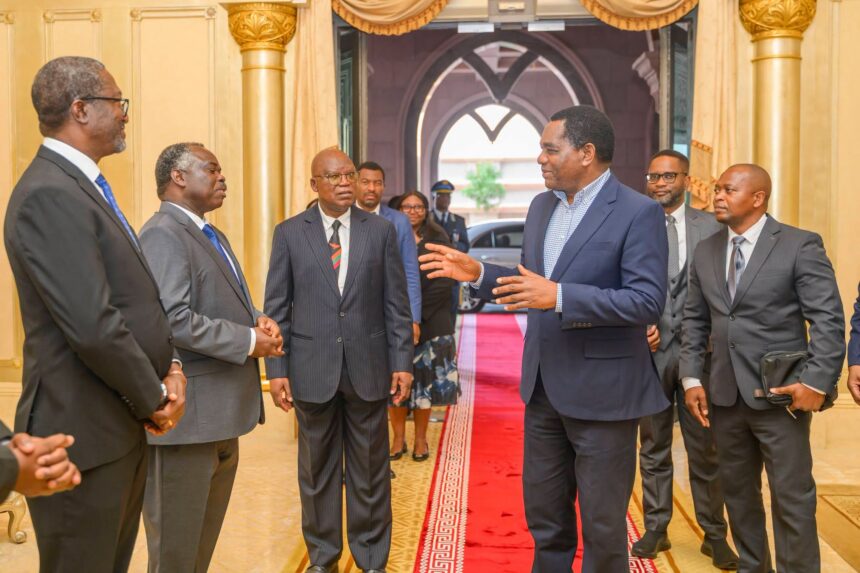
President Hakainde Hichilema has arrived safely in Abu Dhabi, United Arab Emirates, for a two-day working visit focused on strengthening international partnerships and attracting more inward investment to Zambia. The visit forms part of the government’s broader Grow Zambia agenda, which places economic growth, investment, trade and private sector participation at the center of national development efforts. Hichilema’s message to citizens highlights the importance of international cooperation as Zambia seeks to expand economic opportunities and strengthen its position as an investment destination. The engagement with the United Arab Emirates also reflects the growing economic relationship between the two countries. For Zambia, the key issue is how diplomatic discussions can translate into investment, business activity, industrial development and opportunities for citizens.
The President’s arrival in Abu Dhabi comes at a time when Zambia is placing greater emphasis on economic diplomacy. The government has described economic diplomacy as an important part of its approach to attracting investment and expanding trade with international partners. This approach involves using diplomatic relationships to create opportunities for businesses, investors and institutions while promoting Zambia’s economic interests abroad. The United Arab Emirates is an important partner in this effort because of its strong commercial networks, investment capacity and role as a major international business center. Hichilema’s visit therefore carries an economic focus alongside its diplomatic importance.
The two-day working visit is expected to provide an opportunity for Zambia and the UAE to deepen cooperation in several areas of mutual interest. Discussions are expected to cover investment, trade and economic cooperation, with particular attention to sectors that can support long-term growth in Zambia. These areas include mining and mineral value addition, agriculture, energy, infrastructure, transport and logistics, tourism and healthcare. The focus on value addition is particularly important because it involves processing raw materials within Zambia rather than relying mainly on the export of unprocessed commodities. Greater investment in processing and industrial activity could help connect Zambia’s natural resources with manufacturing, services and employment opportunities.
Mining remains one of the most important areas of potential cooperation between Zambia and international investors. Zambia has significant mineral resources and is internationally known for its copper production, while the global transition toward cleaner technologies has increased attention on minerals used in modern energy systems and manufacturing. Attracting investment into mining is only one part of the broader economic objective. The government is also emphasizing mineral value addition, which could involve processing and related industrial activities within the country. The success of such an approach would depend on investment, reliable energy supplies, infrastructure, skills, regulatory conditions and access to markets.
Agriculture is another area with potential importance during Zambia’s engagement with the UAE. Zambia has considerable agricultural potential, while investment can help address challenges involving production, processing, storage, transport and market access. Investment in agro-processing can also create connections between farmers and larger domestic or international markets. This could support the development of value chains rather than limiting economic activity to the production and sale of raw agricultural commodities. Cooperation in agriculture can therefore form part of a wider strategy to increase productivity, strengthen food systems and expand commercial opportunities.
Energy and infrastructure are also central to Zambia’s economic ambitions. Businesses require dependable electricity, efficient transport networks and reliable logistics systems to operate competitively. Investment in these areas can have effects across several parts of the economy because improved infrastructure can reduce business costs and support the movement of goods and people. Energy investment is particularly significant because electricity availability affects households, mines, manufacturers, farms and service businesses. Any new investment partnerships in these sectors would therefore have implications beyond the individual projects involved.
The visit also comes as Zambia and the UAE continue to develop their bilateral relationship. Zambia opened its embassy in Abu Dhabi in 2023, strengthening its diplomatic presence in the UAE. In September 2026, the UAE also deployed its first resident ambassador to Zambia, marking another step in the development of direct diplomatic engagement between the two countries. Earlier engagements have already covered areas such as trade, investment, renewable energy and logistics. These developments provide an established diplomatic framework for discussions about expanding economic cooperation.
A major part of the visit is expected to involve direct engagement with the business community. Hichilema is scheduled to participate in a Zambia-UAE Business and Investment Forum and meet UAE business leaders. Such forums provide opportunities for governments to present investment opportunities while allowing private companies to discuss specific projects, financing arrangements and commercial partnerships. Government-to-government agreements can establish a framework for cooperation, but private sector participation remains essential for turning investment discussions into operating businesses and completed projects. The practical outcome of the visit will therefore depend partly on whether discussions lead to concrete commitments and implementation.
The two countries are also expected to continue discussions around a Comprehensive Economic Partnership Agreement, or CEPA. Such an agreement is intended to improve trade relations and facilitate greater movement of goods and services between participating economies. For Zambia, improved access to international markets could support exporters in agriculture, mining-related industries, manufacturing and other sectors. The benefits would depend on the final terms of the agreement, implementation and the ability of Zambian businesses to meet market requirements. Trade agreements alone do not guarantee higher exports, so domestic production capacity, infrastructure, standards and business competitiveness remain important.
Hichilema’s statement also includes a message of appreciation to Zambians for their continued support and prayers. His communication presents the Abu Dhabi visit as part of a broader national effort to use international partnerships to advance economic development. The emphasis on inward investment reflects the government’s stated objective of attracting external capital into productive activities in Zambia. Investment can provide financing, technology, expertise and access to markets, although its actual impact depends on the quality and implementation of individual projects. For citizens, the most important measure will ultimately be whether these partnerships produce tangible economic opportunities.
The visit should therefore be viewed in terms of both immediate diplomatic engagement and longer-term economic objectives. Meetings, agreements and investment forums can create opportunities, but the results will depend on what happens after the discussions. Projects must move from announcements to financing, construction, production and sustainable operations. The government will also need to maintain conditions that give investors confidence while ensuring that investment supports Zambia’s wider economic interests. This includes attention to transparency, infrastructure, skills development, local participation and the ability of Zambian businesses to benefit from new economic activity.
President Hakainde Hichilema’s arrival in Abu Dhabi signals Zambia’s continued effort to use international partnerships as part of its economic development strategy. The two-day working visit places investment, trade, private sector growth and industrial development at the center of Zambia-UAE engagement. Mining, agriculture, energy, infrastructure, logistics, tourism and healthcare are among the areas where deeper cooperation could create new opportunities. The significance of the visit will ultimately depend on whether discussions lead to measurable investments, stronger trade links, business partnerships and economic activity within Zambia. As the Grow Zambia agenda continues, the focus will remain on converting international relationships into practical opportunities that contribute to long-term economic growth and broader prosperity for Zambians.