







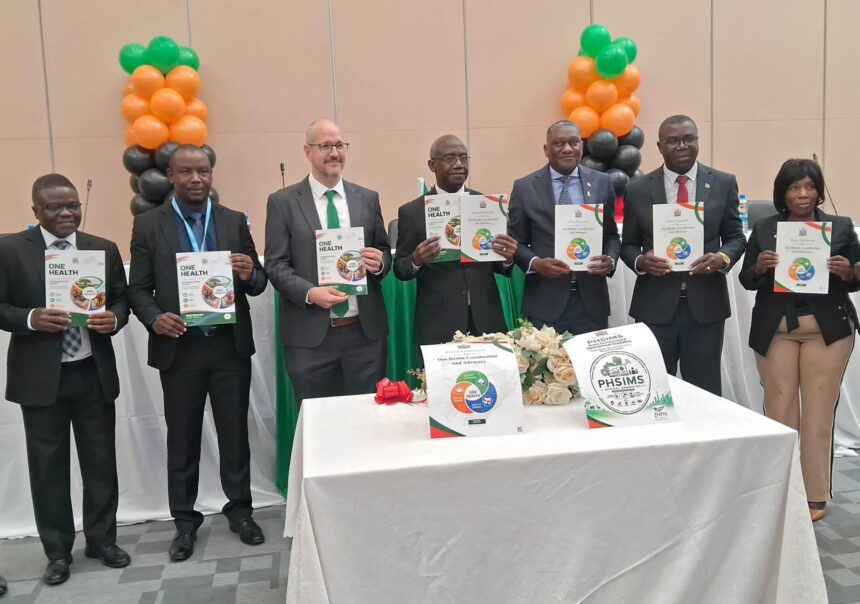
The Government of the Republic of Zambia has strengthened its commitment to protecting public health with the official launch of the Policy Framework for One Health Coordination and Advocacy and the Public Health Security Information Management System (PHSIMS) Guideline. The introduction of these two important instruments represents a significant milestone in the country’s efforts to build stronger and more coordinated public health systems. The initiative is expected to improve collaboration among government institutions while enhancing Zambia’s ability to prevent, detect and respond to health threats more effectively. As public health challenges continue to evolve, the Government has recognized the need for a comprehensive and coordinated approach that brings together different sectors to safeguard the health of both people and animals. The launch demonstrates Zambia’s determination to strengthen national health security through better planning, improved information management and stronger institutional cooperation.
The Policy Framework for One Health Coordination and Advocacy has been developed to institutionalize the One Health approach across the country. One Health recognizes that the health of humans, animals and the environment is closely connected, making collaboration between different sectors essential for addressing complex health challenges. Through this framework, Zambia has established a clear governance structure that promotes accountability, coordination and continuity among ministries, provinces, departments and agencies. By creating defined roles and responsibilities, the framework is expected to improve communication and ensure that all relevant institutions work together toward shared public health goals. This coordinated approach will help reduce duplication of efforts while improving the efficiency of national health interventions.
The launch of the Public Health Security Information Management System Guideline complements the policy framework by strengthening the collection, management and sharing of critical public health information. Timely access to reliable information plays a crucial role in responding effectively to disease outbreaks and other public health emergencies. The guideline provides a standardized approach for managing health security data, allowing decision makers to access accurate information quickly when urgent action is required. Faster information sharing also supports evidence-based policymaking and improves coordination between institutions responsible for emergency preparedness and response. As a result, Zambia will be better positioned to identify emerging health threats early and implement appropriate interventions before they escalate.
Speaking during the official launch, Secretary to the Cabinet Mr. Patrick K. Kangwa emphasized that the framework provides the governance structure needed to strengthen collaboration across all levels of government. He noted that Zambia faces increasingly complex challenges that cannot be addressed by a single institution or ministry working alone. Issues such as disease outbreaks, climate change, antimicrobial resistance and food safety require coordinated action involving multiple sectors and government agencies. According to Mr. Kangwa, the One Health approach creates the foundation for this collaboration by ensuring that institutions work together in a structured and accountable manner. His remarks reinforced the importance of adopting integrated solutions to protect public health and strengthen national resilience.
Mr. Kangwa also highlighted the significant progress Zambia has already made in implementing the One Health approach throughout the country. He noted that One Health coordination structures have now been established across all 10 provinces and all 116 districts, providing a nationwide platform for collaboration. Zambia has also identified priority zoonotic diseases that require coordinated action and has strengthened multisectoral preparedness and response mechanisms to address these risks. These achievements demonstrate the Government’s commitment to building a comprehensive public health system capable of responding to current and future challenges. The nationwide expansion of these structures also ensures that local authorities are better equipped to detect and respond to health threats within their communities.
The Public Health Security Information Management System Guideline is expected to further strengthen Zambia’s emergency response capabilities by improving the speed and quality of information sharing. During disease outbreaks and other public health emergencies, timely information is essential for making informed decisions that protect lives and reduce the spread of disease. The guideline establishes clear processes for collecting and distributing information across institutions, allowing government agencies to respond more efficiently and effectively. Improved coordination will also support better resource allocation and ensure that interventions are based on accurate and up-to-date evidence. These improvements will contribute significantly to Zambia’s overall preparedness for future public health emergencies.
Mr. Kangwa called on all Government institutions to fully embrace the One Health approach, describing it as a shared national responsibility that requires commitment from every sector. He stressed that sustainable health security depends not only on policies and systems but also on strong national ownership and institutional dedication. The Secretary to the Cabinet also acknowledged the valuable support provided by cooperating partners who have contributed to building Zambia’s One Health architecture over the years. Their continued collaboration has helped strengthen the country’s public health capacity while supporting important reforms aimed at improving health security. These partnerships remain an important component of Zambia’s efforts to build resilient systems capable of responding to emerging health challenges.
The official launch of the Policy Framework for One Health Coordination and Advocacy and the Public Health Security Information Management System Guideline marks a major step forward in Zambia’s efforts to strengthen national health security. Together, these instruments provide the governance, coordination and information management systems needed to improve preparedness, enhance emergency response and promote evidence-based decision making. They also reinforce the Government’s commitment to protecting public health through collaboration across sectors and institutions. As Zambia continues to face evolving health challenges, the successful implementation of these initiatives will play a vital role in building a safer, healthier and more resilient nation. With sustained institutional commitment, effective partnerships and strong national ownership, the country is well positioned to strengthen its public health systems for generations to come.