





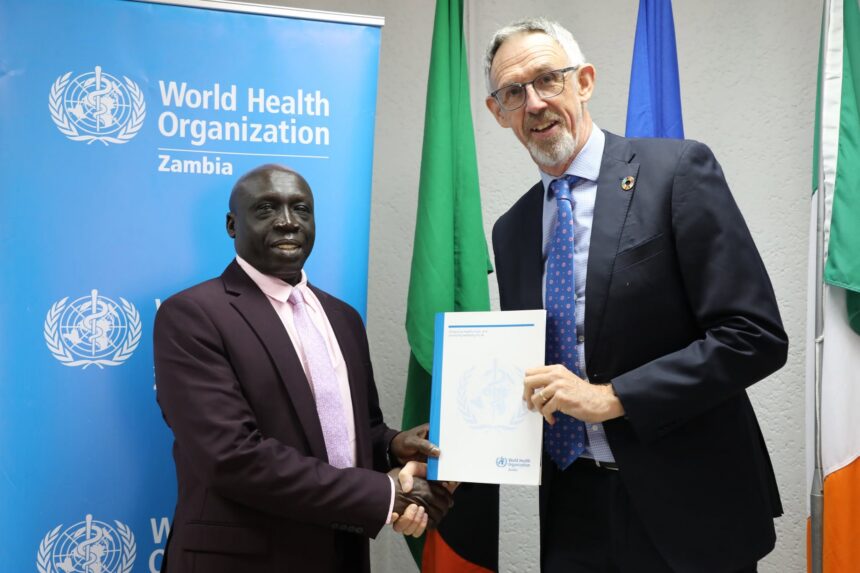
Zambia has received an additional EUR 250,000 contribution from Irish Aid to strengthen the country’s preparedness for Ebola and other high-consequence public health threats. The contribution, worth approximately ZMW 5.4 million, was formalised through a signing involving the World Health Organization Zambia and the Embassy of Ireland in Zambia. The funding will support a range of preparedness and response measures designed to help Zambia identify infectious disease threats earlier and respond to them more effectively. The partnership comes as countries continue to strengthen health security systems capable of responding quickly to outbreaks and other public health emergencies. The additional support will therefore contribute to Zambia’s efforts to protect communities while reinforcing systems that can be used to respond to a range of infectious disease threats.
The new Irish Aid funding will support the operationalisation of Zambia’s national Ebola preparedness guidelines. These guidelines provide an important framework for coordinating preparedness activities and ensuring that health authorities and response teams understand their responsibilities during a potential outbreak. The funding will also support the introduction of Go.Data in priority districts, giving health authorities an additional digital tool for managing information related to disease investigations, cases and contacts. Strong information management is essential during public health emergencies because authorities need accurate and timely data to understand where potential cases are occurring and how diseases may be spreading. Strengthening these systems can help health officials make faster decisions and coordinate response measures more effectively.
Another major area of investment will be Zambia’s disease surveillance system. Effective surveillance allows health authorities to identify unusual health events and suspected cases before they develop into larger outbreaks. The additional funding will help strengthen the country’s capacity to detect, report and investigate suspected cases while improving the management of alerts, cases and contacts. These functions become particularly important when dealing with diseases such as Ebola, which require rapid identification and coordinated intervention. By improving surveillance systems, Zambia can increase its ability to respond to potential health threats at an early stage and reduce the risk of wider transmission.
The contribution will also support the deployment of the Electronic Traveler Information and Monitoring System, known as eTIMS, at all 14 designated points of entry in Zambia. Points of entry are important components of national health security because travellers can move between countries while infectious diseases are circulating. Effective monitoring systems can help authorities identify potential health risks and support appropriate follow-up when necessary. Strengthening traveler monitoring across all designated points of entry can also improve cross-border surveillance and coordination with neighbouring countries. This investment is therefore intended to strengthen Zambia’s ability to monitor health threats while maintaining systems that support safe movement across its borders.
Infection prevention and control will form another important part of the activities supported by the funding. Health workers can face significant risks when dealing with patients who may have highly infectious diseases, particularly when appropriate protective measures and procedures are not consistently followed. The funding will support infection prevention and control assessments as well as biosafety and biosecurity training. These activities can help identify gaps, strengthen practices and improve the ability of health facilities and response teams to operate safely during public health emergencies. Building this capacity is important because protecting healthcare workers also helps protect patients, communities and the wider health system.
Simulation exercises will also be conducted to validate Zambia’s operational readiness. These exercises allow health authorities and response teams to test preparedness plans in controlled scenarios without waiting for an actual outbreak to expose weaknesses. They can help identify gaps in communication, coordination, surveillance, logistics and emergency response procedures. Lessons from the exercises can then be used to improve preparedness plans and strengthen the ability of institutions to work together during a real emergency. Regular testing of response systems is an important part of maintaining readiness because plans and procedures need to work effectively in practice, not only on paper.
The investment is expected to improve Zambia’s ability to manage public health alerts, suspected cases and contacts. Early detection is particularly important when dealing with high-consequence infectious diseases because delays can make containment more difficult. A stronger surveillance and response system gives health authorities better opportunities to investigate unusual health events and determine whether they require an emergency response. Improved management of contacts can also support efforts to monitor people who may have been exposed to an infectious disease. Together, these measures can strengthen Zambia’s overall capacity to detect and contain public health threats before they place greater pressure on communities and health facilities.
The funding also has an important cross-border health security component. Zambia shares borders with several countries, making regional cooperation and surveillance essential for managing infectious disease risks. Diseases do not stop at national borders, so effective preparedness requires countries to maintain systems that allow information and alerts to move quickly between relevant authorities. Strengthening traveler monitoring and cross-border surveillance can help Zambia work more effectively with neighbouring countries when potential health threats emerge. The additional Irish support can therefore contribute not only to Zambia’s national preparedness but also to broader efforts to strengthen health security in the region.
Irish Ambassador Aidan Fitzpatrick welcomed the additional contribution and highlighted its role in strengthening Zambia’s ability to detect, report and respond to public health threats. He also commended the Zambian Government’s leadership and reaffirmed Ireland’s commitment to supporting efforts aimed at protecting the health and wellbeing of the Zambian people. The statement reflects the continued partnership between Ireland and Zambia in the health sector. International development support can provide valuable resources for strengthening systems that require specialised training, technology and coordinated preparedness activities. The additional contribution demonstrates Ireland’s continued interest in supporting Zambia’s capacity to manage health emergencies and build stronger health systems.
WHO Representative Dr Clement Lasuba also emphasised the importance of preparedness in protecting communities from public health emergencies. He described preparedness as a key defence against health threats and said the Irish contribution would strengthen Zambia’s ability to detect threats early, respond rapidly and safeguard its population. This focus reflects the wider principle that countries need to invest in preparedness before emergencies occur. Building surveillance, response and infection prevention capacity during periods without major outbreaks can allow authorities to act more effectively when threats emerge. The support from Irish Aid will therefore contribute to strengthening capabilities that can remain valuable beyond Ebola preparedness alone.
The partnership between WHO, the Government of Ireland and Zambian health authorities highlights the importance of sustained international cooperation in strengthening health security. Public health preparedness requires investment in people, technology, surveillance systems, training and emergency response structures. The EUR 250,000 contribution will support several of these areas while helping Zambia improve its ability to detect and respond to Ebola and other serious infectious disease threats. The work will also strengthen systems that can support the country during future health emergencies. By investing in preparedness, Zambia can improve its capacity to protect communities and maintain essential health services when public health threats arise.
The additional Irish Aid contribution marks an important step in strengthening Zambia’s preparedness for Ebola and other high-consequence infectious diseases. With approximately ZMW 5.4 million supporting surveillance, traveler monitoring, infection prevention, biosafety, biosecurity and emergency simulation exercises, the funding will target several critical areas of national health security. The partnership between Zambia, WHO and Ireland also demonstrates the value of coordinated international support in building resilient health systems. Stronger preparedness can give health authorities the tools, information and skills needed to identify threats early and respond before they escalate. Continued investment in these systems will remain essential as Zambia works to protect the health and wellbeing of its people and strengthen its ability to respond to future public health emergencies.